Input Validation vs Sanitisation: Difference and How to Apply Both
Validation rejects bad data at the boundary while sanitisation cleans data that must pass through, creating two distinct defence layers against injection attacks.

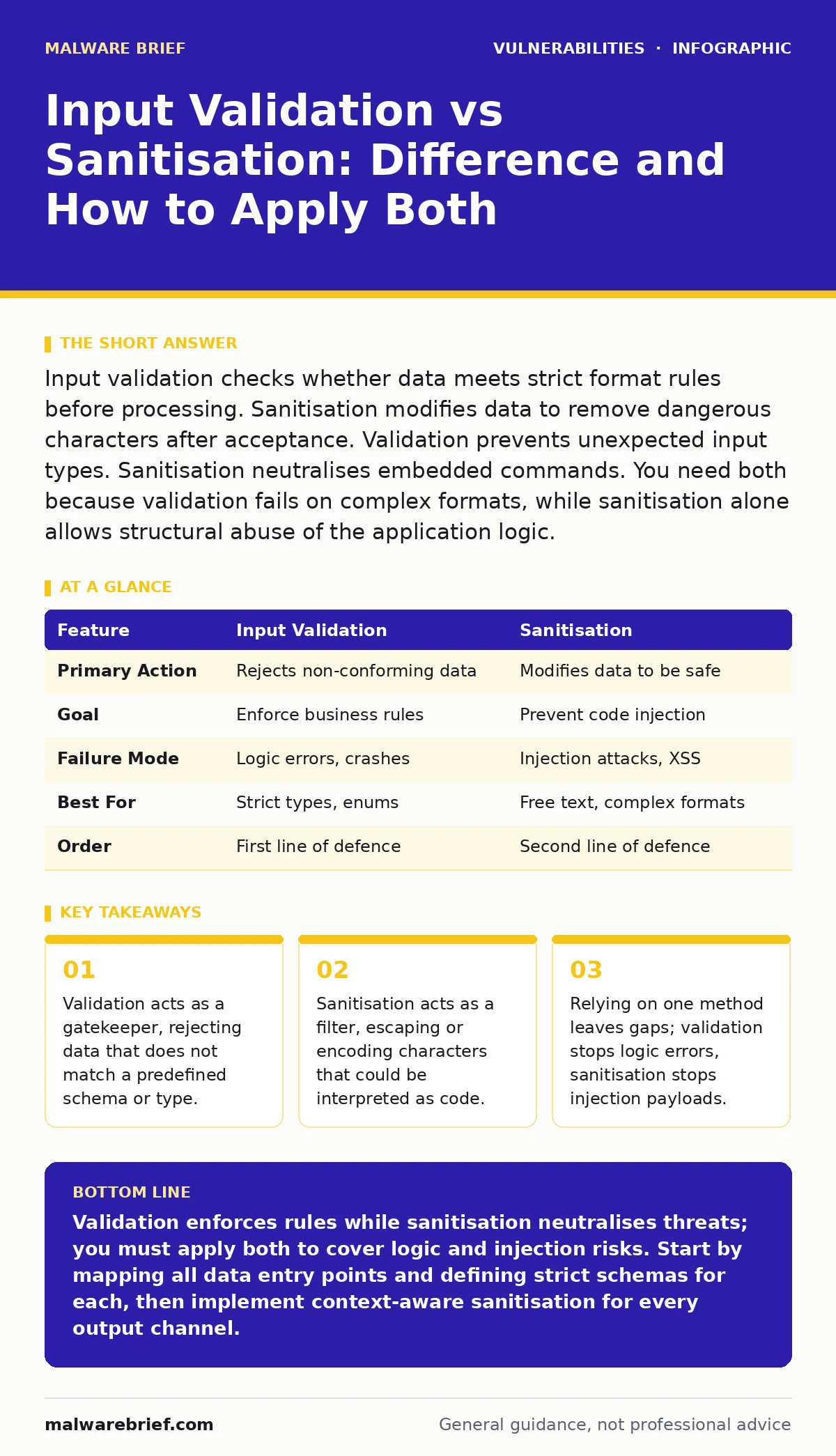
Input validation checks whether data meets strict format rules before processing. Sanitisation modifies data to remove dangerous characters after acceptance. Validation prevents unexpected input types. Sanitisation neutralises embedded commands. You need both because validation fails on complex formats, while sanitisation alone allows structural abuse of the application logic.
What is the difference between input validation and sanitisation?
Input validation and sanitisation serve different purposes in data handling. Validation determines if data is acceptable by checking it against strict rules. Sanitisation alters data to make it safe for a specific context. Validation says "no" to bad input. Sanitisation says "yes" but removes the danger. You use validation to enforce business logic. You use sanitisation to prevent code injection. The difference lies in rejection versus modification.
When should you reject input instead of cleaning it?
You should reject input when the data type must be precise. Imagine a field that only accepts numeric ages. Allowing letters or symbols creates ambiguity. Validation ensures the data fits the expected structure. This prevents logic errors downstream. If you accept a string where an integer is expected, your application may crash or behave unpredictably. Rejection is faster and safer for strict types. It forces the user to provide correct data.
How does sanitisation protect against injection attacks?
Sanitisation protects by encoding or escaping special characters. These characters often have meaning in code or markup languages. A single quote might end a SQL string. A less-than sign might start an HTML tag. Sanitisation transforms these characters into safe representations. The browser or database then treats them as text, not instructions. This stops attackers from executing arbitrary code. It does not change the meaning of the data, only its representation.
Why does validation fail on complex data formats?
Validation fails on complex formats because rules become too broad. Imagine accepting email addresses or URLs. The rules for these formats are intricate and change over time. Writing a perfect validator is nearly impossible. Attackers find edge cases that pass validation but still contain malicious payloads. A validated email might include a script in the display name. You cannot validate every possible variation safely. Sanitisation provides a safety net here.
What happens when you only use one method?
Using only validation leaves you open to injection if the rules are flawed. Using only sanitisation leaves you open to logic abuse if the data structure is wrong. Suppose a price field accepts negative numbers. Validation might allow it if the rule is "numeric". Sanitisation will not change the value. The application processes a negative price, causing financial loss. You need validation to enforce business rules. You need sanitisation to enforce security boundaries.
How do context-specific risks change your approach?
The risk depends on where the data is used. Data displayed in HTML needs different sanitisation than data stored in a database. HTML requires escaping tags to prevent cross-site scripting. SQL requires parameterised queries or escaping quotes. Data sent to a file system needs path traversal prevention. One sanitisation method does not fit all contexts. You must identify the output context before choosing the cleaning method. This prevents mismatched protections.
Can you automate these checks effectively?
Automation helps but does not replace design. Tools can scan code for missing validation or sanitisation. They flag common patterns like string concatenation in queries. However, tools cannot understand business logic. They do not know if a negative number is valid for your specific use case. Manual review is necessary for complex logic. Automated tests should cover boundary values and special characters. This ensures coverage without manual fatigue.
| Feature | Input Validation | Sanitisation |
|---|---|---|
| Primary Action | Rejects non-conforming data | Modifies data to be safe |
| Goal | Enforce business rules | Prevent code injection |
| Failure Mode | Logic errors, crashes | Injection attacks, XSS |
| Best For | Strict types, enums | Free text, complex formats |
| Order | First line of defence | Second line of defence |
How do you handle data that must remain raw?
Some data must remain raw, such as binary files or encrypted payloads. You cannot sanitise binary data without corrupting it. Validation here focuses on file headers and size limits. Check the magic bytes to verify the file type. Limit the size to prevent resource exhaustion. Do not rely on file extensions. An attacker can rename a script to have a safe extension. Validate the content, not the name. This prevents execution of disguised malware.
What role does secure code review play here?
Secure code review identifies gaps in your validation and sanitisation strategy. Reviewers look for inconsistent handling of data. They check if all inputs are treated as untrusted. They verify that sanitisation matches the output context. Reviews catch logic errors that automated tools miss. They ensure that the defence-in-depth approach is applied consistently. Regular reviews keep your codebase aligned with current best practices. They reduce the risk of subtle vulnerabilities.
How do you manage legacy systems with poor input handling?
Legacy systems often lack modern validation frameworks. Refactoring them is costly and risky. You can add a reverse proxy or API gateway in front. This layer performs validation and sanitisation before traffic reaches the old code. It acts as a shield. You do not need to rewrite the application immediately. This approach buys time for a proper migration. It reduces exposure while you plan long-term fixes. It is a pragmatic compromise for older infrastructure.
Key takeaways
- Validation acts as a gatekeeper, rejecting data that does not match a predefined schema or type.
- Sanitisation acts as a filter, escaping or encoding characters that could be interpreted as code.
- Relying on one method leaves gaps; validation stops logic errors, sanitisation stops injection payloads.
Validation enforces rules while sanitisation neutralises threats; you must apply both to cover logic and injection risks. Start by mapping all data entry points and defining strict schemas for each, then implement context-aware sanitisation for every output channel.
Frequently asked questions
Is input validation enough to stop SQL injection?
No. Validation can enforce data types, but it often misses malicious content in allowed fields. You must use parameterised queries or proper sanitisation to stop SQL injection reliably.
Can sanitisation remove all security risks?
No. Sanitisation only addresses injection risks. It does not prevent logic errors, business rule violations, or resource exhaustion. You still need validation to ensure data integrity.
Should I validate before or after sanitisation?
Validate first to reject clearly invalid data. Sanitise second to clean accepted data. This order is efficient and secure. It prevents unnecessary processing of bad input.
Does using a framework eliminate the need for manual checks?
No. Frameworks provide tools, not guarantees. You must still configure them correctly and understand the data flow. Manual review ensures that the framework is applied appropriately to your specific context.
How this guide was produced: written by the Malware Brief editorial team with AI assistance, checked against the public references listed below, and reviewed when the facts change. See our editorial policy or report an error.