Difference Between Red Teaming and Penetration Tester: Scope and Intent
Red teaming simulates full adversary campaigns to test organisational response, whereas penetration testing isolates technical vulnerabilities within agreed boundaries.

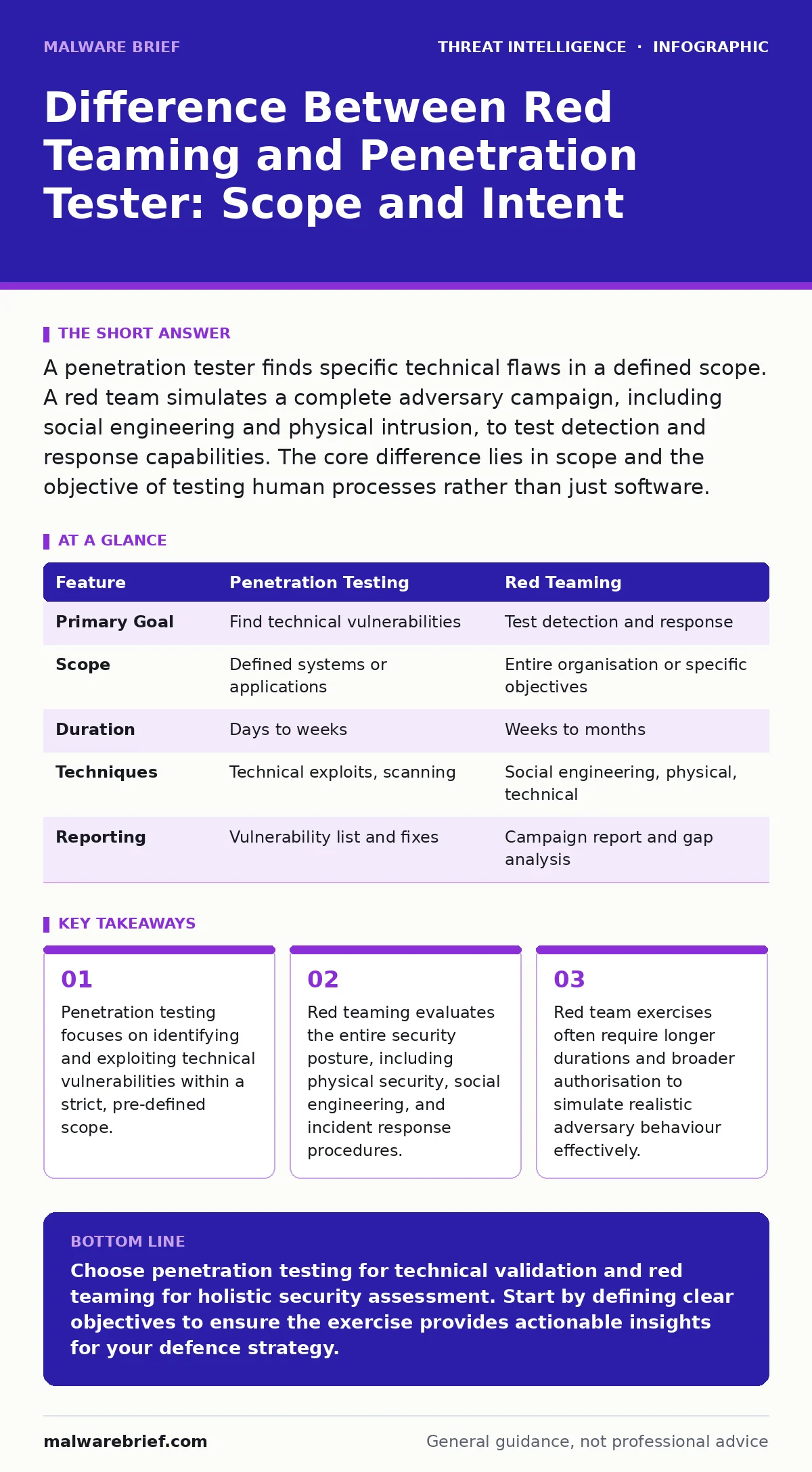
A penetration tester finds specific technical flaws in a defined scope. A red team simulates a complete adversary campaign, including social engineering and physical intrusion, to test detection and response capabilities. The core difference lies in scope and the objective of testing human processes rather than just software.
What is the difference between red teaming and penetration tester?
Red teaming differs from penetration testing primarily in scope, duration, and the inclusion of non-technical attack vectors. A penetration tester acts as a specialist who identifies and exploits technical vulnerabilities within a specific system or application. A red team operates as a simulated adversary, employing any method necessary to achieve a specific objective, such as accessing sensitive data. This includes social engineering, physical intrusion, and lateral movement across networks. The goal is not merely to find flaws but to test the organisation’s ability to detect and respond to a coordinated attack.
How do scopes and rules of engagement differ?
Penetration tests operate under strict rules of engagement that define exactly which systems may be tested and which techniques are prohibited. These boundaries prevent accidental disruption of critical services. Red teaming operates with broader authorisation, allowing the team to pivot through unexpected paths. Imagine a scenario where a penetration tester is restricted to a single web application. A red team might start by phishing an employee to gain initial access, then move laterally to reach the same application from the internal network. This broader scope reveals gaps in monitoring that isolated technical tests often miss.
Why does detection capability matter more in red teaming?
Penetration testing reports typically list vulnerabilities and remediation steps. The success metric is the number of critical flaws found. Red teaming measures success by whether the defence team detected the activity. If a red team accesses the target data without triggering alerts, the exercise fails the defensive team, even if no new technical vulnerabilities were exploited. This shift in focus forces organisations to improve their logging, monitoring, and analyst skills. It highlights that finding a vulnerability is less useful than detecting its exploitation in real time.
What role does social engineering play in each?
Penetration testers rarely engage in social engineering unless explicitly included in the scope. Their primary tools are technical exploits and configuration errors. Red teams frequently use social engineering as a primary entry vector. This might involve pretexting phone calls to IT support or sending targeted emails to staff. Testing human behaviour reveals weaknesses that technical scans cannot find. An employee clicking a malicious link is a failure of security awareness, not a software bug. Including these methods provides a more holistic view of organisational risk.
| Feature | Penetration Testing | Red Teaming |
|---|---|---|
| Primary Goal | Find technical vulnerabilities | Test detection and response |
| Scope | Defined systems or applications | Entire organisation or specific objectives |
| Duration | Days to weeks | Weeks to months |
| Techniques | Technical exploits, scanning | Social engineering, physical, technical |
| Reporting | Vulnerability list and fixes | Campaign report and gap analysis |
How do duration and resource requirements compare?
Penetration tests are typically short engagements, lasting a few days to a couple of weeks. This allows for rapid identification of critical issues. Red teaming requires significantly more time, often spanning several weeks or months. The extended duration allows the team to simulate the patience and persistence of real threat actors. This pace tests whether security operations centres can maintain alert levels over time. It also reveals fatigue in monitoring processes. Organisations must allocate substantial resources to support longer engagements without disrupting normal business operations.
See also: Hacktivism Explained: Motives, Methods and Technical Realities · How Bulletproof Hosting Operates: The Technical Lifecycle
When should you choose penetration testing over red teaming?
You should choose penetration testing when you need to validate the security of a specific system before release. This is common for new applications or major updates. Penetration testing provides a detailed list of technical weaknesses that developers can fix. It is also suitable when regulatory compliance requires regular testing of specific assets. Red teaming is too broad and resource-intensive for routine software validation. If your goal is to ensure a single application is secure, a penetration test is the appropriate choice. It offers focused feedback without the complexity of a full campaign simulation.
What are the hidden costs of red teaming?
Red teaming exercises can disrupt normal business operations if not carefully managed. Simulated attacks may trigger false alarms in security systems, consuming analyst time. Employees may experience stress or confusion during social engineering attempts. There is also a risk of accidental damage if the team exploits vulnerabilities in unexpected ways. To mitigate this, organisations must establish clear communication channels and safe words. The cost is not just financial but also reputational and operational. Poorly executed red teaming can erode trust between security teams and the rest of the organisation.
How does this relate to broader threat intelligence?
Understanding the difference helps in interpreting threat intelligence feeds. Indicators of compromise often originate from technical exploits found during penetration tests. However, red teaming provides context on how these indicators fit into larger attack chains. For example, knowledge of lateral movement techniques helps analysts recognise when an initial breach is part of a larger campaign. This contextual awareness improves incident response. It allows teams to prioritise alerts based on the likelihood of advanced persistent threats rather than isolated scanning activity.
What steps should you take before starting?
- Define clear objectives for the exercise, whether technical validation or detection testing.
- Establish strict rules of engagement and communication protocols with all stakeholders.
- Brief relevant staff to prevent confusion and unnecessary escalation of simulated attacks.
- Ensure monitoring systems are fully operational and analysts are prepared for increased alert volume.
- Plan a debrief session to discuss findings and improve defensive procedures.
Key takeaways
- Penetration testing focuses on identifying and exploiting technical vulnerabilities within a strict, pre-defined scope.
- Red teaming evaluates the entire security posture, including physical security, social engineering, and incident response procedures.
- Red team exercises often require longer durations and broader authorisation to simulate realistic adversary behaviour effectively.
Choose penetration testing for technical validation and red teaming for holistic security assessment. Start by defining clear objectives to ensure the exercise provides actionable insights for your defence strategy.
Frequently asked questions
Can a penetration tester also perform red teaming?
Yes, many professionals have skills in both areas, but the scope and methodology differ significantly between the two disciplines.
Is red teaming legal?
Red teaming is legal when conducted with explicit written authorisation and within agreed boundaries, similar to penetration testing.
How often should organisations conduct red team exercises?
Frequency depends on risk appetite and resource availability, but annual or biennial exercises are common for mature security programmes.
Do red teams use commercial products?
Red teams may use open standards and custom tools, but they avoid naming specific commercial vendors in general discussions to maintain neutrality.
How this guide was produced: written by the Malware Brief editorial team with AI assistance, checked against the public references listed below, and reviewed when the facts change. See our editorial policy or report an error.