Hacktivism Explained: Motives, Methods and Technical Realities
Hacktivism relies on low-sophistication tools and public data, making attribution difficult but technical defence straightforward through standard hardening.
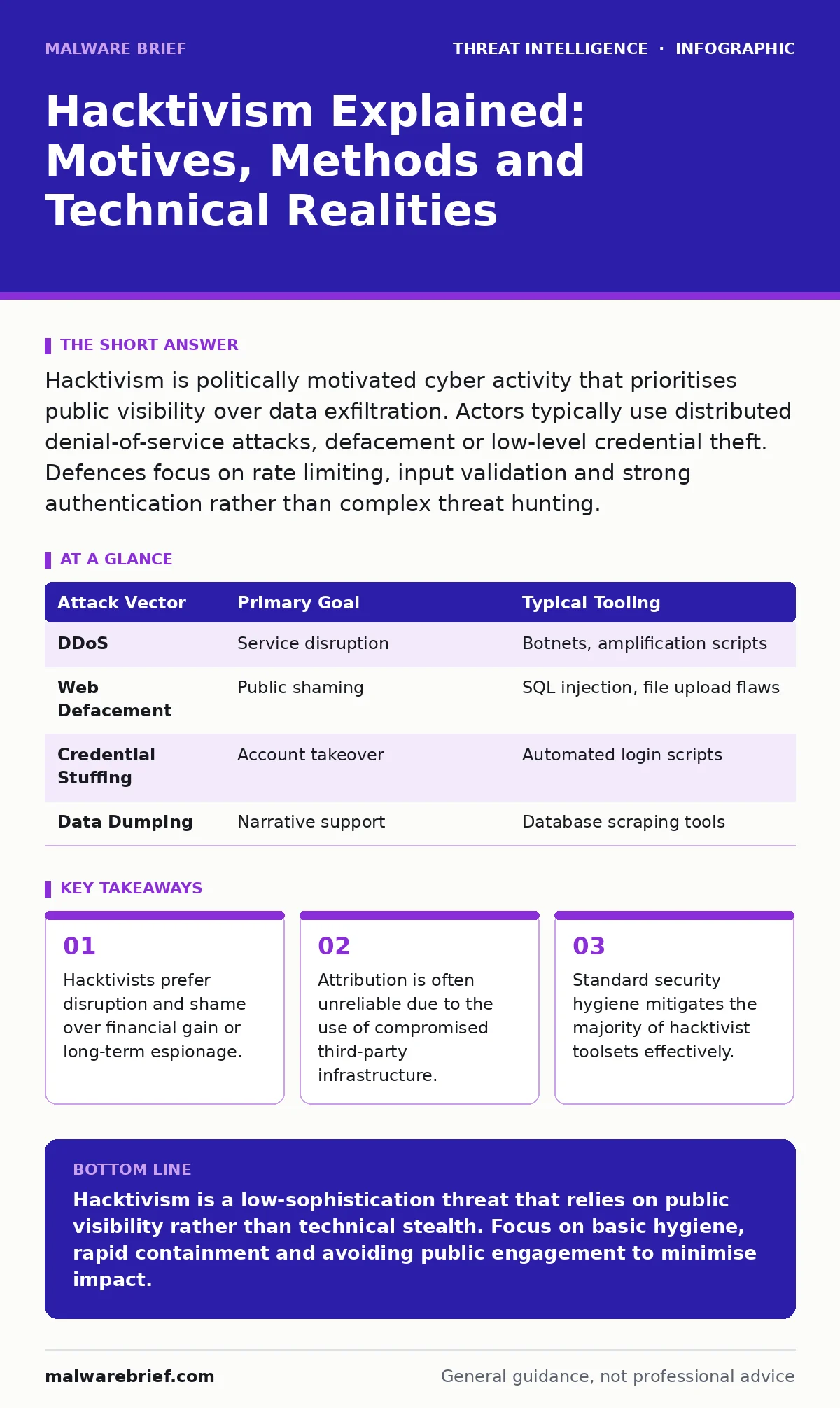
Hacktivism is politically motivated cyber activity that prioritises public visibility over data exfiltration. Actors typically use distributed denial-of-service attacks, defacement or low-level credential theft. Defences focus on rate limiting, input validation and strong authentication rather than complex threat hunting.
What defines hacktivism in technical terms?
Hacktivism is the use of digital tools to support political or social causes through disruption, data leaking or public shaming. Unlike criminal groups seeking ransom or state actors seeking espionage, hacktivists prioritise visibility and narrative impact. They often target high-profile organisations to maximise media coverage rather than to steal sensitive intellectual property.
How do hacktivists choose their targets?
Targets are selected based on symbolic value and public recognisability rather than technical vulnerability alone. An organisation with a controversial public stance becomes a priority regardless of its security posture. Hacktivists scan for easy wins that generate headlines, such as a defaced homepage or a leaked email database. This selection process means you may be targeted simply for your brand reputation, not your data.
What tools do hacktivists typically use?
Most hacktivist groups rely on publicly available scripts, automated scanners and rented botnet capacity. They rarely develop custom malware because their goal is speed and volume, not stealth. Distributed denial-of-service (DDoS) attacks are common because they require minimal technical skill but cause significant service interruption. You will often see the same open-source tools used across different campaigns, making pattern recognition useful for defence.
Is hacktivist attribution reliable?
Attribution is frequently unreliable because hacktivists use compromised servers, anonymisation networks and false flags. A group may claim responsibility for an attack they did not perform to influence public opinion. Conversely, a state actor may mimic hacktivist tactics to create plausible deniability. Relying on self-attribution or simple IP address tracing often leads to incorrect conclusions about the true source of an incident.
How does hacktivism differ from state-sponsored threats?
State-sponsored actors invest in custom tooling, long-term persistence and sophisticated evasion techniques. Hacktivists operate with short timelines, public declarations and off-the-shelf exploits. The financial and operational overhead for state actors is significantly higher, leading to more refined tradecraft. Understanding this difference helps you allocate resources; you do not need to hunt for fileless malware if the threat actor is using a known web shell.
See also: Threat Actors Explained: Motives, Methods and Misconceptions · Phishing Kits: Definition, Mechanics and Operational Reality
What are the common attack vectors?
Web application vulnerabilities, weak credentials and unpatched public-facing services are the primary entry points. Hacktivists often use credential stuffing, where they try username and password combinations leaked from other breaches. They also exploit misconfigured cloud storage buckets that expose internal data to the internet. These vectors are low-hanging fruit that require basic configuration changes to mitigate.
| Attack Vector | Primary Goal | Typical Tooling |
|---|---|---|
| DDoS | Service disruption | Botnets, amplification scripts |
| Web Defacement | Public shaming | SQL injection, file upload flaws |
| Credential Stuffing | Account takeover | Automated login scripts |
| Data Dumping | Narrative support | Database scraping tools |
How do you detect hacktivist activity?
Monitoring for unusual spikes in traffic, failed login attempts and unexpected changes to public-facing files provides early warning. Look for indicators of compromise that match known hacktivist toolkits, such as specific defacement images or forum links. IOC enrichment helps you understand whether the indicators are linked to a known campaign or a random opportunist. Automated alerts should trigger on deviations from baseline web traffic patterns.
What is the role of bulletproof hosting?
Hacktivists often use bulletproof hosting providers that ignore abuse reports to host their command-and-control infrastructure or leaked data. This makes takedown efforts difficult because the host is contractually or legally insulated from pressure. You cannot rely on upstream providers to remove malicious content hosted on these resilient platforms. Your defence must focus on blocking access to these domains at your network perimeter rather than expecting them to disappear.
How do hacktivists maintain persistence?
Persistence is usually short-lived and crude, often involving simple web shells or modified configuration files. They rarely attempt to hide deep within the operating system because their campaign duration is measured in days, not months. Beaconing behaviour is uncommon compared to state-sponsored malware that needs to report back quietly. Once the public attention fades, they typically abandon the compromised infrastructure.
Does hacktivism involve remote code execution?
Remote code execution (RCE) vulnerabilities are highly valued because they allow immediate control of a server. Hacktivists use RCE to upload defacement pages or install backdoors for future access. However, they often lack the skill to chain multiple vulnerabilities together, making single-point exploits their primary method. Patching known RCE vulnerabilities in web servers and applications is the most effective countermeasure.
How do you respond to a hacktivist incident?
Immediate containment involves isolating affected systems and blocking malicious IP ranges. Do not engage with the attackers on social media, as this amplifies their narrative and validates their success. Preserve logs for forensic analysis, but focus on restoring services from clean backups. Threat actors who are purely hacktivists will often move on to new targets if you deny them the satisfaction of a public response.
What is the long-term impact on an organisation?
The primary damage is reputational, with potential loss of customer trust and public scrutiny. Financial loss is usually indirect, stemming from downtime and the cost of incident response rather than direct theft. Technical debt may increase if quick fixes are applied without proper security review. Long-term, the incident may force a necessary overhaul of security practices that were previously neglected.
How does hacktivism relate to red teaming?
Red teaming exercises simulate advanced persistent threats to test defences, which are far more complex than typical hacktivist attacks. However, the basic principles of identifying exposed assets and testing for easy wins are similar. A red team may use hacktivist-style tactics as a baseline to demonstrate how easily an organisation can be compromised. Understanding these low-level tactics helps you appreciate the value of basic security controls.
Can hacktivists be stopped completely?
No single measure stops all hacktivist activity, as the barrier to entry is extremely low. However, implementing multi-factor authentication, web application firewalls and regular patching eliminates the majority of their successful entry points. You reduce your surface area by removing unnecessary public-facing services. The goal is to make your organisation a difficult and unrewarding target compared to others.
What is the role of credential dumping?
Credential dumping involves extracting password hashes from memory or system files to crack offline. Hacktivists use this technique to gain administrative access to servers or to leak employee email accounts. It is a common step after initial compromise via a web vulnerability. Protecting against this requires restricting local administrator rights and using strong, unique passwords that resist offline cracking.
How do you communicate during an incident?
Internal communication must be clear and factual to prevent panic among staff. External statements should be brief, acknowledging the disruption without speculating on the cause or motive. Avoid naming the attacking group unless you have definitive proof, as this may escalate the situation. Consistency in messaging helps maintain stakeholder confidence during the recovery phase.
Key takeaways
- Hacktivists prefer disruption and shame over financial gain or long-term espionage.
- Attribution is often unreliable due to the use of compromised third-party infrastructure.
- Standard security hygiene mitigates the majority of hacktivist toolsets effectively.
Hacktivism is a low-sophistication threat that relies on public visibility rather than technical stealth. Focus on basic hygiene, rapid containment and avoiding public engagement to minimise impact.
Frequently asked questions
Is hacktivism a criminal offence?
Yes, unauthorised access to computer systems, data modification and service disruption are illegal in most jurisdictions, regardless of the motive.
Do hacktivists target small businesses?
Small businesses are rarely targeted directly unless they are associated with a larger, controversial entity or provide critical infrastructure.
Can I use hacktivist tools for testing?
Using tools to attack systems you do not own or have explicit permission to test is illegal and unethical, even for educational purposes.
How long does a hacktivist campaign last?
Campaigns typically last from a few hours to a few weeks, fading as public attention shifts or the target mitigates the issue.
How this guide was produced: written by the Malware Brief editorial team with AI assistance, checked against the public references listed below, and reviewed when the facts change. See our editorial policy or report an error.