How Bulletproof Hosting Operates: The Technical Lifecycle
Bulletproof hosting survives not through superior encryption, but by exploiting jurisdictional gaps and contractual silence to outlast standard takedown requests.

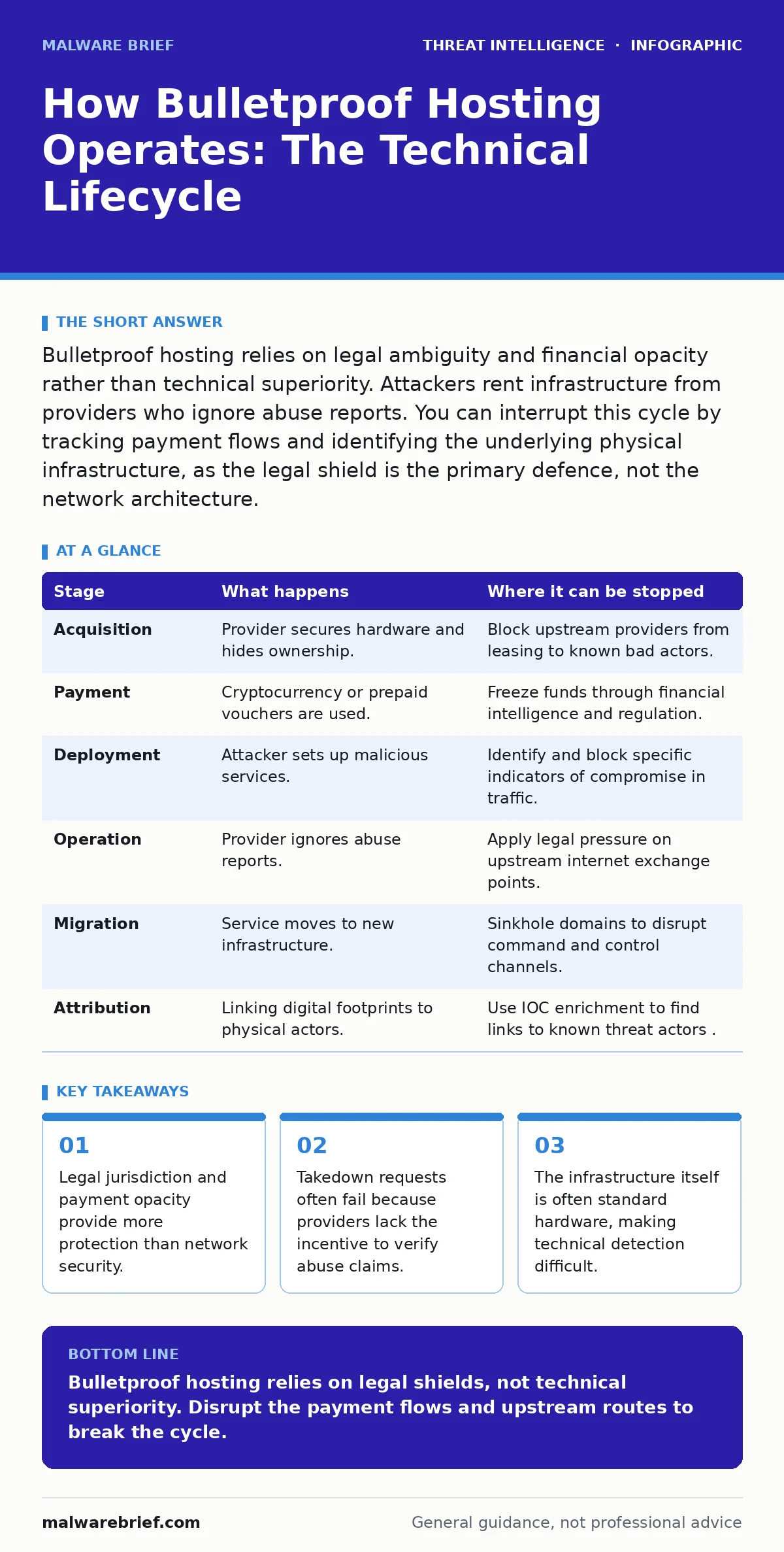
Bulletproof hosting relies on legal ambiguity and financial opacity rather than technical superiority. Attackers rent infrastructure from providers who ignore abuse reports. You can interrupt this cycle by tracking payment flows and identifying the underlying physical infrastructure, as the legal shield is the primary defence, not the network architecture.
The Foundation of Plausible Deniability
Bulletproof hosting is a service model designed to resist takedown requests. It does not rely on advanced cryptography or unbreakable firewalls. Instead, it exploits gaps in international law and the reluctance of upstream providers to engage in content moderation. The core mechanism is contractual silence. The hosting provider agrees to host content without verifying its legality. This creates a buffer between the criminal activity and the physical infrastructure owner.
The provider typically operates in a jurisdiction with weak cybercrime laws or limited international cooperation. They may also use shell companies to obscure ownership. This legal shielding is the primary defence. If you attempt to disrupt the service, you are often fighting a legal entity that has no obligation to act. The technical infrastructure is usually standard. The difference lies in the business model and the location.
### Stage 1: Infrastructure Acquisition and Obfuscation
The process begins with securing physical servers or virtual machines. The provider often purchases hardware in bulk to avoid scrutiny from data centre managers. They may use residential IP addresses or mix legitimate traffic with malicious streams. This makes the traffic appear normal to upstream filters. The goal is to blend in. The provider registers domains using privacy protection services. This hides the registrant's identity from public records. They often use fast-flux DNS techniques. This rotates IP addresses frequently, making it hard to pinpoint the physical location. The infrastructure is not unique. It is simply hidden behind layers of legal and technical obscurity.
### Stage 2: Contractual Shielding and Payment Rings
Once the infrastructure is ready, the provider establishes payment channels. They accept cryptocurrencies or prepaid vouchers to avoid banking trails. This breaks the link between the customer and the financial system. The provider signs contracts that explicitly state they will not monitor content. This is their legal shield. If law enforcement requests data, the provider can claim they have no access to it. They may also use offshore bank accounts for any fiat currency transactions. This adds another layer of complexity for investigators. The money flow is designed to be opaque.
### Stage 3: Onboarding and Technical Deployment
The attacker rents the space and deploys their software. This could be a phishing site, a command-and-control server, or a malware distribution point. They configure the server to handle high traffic and resist distributed denial-of-service attacks. The provider does not inspect the traffic. They route it directly to the internet. The attacker may use encryption to hide the payload. This prevents intermediate nodes from seeing the content. The server is now live. It is accessible to the public. The provider’s role ends here, technically. They continue to bill the customer. They do not engage with the content.
### Stage 4: Operational Resilience and Migration
When abuse reports arrive, the provider ignores them. They may delete the reports to avoid creating a paper trail. If the pressure mounts, they migrate the service. They move the data to a new server in a different jurisdiction. This is often done automatically. The attacker has pre-configured multiple locations. The DNS records are updated to point to the new IP. The service goes offline briefly. Then it comes back up. The cycle repeats. This resilience is not technical. It is procedural. The provider is prepared to abandon assets quickly. The cost of a server is low. The cost of compliance is high.
See also: IOC Enrichment: Turning Raw Signals into Actionable Context · Threat Actors Explained: Motives, Methods and Misconceptions
### Stage 5: Detection and Attribution Challenges
Detecting bulletproof hosting is difficult because the traffic looks normal. The infrastructure is shared with legitimate users. This makes blacklisting IP addresses ineffective. You risk blocking innocent traffic. The provider uses standard protocols. There are no unique signatures. Attribution requires linking the domain, the IP, and the payment. This is where the chain breaks. The payment is opaque. The domain registration is hidden. The IP is often leased. You must look for anomalies in timing or traffic patterns. Indicators of compromise may be present, but they are rarely unique. You need context to understand their significance.
### Stage 6: Interruption and Takedown
Interrupting the service requires a multi-pronged approach. You cannot simply ask the provider to stop. They will refuse. You must target the upstream providers. This involves convincing the internet service provider that routes the traffic to block it. This is often a legal process. You may need to involve law enforcement. Another method is to sinkhole the domain. This redirects traffic to a safe server. This disrupts the attacker’s control. It does not stop the hosting. It only breaks the command channel. You can also target the payment processors. If you can freeze the funds, the service may shut down. This is the most effective method. It hits the business model.
| Stage | What happens | Where it can be stopped |
|---|---|---|
| Acquisition | Provider secures hardware and hides ownership. | Block upstream providers from leasing to known bad actors. |
| Payment | Cryptocurrency or prepaid vouchers are used. | Freeze funds through financial intelligence and regulation. |
| Deployment | Attacker sets up malicious services. | Identify and block specific indicators of compromise in traffic. |
| Operation | Provider ignores abuse reports. | Apply legal pressure on upstream internet exchange points. |
| Migration | Service moves to new infrastructure. | Sinkhole domains to disrupt command and control channels. |
| Attribution | Linking digital footprints to physical actors. | Use IOC enrichment to find links to known threat actors. |
The Limits of Technical Defences
You cannot out-tech bulletproof hosting. The infrastructure is standard. The protection is legal. Focusing on network security is a mistake. You must focus on the business model. The provider survives because it is cheap and legal. Disrupting the payment flow is the most effective strategy. This requires cooperation between security teams and financial institutions. It is slow and difficult. But it is the only way to break the cycle. The attacker relies on your frustration. They know you will give up. Do not. Keep tracking the money. The trail always leads somewhere.
Integrating Intelligence for Disruption
To effectively disrupt these services, you must integrate multiple data sources. Network logs provide the technical footprint. Financial data provides the motive. Legal records provide the identity. You must combine these. IOC enrichment helps you link disparate data points. You may find that a server is linked to a known threat actor through a shared payment method. This strengthens your case for takedown. You can also look for beaconing patterns. These regular check-ins can be identified and blocked. This disrupts the attacker’s operations. It does not stop the hosting. But it makes the service useless. The attacker must then find new infrastructure. This increases their cost. Over time, this makes the model unsustainable.
Key takeaways
- Legal jurisdiction and payment opacity provide more protection than network security.
- Takedown requests often fail because providers lack the incentive to verify abuse claims.
- The infrastructure itself is often standard hardware, making technical detection difficult.
Bulletproof hosting relies on legal shields, not technical superiority. Disrupt the payment flows and upstream routes to break the cycle.
Frequently asked questions
Can I block bulletproof hosting with a firewall?
No, because the IP addresses change frequently and share infrastructure with legitimate users. Blocking them risks disrupting normal traffic.
Why do providers ignore abuse reports?
They operate in jurisdictions with weak laws and have no contractual obligation to monitor content. Ignoring reports is their business model.
Is bulletproof hosting always illegal?
The service itself is often legal. The content hosted may be illegal. The provider relies on this distinction to avoid liability.
How do I identify bulletproof hosting?
Look for frequent IP changes, privacy-protected domains, and a history of ignored abuse reports. Use **IOC enrichment** to find patterns.
How this guide was produced: written by the Malware Brief editorial team with AI assistance, checked against the public references listed below, and reviewed when the facts change. See our editorial policy or report an error.