Cloud API Insecurity Myths: What You Get Wrong About Interface Risks
API security fails not because of weak encryption, but because developers assume the cloud provider handles logic flaws and identity verification.
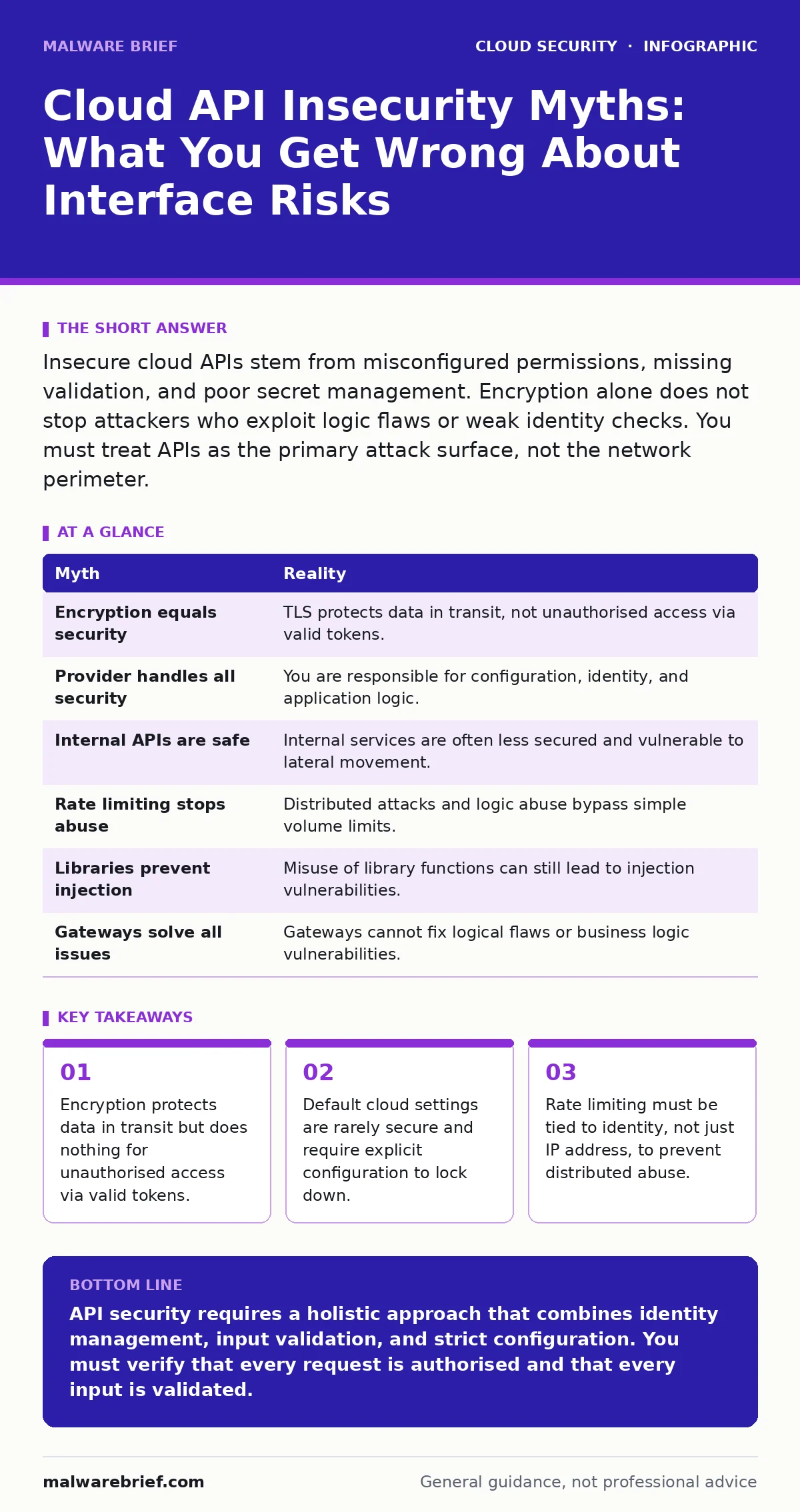
Insecure cloud APIs stem from misconfigured permissions, missing validation, and poor secret management. Encryption alone does not stop attackers who exploit logic flaws or weak identity checks. You must treat APIs as the primary attack surface, not the network perimeter.
Myth: Encryption Makes the API Secure
Reality: Transport Layer Security (TLS) protects data while it moves between your client and the server. It does not verify who is requesting that data or whether they have permission to see it. An attacker with a stolen session token can retrieve sensitive information over an encrypted channel without triggering any security alerts. You may encrypt the pipe, but you leave the vault door open. This is why the shared responsibility model places the burden of identity and access management squarely on you, not the provider.
Encryption is a transport mechanism, not an access control system. When you assume TLS equals security, you ignore the logic layer where most breaches occur. Attackers do not need to break the cipher; they only need to find a way to act as a legitimate user. This distinction is central to understanding identity as the new perimeter. The network boundary is now defined by credentials and tokens, not firewalls.
Myth: The Cloud Provider Handles All Security
Reality: The provider secures the infrastructure that runs your services. You secure everything you build and configure on top of it. Many teams assume that default settings are hardened against attack. They are not. Default configurations prioritise ease of use and connectivity over restriction. Leaving these defaults active exposes your APIs to common exploitation techniques. You must actively restrict access rather than relying on implicit denial.
This misunderstanding leads to lax configurations in cloud landing zones. If your foundational environment lacks strict network segmentation and identity controls, every API deployed within it inherits those weaknesses. The provider ensures the hypervisor is intact. You ensure that your application does not allow users to access resources belonging to others. This separation of duties is non-negotiable in modern cloud architecture.
Myth: Internal APIs Are Safe from External Attackers
Reality: Once an attacker gains a foothold inside your network, internal APIs are often less protected than public-facing ones. Developers frequently skip rigorous authentication for services that communicate behind the firewall. They assume that network isolation provides sufficient security. This assumption fails when lateral movement occurs. An attacker with access to one vulnerable service can pivot to internal APIs to extract data or escalate privileges.
Treating internal APIs as trusted creates a false sense of security. Every service-to-service call should verify identity and authorisation. Implementing service mesh security can help enforce these checks without modifying application code. This approach ensures that even if an attacker bypasses the perimeter, they cannot easily move laterally. Internal traffic must be treated as hostile until proven otherwise.
Myth: Rate Limiting Stops All Abuse
Reality: Rate limiting restricts the number of requests from a single source within a time window. It does not stop distributed attacks or logic-based abuse. Attackers can use multiple IP addresses to bypass simple counters. They can also craft low-volume requests that exhaust computational resources or trigger expensive database queries. A rate limit of one hundred requests per minute is ineffective if each request takes five seconds to process.
Effective rate limiting must be tied to identity, not just network address. You must also monitor for anomaly patterns, such as rapid enumeration of user IDs. Policy as code allows you to define and enforce these limits consistently across your infrastructure. Without identity-aware controls, attackers can simply scale their infrastructure to match your limits. Volume is not the only metric of abuse.
Myth: Standard Libraries Prevent Injection Flaws
Reality: Using well-known libraries reduces the risk of implementation errors. It does not eliminate the risk of insecure design. Developers often pass user input directly to database queries or command interpreters, assuming the library will sanitise it. Many libraries provide safe defaults but also offer functions that bypass these safeguards. Misuse of these functions leads to injection vulnerabilities. The library is only as safe as the code that calls it.
Input validation must happen at the edge, before data enters the application logic. You cannot rely on the database to reject malicious input. You must define strict schemas for all API parameters and reject anything that does not fit. This defence-in-depth approach ensures that even if one layer fails, others remain intact. Validation is a continuous process, not a one-time fix.
See also: Identity as the New Perimeter: Why Firewalls No Longer Define Security · Cloud Shared Responsibility Model: Who Fixes What
Myth: API Gateways Solve All Security Issues
Reality: API gateways provide a central point for authentication, routing, and rate limiting. They do not fix vulnerabilities in the backend services. If your application has a logical flaw, the gateway cannot detect it. The gateway sees valid requests and forwards them. It does not understand the business context or the specific risks associated with each endpoint. Relying solely on the gateway creates a blind spot in your security posture.
You must secure the services themselves, not just the entry point. This includes proper error handling, input validation, and least-privilege access controls. SaaS security posture management tools can help identify misconfigurations in your cloud services. However, they cannot replace robust application security practices. The gateway is a filter, not a cure.
| Myth | Reality |
|---|---|
| Encryption equals security | TLS protects data in transit, not unauthorised access via valid tokens. |
| Provider handles all security | You are responsible for configuration, identity, and application logic. |
| Internal APIs are safe | Internal services are often less secured and vulnerable to lateral movement. |
| Rate limiting stops abuse | Distributed attacks and logic abuse bypass simple volume limits. |
| Libraries prevent injection | Misuse of library functions can still lead to injection vulnerabilities. |
| Gateways solve all issues | Gateways cannot fix logical flaws or business logic vulnerabilities. |
Key takeaways
- Encryption protects data in transit but does nothing for unauthorised access via valid tokens.
- Default cloud settings are rarely secure and require explicit configuration to lock down.
- Rate limiting must be tied to identity, not just IP address, to prevent distributed abuse.
API security requires a holistic approach that combines identity management, input validation, and strict configuration. You must verify that every request is authorised and that every input is validated.
Frequently asked questions
Do I need a separate WAF for cloud APIs?
A Web Application Firewall can help block common attack patterns, but it cannot replace proper application security. It is an additional layer, not a substitute for secure coding.
How do I secure serverless APIs?
Serverless functions still require secure configuration and input validation. You must manage permissions and secrets carefully, as the provider handles the runtime but not the logic.
Is OAuth enough for API security?
OAuth provides delegation, but you must still enforce least-privilege access and validate tokens. It is a mechanism, not a complete security solution.
Can I automate API security testing?
Yes, integrating security scans into your CI/CD pipeline can help identify vulnerabilities early. However, manual review and penetration testing remain necessary for complex logic flaws.
How this guide was produced: written by the Malware Brief editorial team with AI assistance, checked against the public references listed below, and reviewed when the facts change. See our editorial policy or report an error.