Identity as the New Perimeter: Why Firewalls No Longer Define Security
The network boundary has dissolved, meaning your security posture now depends entirely on verifying who or what is making every single request.
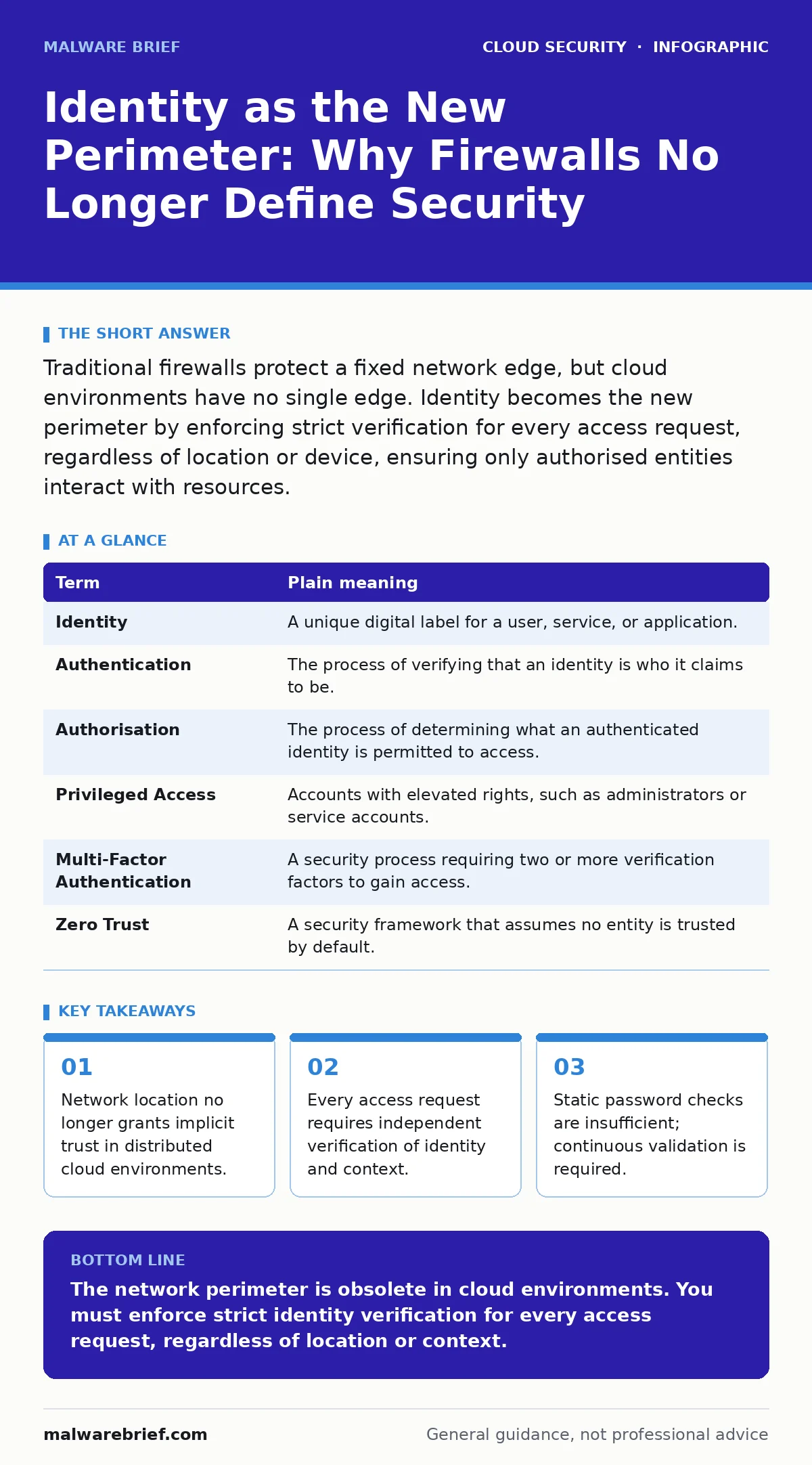
Traditional firewalls protect a fixed network edge, but cloud environments have no single edge. Identity becomes the new perimeter by enforcing strict verification for every access request, regardless of location or device, ensuring only authorised entities interact with resources.
The Castle and the Keycard
Imagine a medieval castle surrounded by a high stone wall. Anyone inside the wall is assumed to be a friend. The guards only check people at the main gate. Once you are inside, you can walk into the treasury, the armory, or the kitchen without further inspection. This is the traditional network perimeter. You trust the network because you are connected to it.
Now imagine that castle wall disappears. The castle buildings are scattered across different towns, countries, and even continents. There is no single gate. A person standing in a different town can request access to the treasury. The old method of checking the gate fails because there is no gate. You must now check every person, at every building, for every single action they wish to take. This shift is what security professionals call identity as the new perimeter.
Why the Network Edge Vanished
In on-premise data centres, you controlled the physical hardware. The network boundary was tangible. You placed firewalls at the edge to filter traffic entering your private network. If a packet came from inside the network, you assumed it was legitimate. This assumption created a blind spot. If an attacker breached the perimeter, they moved laterally with ease.
Cloud computing dismantles this model. Resources are accessed via the public internet. There is no private network edge to defend. Users and applications connect from anywhere. The concept of "inside" and "outside" loses its meaning. You cannot secure what you cannot define. The perimeter must move from the network to the identity of the entity requesting access.
Defining the Core Terms
To understand this shift, you must distinguish between related concepts. Identity is not just a username. It is a digital representation of a user, service, or application. Authentication is the process of proving that identity. Authorisation is the decision of what that identity is allowed to do. Privileged Access Management controls high-level accounts. Multi-factor authentication adds layers of verification. These terms are often conflated, leading to weak security designs.
| Term | Plain meaning |
|---|---|
| Identity | A unique digital label for a user, service, or application. |
| Authentication | The process of verifying that an identity is who it claims to be. |
| Authorisation | The process of determining what an authenticated identity is permitted to access. |
| Privileged Access | Accounts with elevated rights, such as administrators or service accounts. |
| Multi-Factor Authentication | A security process requiring two or more verification factors to gain access. |
| Zero Trust | A security framework that assumes no entity is trusted by default. |
The Illusion of Internal Trust
A common point of confusion is the belief that internal traffic is safe. Many organisations configure their firewalls to allow all traffic between internal servers. This is a dangerous assumption. In a cloud environment, a compromised application server can pivot to a database server. If the database trusts the application solely because they are on the same virtual network, the attacker gains access.
You must treat internal traffic with the same suspicion as external traffic. This requires micro-segmentation and strict identity checks between services. It is not enough to secure the entry point. You must secure every hop. This approach aligns with the principles found in guides on cloud logging gaps, where visibility into internal traffic is often limited. Without logging these interactions, you cannot detect lateral movement.
Implementing Continuous Verification
Static checks are insufficient. A user might authenticate successfully at the start of a session, but their context may change. Their device might become compromised. Their location might shift to a high-risk region. Your security system must re-evaluate the risk continuously. This is known as adaptive authentication. It adjusts the level of scrutiny based on real-time signals.
This requires a robust policy engine. You must define rules that govern access decisions. For example, a rule might deny access if a login attempt originates from an unusual country, even if the password is correct. This dynamic approach is central to policy as code, where security policies are defined in machine-readable formats. This allows for automated enforcement and reduces human error.
See also: Cloud data exfiltration: how it works and how to stop it · Policy as Code for Small Teams: Automate Cloud Rules
Managing Service Identities
Humans are not the only identities in your environment. Applications and services also need identities. These are often called service accounts. They interact with databases, APIs, and other services. If a service account is compromised, the attacker can automate attacks at scale. These accounts often have broad permissions, making them high-value targets.
You must apply the same strict identity controls to services as you do to humans. This includes rotating credentials regularly and limiting permissions. It also involves securing the keys used for authentication. This is where cloud key management services become relevant. They provide a secure way to store and manage cryptographic keys. Without proper key management, service identities are vulnerable to theft.
Try This Now
- Audit your current firewall rules. Identify any rules that allow unrestricted internal traffic. Plan to replace these with identity-based access controls.
- Review your service accounts. Identify accounts with excessive permissions. Reduce their privileges to the minimum required for their function.
- Implement multi-factor authentication for all privileged accounts. Ensure that this includes service accounts where possible, using certificate-based authentication.
The Shared Responsibility Reality
Securing identity is not just a technical task. It is a shared responsibility. The cloud provider secures the underlying infrastructure. You secure the identities and access controls. Misconfigurations in your identity management are a leading cause of breaches. You must understand where your responsibility begins and ends.
This concept is detailed in the shared responsibility model. It clarifies that security is a joint effort. Ignoring your portion of the responsibility leaves you exposed. You must actively manage your identities, monitor for anomalies, and enforce strict policies. This includes reviewing access logs regularly to detect suspicious activity.
Key takeaways
- Network location no longer grants implicit trust in distributed cloud environments.
- Every access request requires independent verification of identity and context.
- Static password checks are insufficient; continuous validation is required.
The network perimeter is obsolete in cloud environments. You must enforce strict identity verification for every access request, regardless of location or context.
Frequently asked questions
Is identity as the new perimeter the same as zero trust?
Identity is a core component of zero trust. Zero trust is the broader framework that assumes no trust by default, while identity is the mechanism used to verify entities within that framework.
Do I still need firewalls?
Yes, firewalls remain useful for network segmentation and filtering traffic. However, they are no longer sufficient as the primary security boundary. They must be complemented by identity-based controls.
How do I secure service accounts?
Use least privilege principles, rotate credentials regularly, and store secrets securely. Consider using cloud-native identity providers that offer certificate-based authentication for services.
What is the biggest risk in this model?
The biggest risk is misconfigured permissions. Overly broad permissions allow attackers to escalate privileges and move laterally. Regular audits and automated policy enforcement mitigate this risk.
How this guide was produced: written by the Malware Brief editorial team with AI assistance, checked against the public references listed below, and reviewed when the facts change. See our editorial policy or report an error.