Policy as Code for Small Teams: Automate Cloud Rules
Translating security rules into machine-readable scripts prevents configuration drift and removes human error from cloud deployments.

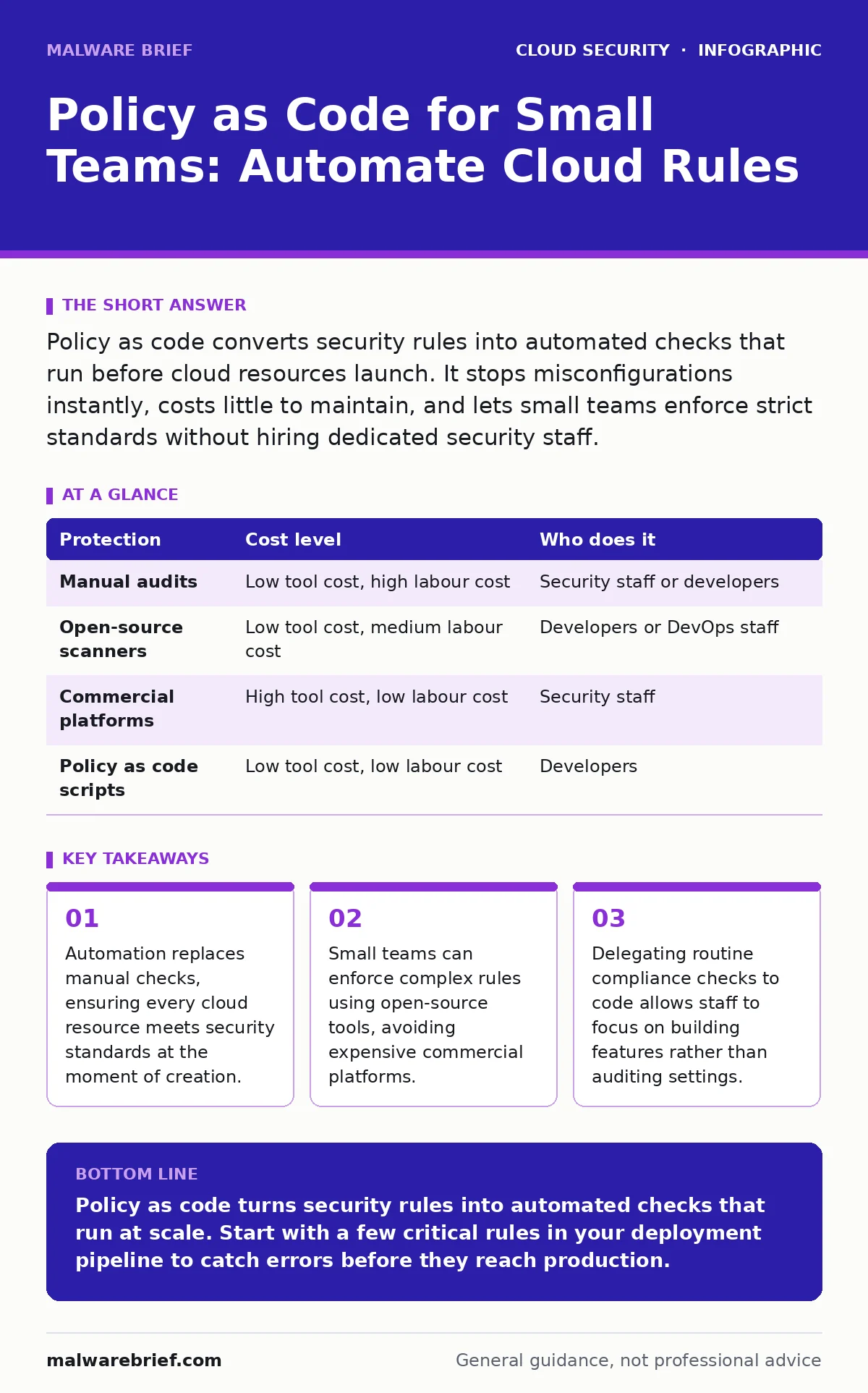
Policy as code converts security rules into automated checks that run before cloud resources launch. It stops misconfigurations instantly, costs little to maintain, and lets small teams enforce strict standards without hiring dedicated security staff.
The Hidden Cost of Manual Audits
Manual security reviews rely on human attention. Humans miss details. When a small team manages cloud infrastructure, members often wear multiple hats. They build applications, manage servers, and handle customer support. Security becomes a secondary task.
Configuration drift is the silent risk. This occurs when a system changes from its secure baseline over time. A setting that was secure yesterday may be open today because someone adjusted it to fix a bug. Manual audits only capture a snapshot in time. They miss the changes that happen between reviews.
Policy as code treats security rules as software. You write the rules in a programming language or a configuration format. The system checks these rules automatically. If a change violates a rule, the system blocks it. This creates a continuous guardrail rather than a periodic checkpoint.
For small businesses, this approach is not about buying expensive tools. It is about changing how you verify trust. You shift from trusting people to remember rules to trusting software to enforce them. The software does not get tired. It does not skip checks because of a deadline.
Why Scale Changes the Risk Profile
Large organisations have teams dedicated to compliance. They have budgets for commercial governance platforms. Small teams operate with different constraints. You have fewer people and less budget. This makes manual processes more dangerous, not less.
In a large company, one person’s mistake might be caught by another. In a small team, there is often no one left to catch the error. The developer who made the mistake is likely the only person who knows the system. This creates a single point of failure.
Policy as code levels the playing field. It allows a three-person team to enforce the same level of scrutiny as a hundred-person team. The code does not care how many people you have. It checks every resource against the same standard.
The risk for small businesses is not just financial. It is operational. A single misconfiguration can take down your service or expose customer data. Recovering from such an incident consumes time you do not have. Preventing it through automation protects your limited resources.
See the related guide on identity as the new perimeter to understand how access controls complement these automated checks.
Affordable Implementation Strategies
You do not need enterprise software to start. Many open-source tools provide the core functionality. These tools scan your infrastructure definitions and report violations. They run on your own machines or in your CI/CD pipeline.
The cost is primarily time. You need to write the rules. You need to integrate the tool into your deployment process. Once set up, the ongoing cost is minimal. The code runs automatically every time you deploy.
Start with a few critical rules. Do not try to enforce every possible standard at once. Focus on high-impact areas. Encrypt data at rest. Disable public access to databases. Ensure logging is enabled. These rules provide the most protection for the least effort.
As you gain confidence, add more rules. Review the output of your scans. Tune the rules to fit your workflow. The goal is to reduce friction, not to stop development. If the rules block too many legitimate changes, developers will find ways to bypass them.
Defining What to Delegate
Not every security task should be automated. Some decisions require human judgment. Policy as code is best suited for repetitive, objective checks. It is poor at handling nuanced business requirements.
Delegate the enforcement of technical standards to code. Examples include port configurations, encryption protocols, and tagging requirements. These are binary states. A port is either open or closed. A tag is either present or missing.
Keep strategic decisions human. Deciding which data needs long-term retention is a business decision. Determining who should have access to production environments is a people decision. Code can enforce the access list, but it cannot decide who belongs on it.
This distinction prevents over-automation. If you try to automate everything, you create brittle systems. They break when business needs change. By keeping strategy human and execution automated, you maintain flexibility.
Consult the guide on cloud audit logs to see how automated logging supports these manual reviews.
Building a Sustainable Workflow
Integration is key. Policy checks must run early in the development process. Waiting until the end of a project is too late. Fixing a mistake in production costs more than fixing it in code.
Embed the checks in your CI/CD pipeline. This is the system that builds and deploys your software. Every time a developer pushes code, the pipeline runs the policy checks. If the checks fail, the deployment stops.
This creates a feedback loop. Developers see the error immediately. They learn what went wrong. They fix the code locally. Over time, they internalise the security requirements. The code teaches them.
Document the rules clearly. Explain why each rule exists. If a developer does not understand the reason, they may disable the check. Transparency builds trust in the process.
Review cloud landing zones for best practices on structuring your cloud environment to support these workflows.
See also: Identity as the New Perimeter: Why Firewalls No Longer Define Security · Cloud data exfiltration: how it works and how to stop it
Common Pitfalls and Edge Cases
A common mistake is treating policy as code as a set-and-forget solution. Rules become outdated. New services appear. Old services disappear. You must maintain the code that enforces your policies.
Another pitfall is false positives. A rule may block a legitimate change. This frustrates developers. If the system is too noisy, people ignore it. Tune your rules to match your actual infrastructure. Exclude test environments if necessary.
Be aware of cloud data exfiltration risks that policy alone cannot stop. Encryption and network rules help, but they do not prevent a user from downloading data to an authorised device. Policy as code manages configuration, not user intent.
Monitor insecure cloud APIs regularly. Even with strict policies, underlying platform vulnerabilities can emerge. Your code checks your configuration, not the security of the cloud provider’s infrastructure.
Check for cloud logging gaps that might hide violations. If you do not log policy check results, you have no evidence of compliance. Ensure the tool records every pass and fail.
Comparing Protection Options
| Protection | Cost level | Who does it |
|---|---|---|
| Manual audits | Low tool cost, high labour cost | Security staff or developers |
| Open-source scanners | Low tool cost, medium labour cost | Developers or DevOps staff |
| Commercial platforms | High tool cost, low labour cost | Security staff |
| Policy as code scripts | Low tool cost, low labour cost | Developers |
Ask your IT provider these questions:
- Can you show me examples of policies written as code?
- How do you handle false positives in the pipeline?
- Who maintains the policy rules when cloud features change?
- How do you integrate these checks into our existing workflow?
Review the guide on cloud key management services to ensure your encryption keys are protected separately from your policy logic.
Key takeaways
- Automation replaces manual checks, ensuring every cloud resource meets security standards at the moment of creation.
- Small teams can enforce complex rules using open-source tools, avoiding expensive commercial platforms.
- Delegating routine compliance checks to code allows staff to focus on building features rather than auditing settings.
Policy as code turns security rules into automated checks that run at scale. Start with a few critical rules in your deployment pipeline to catch errors before they reach production.
Frequently asked questions
Does policy as code replace security staff?
No, it shifts their focus from manual checking to rule definition and exception management.
Is policy as code suitable for on-premise servers?
Yes, the same principles apply to any infrastructure defined by code or configuration.
How do I handle urgent changes that violate policy?
Use an exception process that requires approval and sets an expiry date for the bypass.
What happens if the policy code contains a bug?
It may block legitimate work or allow insecure configurations, so peer review the policy code.
How this guide was produced: written by the Malware Brief editorial team with AI assistance, checked against the public references listed below, and reviewed when the facts change. See our editorial policy or report an error.