Service Mesh Security: Benefits, Limits and When to Deploy
Service meshes automate traffic encryption and policy enforcement, but they introduce latency and obscure the underlying application logic from simple network tools.

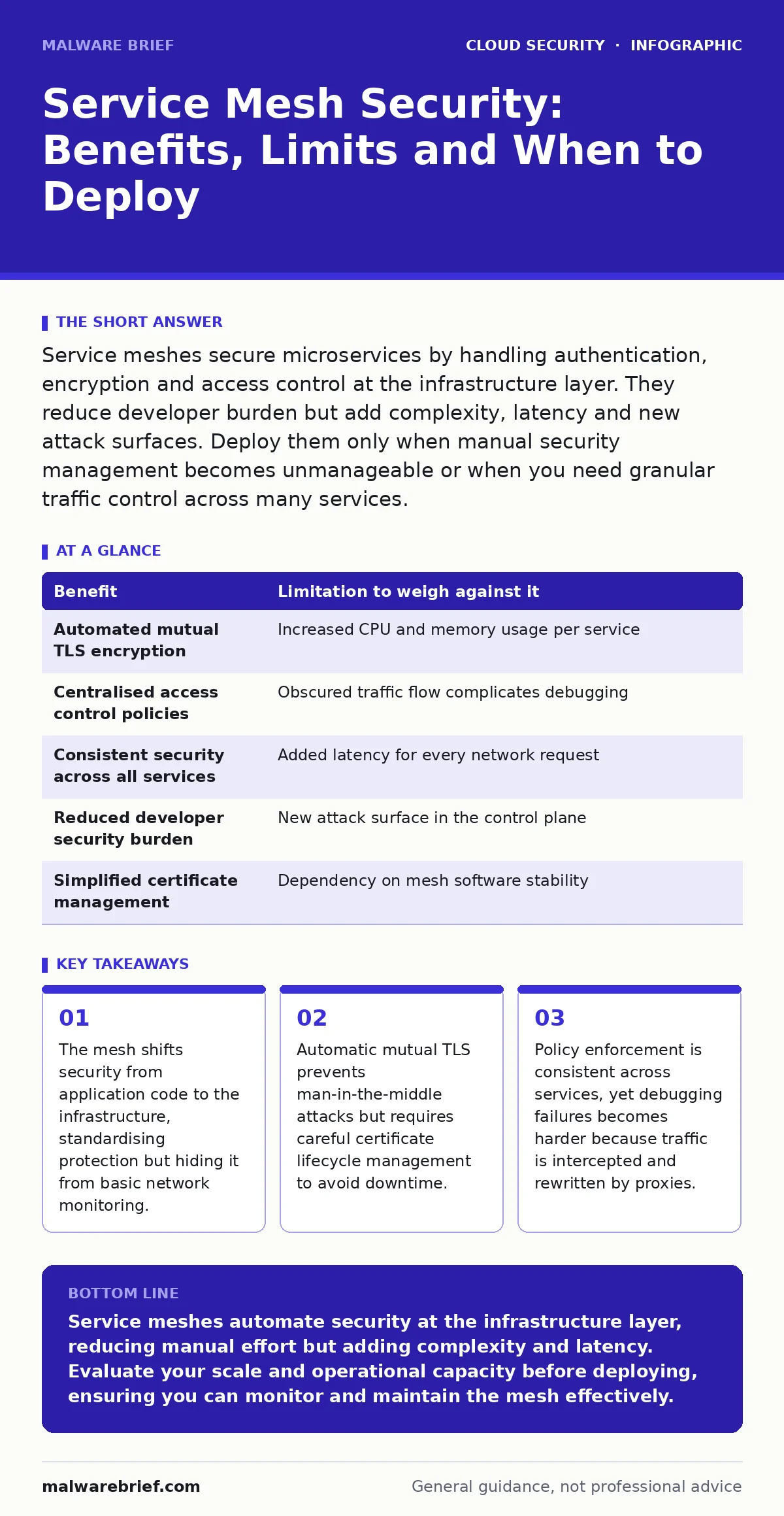
Service meshes secure microservices by handling authentication, encryption and access control at the infrastructure layer. They reduce developer burden but add complexity, latency and new attack surfaces. Deploy them only when manual security management becomes unmanageable or when you need granular traffic control across many services.
What a Service Mesh Actually Does
A service mesh is a dedicated infrastructure layer for handling service-to-service communication. It typically uses a sidecar proxy, a small piece of software that runs alongside each application instance, to intercept network traffic. This proxy handles tasks such as encryption, routing and authentication without requiring changes to the application code. The mesh decouples the security logic from the business logic, allowing you to update security policies without redeploying your applications.
This separation means that security becomes a property of the platform rather than a feature of the application. Developers focus on functionality while the mesh enforces standards. However, this abstraction comes with a cost. The proxy adds a layer between the client and the server, which can introduce latency and complexity. You are trading application-level control for infrastructure-level consistency.
The Hidden Cost of Abstraction
Imagine you deploy a new microservice that fails to respond to health checks. In a traditional setup, you would check the application logs and network connections. With a service mesh, the proxy might be blocking the traffic due to a misconfigured policy. The application is healthy, but the mesh is denying access. This obscures the root cause from standard monitoring tools.
The mesh creates a hidden layer of logic. If you do not instrument the mesh itself, you lose visibility into why traffic is failing. You must monitor the proxies as well as the applications. This doubles the logging and tracing effort. It also means that a bug in the mesh software can take down your entire platform, regardless of how stable your applications are.
Concrete Benefits of Mesh Security
The primary benefit is automated mutual TLS. Mutual TLS requires both the client and server to present certificates to prove their identity. Configuring this manually for hundreds of services is error-prone and difficult to maintain. The mesh handles certificate rotation and validation automatically. This ensures that all internal traffic is encrypted and authenticated by default.
Another benefit is centralised policy enforcement. You can define access rules in one place and apply them to all services. For example, you can restrict access to a database service to only specific microservices. This reduces the risk of misconfiguration, where a developer accidentally leaves a service exposed. It also simplifies compliance audits, as you can prove that encryption and access controls are applied uniformly.
Honest Limitations and Trade-offs
The sidecar proxy consumes resources. Each service instance runs an additional process that uses CPU and memory. This increases the operational cost of your infrastructure. It also adds latency to every request, as the proxy must process the packet before passing it to the application. For high-throughput, low-latency applications, this overhead can be significant.
Debugging is another limitation. When traffic is intercepted and rewritten, traditional debugging tools may not work as expected. You cannot simply use a packet sniffer to see the raw traffic between services, as the mesh may have altered the headers or encrypted the payload. You need specialised tools to inspect mesh traffic. This raises the barrier to entry for junior engineers who are not familiar with the mesh architecture.
Benefit vs Limitation Matrix
| Benefit | Limitation to weigh against it |
|---|---|
| Automated mutual TLS encryption | Increased CPU and memory usage per service |
| Centralised access control policies | Obscured traffic flow complicates debugging |
| Consistent security across all services | Added latency for every network request |
| Reduced developer security burden | New attack surface in the control plane |
| Simplified certificate management | Dependency on mesh software stability |
See also: Cloud Audit Logs: 7 Common Mistakes That Blind Your Security Team · Cloud Landing Zones: Benefits, Limits and When to Deploy
When It Is Worth It
You should consider a service mesh when you have a large number of microservices with complex communication patterns. If you are struggling to manage certificates or enforce consistent access controls manually, the mesh can automate these tasks. It is particularly valuable when you need granular traffic management, such as canary releases or A/B testing, alongside security features.
It is also worth it when you have a dedicated platform team that can manage the mesh. The mesh requires careful configuration and monitoring. If your team lacks the expertise, the complexity may outweigh the benefits. Consider the long-term operational cost. If the mesh simplifies your security posture enough to offset the resource overhead, it is a viable investment.
When It Is Not Worth It
Do not deploy a service mesh if you have a small number of services or a monolithic architecture. The overhead of the sidecar proxies is unnecessary for simple applications. If your services communicate primarily through synchronous requests and you do not need advanced traffic management, a simpler solution may suffice.
It is also not worth it if you lack the resources to monitor and maintain the mesh. The mesh introduces a new layer of failure. If you cannot afford the downtime or the operational burden of managing the control plane, stick to application-level security. Remember that the mesh is not a silver bullet. It does not replace the need for secure coding practices or regular security testing.
Related topics such as cloud audit logs can help you track mesh activity, but they do not replace the need for proper mesh configuration. Similarly, policy as code can automate mesh policy deployment, but it requires a mature DevOps culture.
Integrating with Broader Security
The service mesh is part of a broader security strategy. It works best when combined with other controls. For example, cloud key management services can store the root certificates used by the mesh, ensuring that private keys are never exposed. This separation of duties enhances security by limiting access to sensitive material.
Identity is central to mesh security. The mesh relies on strong identity verification to enforce policies. This aligns with the concept of identity as the new perimeter, where access is granted based on identity rather than network location. Ensure that your identity provider is robust and that identities are regularly reviewed.
Key takeaways
- The mesh shifts security from application code to the infrastructure, standardising protection but hiding it from basic network monitoring.
- Automatic mutual TLS prevents man-in-the-middle attacks but requires careful certificate lifecycle management to avoid downtime.
- Policy enforcement is consistent across services, yet debugging failures becomes harder because traffic is intercepted and rewritten by proxies.
Service meshes automate security at the infrastructure layer, reducing manual effort but adding complexity and latency. Evaluate your scale and operational capacity before deploying, ensuring you can monitor and maintain the mesh effectively.
Frequently asked questions
Does a service mesh protect against DDoS attacks?
No, a service mesh does not provide comprehensive DDoS protection. It can help rate-limit traffic, but you need dedicated DDoS mitigation services at the network edge.
Can I use a service mesh with serverless functions?
It is challenging. Serverless functions are ephemeral and do not run sidecar proxies. Some mesh providers offer serverless-compatible modes, but functionality may be limited.
How does a service mesh affect compliance?
It can help by enforcing encryption and access controls uniformly. However, you must still configure the mesh correctly and audit its policies to meet compliance requirements.
Is a service mesh a replacement for a WAF?
No, a web application firewall protects against application-layer attacks. A service mesh secures service-to-service communication. They serve different purposes and can be used together.
How this guide was produced: written by the Malware Brief editorial team with AI assistance, checked against the public references listed below, and reviewed when the facts change. See our editorial policy or report an error.