Cloud Landing Zones: Benefits, Limits and When to Deploy
Landing zones prevent configuration drift but introduce architectural complexity that slows initial deployment and masks underlying policy failures.
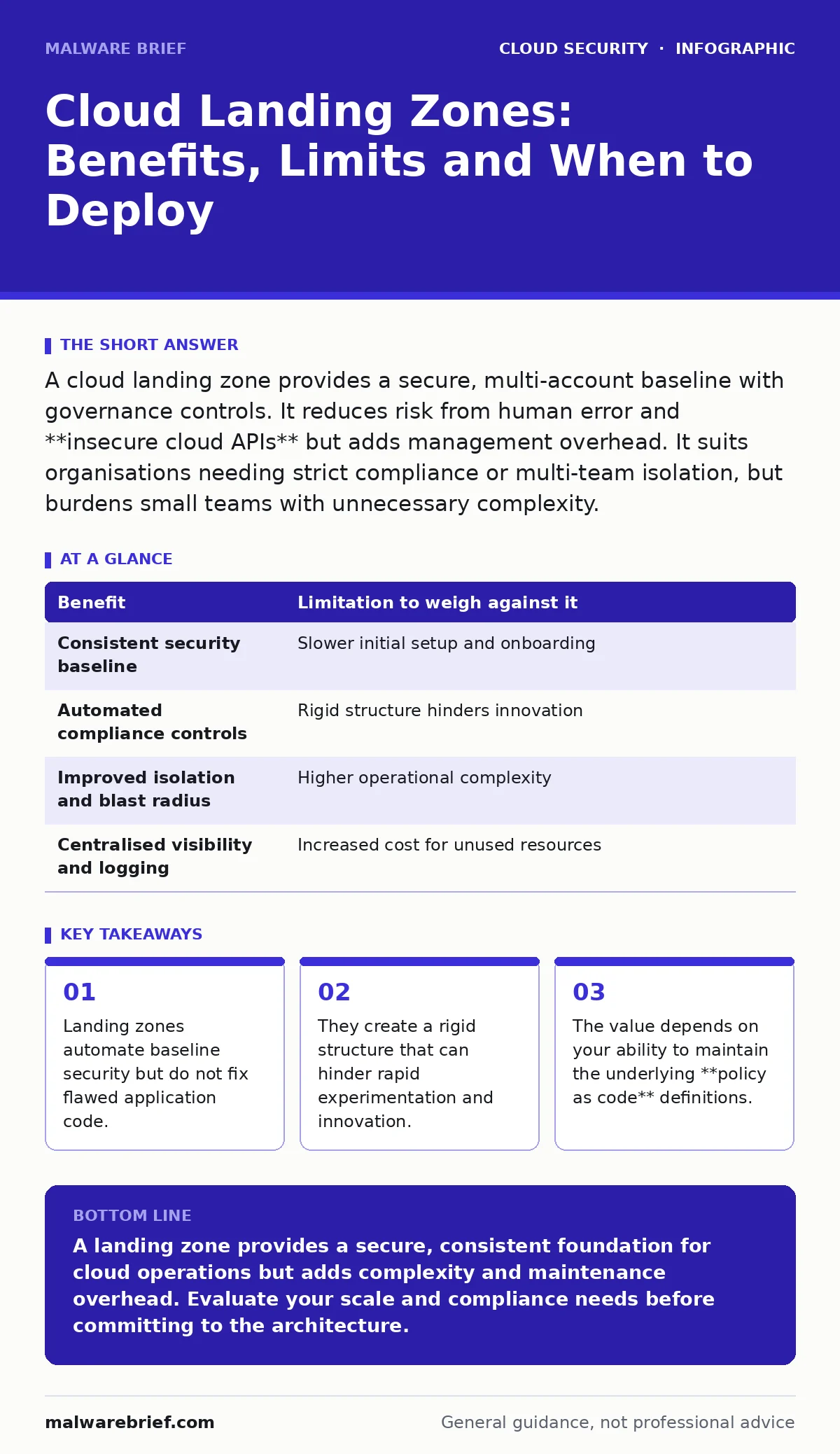
A cloud landing zone provides a secure, multi-account baseline with governance controls. It reduces risk from human error and **insecure cloud APIs** but adds management overhead. It suits organisations needing strict compliance or multi-team isolation, but burdens small teams with unnecessary complexity.
The Architecture of Control
A cloud landing zone is a foundational environment for cloud accounts. It establishes the security, governance, and network connectivity standards before any workload is deployed. You build this foundation once, then replicate it for new projects. This approach prevents teams from starting with blank slates that lack basic protections.
The core mechanism is automation. You define the desired state of your infrastructure using policy as code. When a new account is created, scripts apply these rules automatically. This ensures that every environment starts with the same security posture. It removes the variability that comes from manual configuration.
Imagine a developer spins up a new project. Without a landing zone, they might forget to enable encryption or open overly permissive network rules. With a landing zone, the account is born with logging enabled and access restricted. The developer cannot bypass these constraints without elevated privileges. This shifts security left in the development lifecycle.
Concrete Benefits of Standardisation
The primary benefit is consistency. Every account follows the same security model. This makes audits predictable and reduces the cognitive load on security teams. You do not need to reinvent the wheel for every new initiative.
Isolation is another key advantage. Landing zones typically use a multi-account strategy. Each workload runs in its own account with its own identity and access controls. If one application is compromised, the attacker is contained within that specific account. This limits the blast radius of a breach.
You also gain visibility. Centralised logging and monitoring are baked into the foundation. All accounts send data to a shared security hub. This allows you to detect anomalies across the entire organisation, not just within single silos. It supports effective cloud audit logs analysis at scale.
| Benefit | Limitation to weigh against it |
|---|---|
| Consistent security baseline | Slower initial setup and onboarding |
| Automated compliance controls | Rigid structure hinders innovation |
| Improved isolation and blast radius | Higher operational complexity |
| Centralised visibility and logging | Increased cost for unused resources |
Honest Limitations and Hidden Costs
Landing zones are not a silver bullet. They address infrastructure configuration, not application security. A well-configured landing zone can still host a vulnerable web application. You must still secure your code and dependencies.
There is a significant maintenance burden. As cloud providers release new services, your landing zone definitions must evolve. If your policy as code is outdated, you are deploying known weaknesses automatically. This requires dedicated engineering time to keep the foundation current.
Complexity is the hidden cost. Debugging issues in a multi-account environment is harder than in a single account. Network connectivity between accounts requires careful planning. Misconfigured transit gateways or peering connections can break workflows silently. You trade simplicity for security.
When It Is Worth It
You should implement a landing zone if you manage multiple teams or projects. The overhead of manual configuration becomes unsustainable at scale. Automation pays for itself by preventing repeated mistakes.
It is worth the effort if you face strict compliance requirements. Regulations often demand specific controls like encryption, logging, and access reviews. A landing zone embeds these controls into the fabric of your cloud usage. This makes cloud compliance easier to demonstrate and maintain.
Organisations with high-security workloads benefit most. Financial services, healthcare, and government agencies operate in high-risk environments. The isolation and governance features of a landing zone provide the necessary controls. The cost of a breach outweighs the cost of implementation.
When It Is Not Worth It
Small teams or startups should avoid complex landing zones initially. The time spent building and maintaining the foundation detracts from product development. A simple, single-account setup with basic security hygiene is often sufficient.
If your cloud usage is transient or experimental, a landing zone adds friction. Researchers or data scientists may need rapid iteration. Strict governance can slow down their ability to test hypotheses. In these cases, flexible, temporary environments are more appropriate.
See also: Cloud data exfiltration: how it works and how to stop it · Policy as Code for Small Teams: Automate Cloud Rules
Integration with Broader Security
A landing zone is one layer of defence. It must work with other security measures. For example, cloud key management services should be integrated to manage encryption keys centrally. This ensures that data at rest is protected consistently across all accounts.
You must also consider SaaS security posture management. Landing zones cover infrastructure, but many applications run in Software-as-a-Service platforms. These platforms have their own risks and configurations. You need a separate strategy to secure SaaS applications.
The shared responsibility model remains critical. The cloud provider secures the infrastructure, but you secure what you put on it. A landing zone helps you meet your side of the bargain. It ensures that your configurations align with best practices.
Maintenance and Evolution
Building the landing zone is only the beginning. You must treat it as a living system. Regular reviews are necessary to ensure it meets current threats and business needs. Stagnation leads to security decay.
Automate the testing of your landing zone. Use tools to validate that new accounts are created correctly. Detect drift where configurations diverge from the desired state. This ensures that the foundation remains reliable over time.
Key takeaways
- Landing zones automate baseline security but do not fix flawed application code.
- They create a rigid structure that can hinder rapid experimentation and innovation.
- The value depends on your ability to maintain the underlying **policy as code** definitions.
A landing zone provides a secure, consistent foundation for cloud operations but adds complexity and maintenance overhead. Evaluate your scale and compliance needs before committing to the architecture.
Frequently asked questions
Does a landing zone replace a security team?
No. It automates baseline configuration but requires human oversight for policy updates, incident response, and application security.
Can I use a landing zone for personal projects?
It is usually overkill. The complexity outweighs the benefits for small-scale or individual usage.
How does it handle third-party access?
It provides a framework for managing external access, but you must still define specific permissions and monitor usage carefully.
Is it difficult to migrate to a landing zone?
Yes. Migrating existing workloads requires significant planning and testing to avoid downtime and security gaps.
How this guide was produced: written by the Malware Brief editorial team with AI assistance, checked against the public references listed below, and reviewed when the facts change. See our editorial policy or report an error.