SaaS Security Posture Management: Definition, Purpose and Mechanics
SaaS posture management exposes configuration drift and shadow IT by continuously mapping application settings against a defined security baseline.
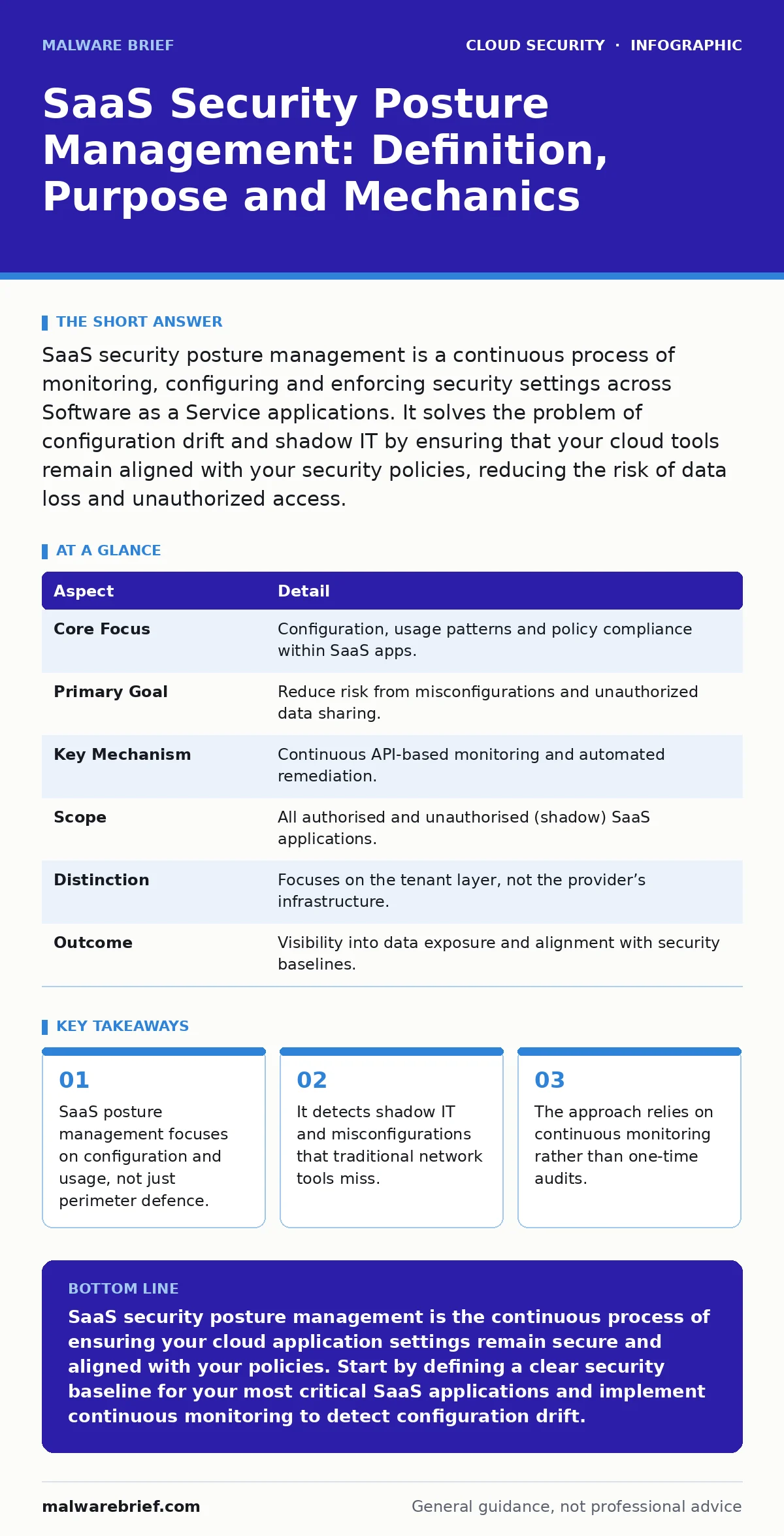
SaaS security posture management is a continuous process of monitoring, configuring and enforcing security settings across Software as a Service applications. It solves the problem of configuration drift and shadow IT by ensuring that your cloud tools remain aligned with your security policies, reducing the risk of data loss and unauthorized access.
The Library Analogy
Imagine a large public library. The building itself is secure, with locked doors and security cameras. This is the responsibility of the library owners. However, inside, patrons can arrange books on shelves, leave notes on tables or share their study carrels with strangers. If a patron leaves a confidential document on a public table, the library’s outer security does not help. You need a librarian who walks the floor, checking that documents are stored correctly and that shared spaces are not being abused. SaaS security posture management acts as that librarian for your cloud applications. It checks the internal rules and settings of each application, ensuring they remain secure even though you do not control the underlying infrastructure.
| Aspect | Detail |
|---|---|
| Core Focus | Configuration, usage patterns and policy compliance within SaaS apps. |
| Primary Goal | Reduce risk from misconfigurations and unauthorized data sharing. |
| Key Mechanism | Continuous API-based monitoring and automated remediation. |
| Scope | All authorised and unauthorised (shadow) SaaS applications. |
| Distinction | Focuses on the tenant layer, not the provider’s infrastructure. |
| Outcome | Visibility into data exposure and alignment with security baselines. |
The Problem of Tenant Misconfiguration
Software as a Service providers build secure platforms. They protect the servers, the network and the application code. This is known as the infrastructure layer. However, when you subscribe to a SaaS product, you are given a tenant. A tenant is your isolated instance of the application, where you store your data and configure your settings. You control this layer. Most security breaches in SaaS environments do not happen because the provider was hacked. They happen because a user or administrator configured the tenant incorrectly.
For example, you might enable external file sharing by default. You might allow login from any geographic location. You might grant excessive permissions to an integration. These settings are often easy to change and hard to track. Over time, these small changes accumulate. This is called configuration drift. Your security posture slowly degrades until it no longer matches your original intent. Traditional network security tools cannot see inside these applications. They see encrypted traffic, but they do not see what that traffic is doing.
What SaaS Posture Management Does
SaaS security posture management uses APIs to connect to your SaaS applications. An API, or Application Programming Interface, is a set of rules that allows different software systems to talk to each other. By using these APIs, the management tool can read your current settings. It compares these settings against a baseline. A baseline is a defined set of secure configurations that your organisation has agreed to follow.
If the tool finds a deviation, it flags it. For instance, if your baseline says "no external sharing," but a user has shared a folder with an external domain, the tool records this event. It also looks for usage anomalies. If a user suddenly downloads thousands of documents, the tool may alert you. This is not just about blocking bad actors. It is about ensuring that your environment remains in a known, secure state. It provides visibility into how your people are actually using the tools, not just how you intended them to be used.
The Main Components
A mature SaaS posture management strategy consists of several interconnected parts. First, there is discovery. This involves identifying all SaaS applications in use, including those not approved by IT. This is often called shadow IT. If you do not know an application exists, you cannot secure it. Second, there is assessment. The tool evaluates the security configuration of each discovered application. It checks for weak settings, excessive permissions and risky integrations.
Third, there is enforcement. This can be automated or manual. Automated enforcement might disable a risky setting or block a login from an unusual location. Manual enforcement involves alerting an administrator to take action. Fourth, there is reporting. You need to understand the trend. Are misconfigurations increasing? Are certain departments more risky than others? This data helps you prioritise your efforts. It also supports audits by providing evidence of your security controls.
Where It Fits in Your Defence
SaaS posture management does not replace other security measures. It complements them. Identity and access management controls who can log in. SaaS posture management controls what they can do once they are in. You must understand the shared responsibility model. This model defines which security tasks are the provider’s and which are yours. The provider secures the cloud. You secure what you put in the cloud.
SaaS posture management sits at the intersection of identity, data and application security. It works closely with identity providers to ensure that access rights are correct. It works with data loss prevention tools to stop sensitive information from leaving the organisation. It also helps address the concept of identity as the new perimeter. Since your workforce is distributed, your perimeter is no longer the office firewall. It is the identity of each user and the applications they access. Posture management ensures that these identities are behaving as expected.
See also: Cloud Audit Logs: 7 Common Mistakes That Blind Your Security Team · Cloud Landing Zones: Benefits, Limits and When to Deploy
Common Misconceptions
Many organisations misunderstand what SaaS posture management is. One common mistake is thinking it is the same as a Cloud Access Security Broker. A CASB focuses heavily on network traffic and data in motion. SaaS posture management focuses on configuration and data at rest within the application. While they often overlap, their primary functions differ. Another mistake is assuming that a one-time audit is enough. SaaS environments change constantly. New users join, settings change, and integrations are added. Continuous monitoring is necessary to catch drift.
Some believe that SaaS posture management will solve all their problems. It will not. It requires a clear security policy. If you do not define what "secure" looks like, the tool has nothing to compare against. It also requires resources to act on the findings. Alert fatigue is real. If you receive hundreds of alerts a day, you will ignore them. You must tune the tool to focus on high-risk events. Finally, do not confuse this with securing insecure cloud APIs. While posture management uses APIs, it does not fix vulnerabilities in the API code itself. That is the provider’s job.
Integrating with Broader Cloud Strategy
SaaS posture management is part of a larger cloud security strategy. It should work alongside cloud logging gaps analysis. If your logs are incomplete, you cannot detect all activities. Posture management helps fill some of these gaps by providing application-level visibility. It also supports cloud compliance efforts. Many regulations require you to demonstrate that you control access to sensitive data. Posture management provides the evidence needed for these audits.
It is also relevant to preventing cloud data exfiltration. By monitoring sharing settings and download patterns, you can stop data from leaving your organisation. However, it is not a substitute for cloud landing zones. Landing zones provide a secure foundation for your cloud infrastructure. Posture management secures the applications that run on top of that foundation. You need both. Without a secure landing zone, your infrastructure is vulnerable. Without posture management, your applications are vulnerable.
Key takeaways
- SaaS posture management focuses on configuration and usage, not just perimeter defence.
- It detects shadow IT and misconfigurations that traditional network tools miss.
- The approach relies on continuous monitoring rather than one-time audits.
SaaS security posture management is the continuous process of ensuring your cloud application settings remain secure and aligned with your policies. Start by defining a clear security baseline for your most critical SaaS applications and implement continuous monitoring to detect configuration drift.
Frequently asked questions
Is SaaS posture management the same as a CASB?
No. A CASB focuses on network traffic and data in motion, while SaaS posture management focuses on configuration settings and usage patterns within the application tenant.
Do I need SaaS posture management if I use MFA?
Yes. MFA secures the login process, but it does not prevent users from misconfiguring sharing settings or granting excessive permissions within the application.
Can SaaS posture management detect shadow IT?
Yes. By analysing network traffic and identity logs, it can identify SaaS applications that are in use but not approved by your IT department.
How often should I review my SaaS security baseline?
You should review it regularly, at least when your business processes change or when new security threats emerge. Continuous monitoring helps identify when the baseline is no longer effective.
How this guide was produced: written by the Malware Brief editorial team with AI assistance, checked against the public references listed below, and reviewed when the facts change. See our editorial policy or report an error.