Cloud Logging Gaps: Response and Recovery Steps
Missing logs destroy forensic timelines, forcing teams to reconstruct attacker movements from incomplete network traces and memory dumps rather than audit trails.
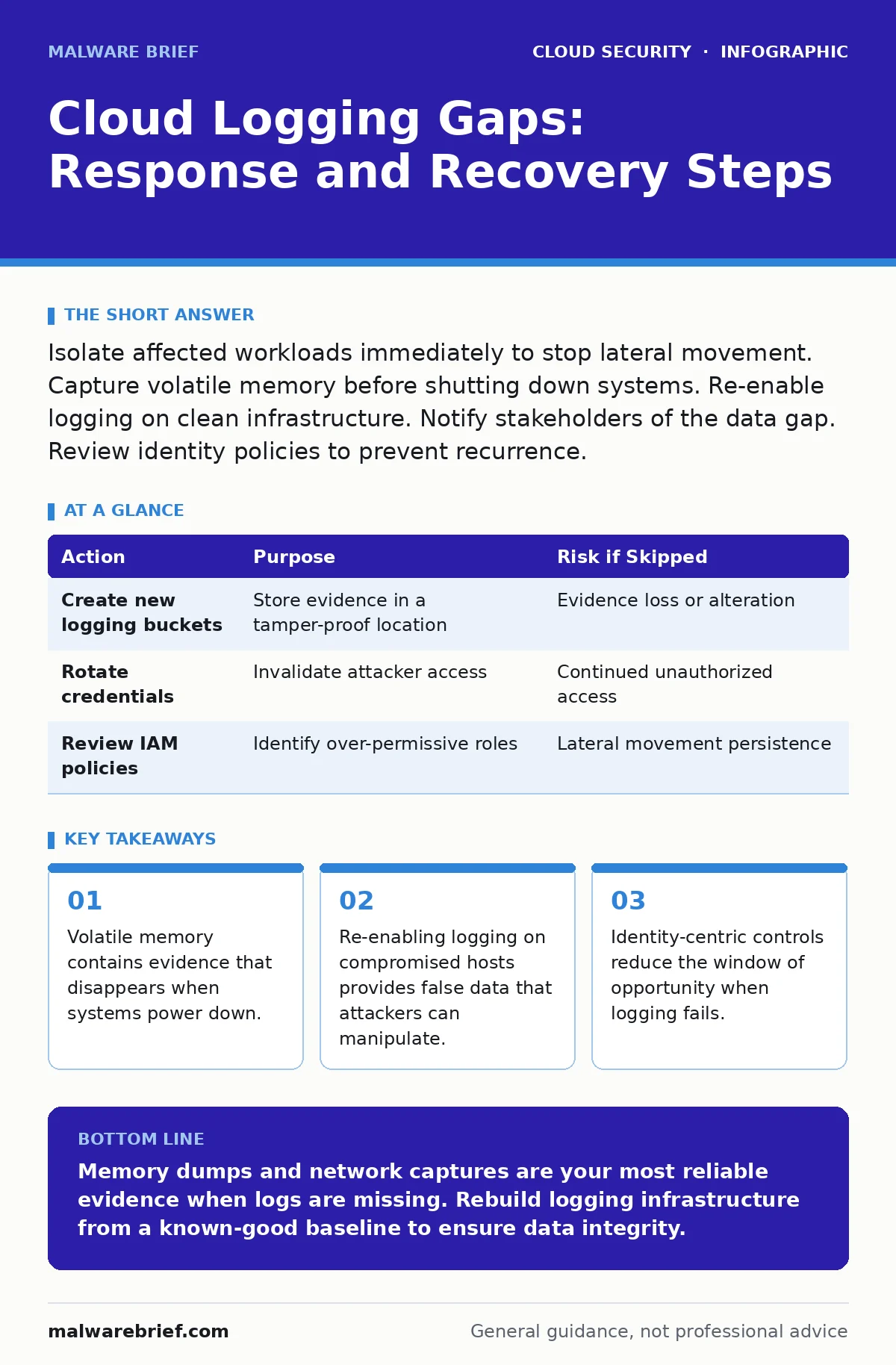
Isolate affected workloads immediately to stop lateral movement. Capture volatile memory before shutting down systems. Re-enable logging on clean infrastructure. Notify stakeholders of the data gap. Review identity policies to prevent recurrence.
First hour
The immediate priority is containment, not investigation. When you discover a gap in cloud logging, assume the attacker is still present. The absence of logs often means the adversary has already disabled them to hide their tracks. You must stop the bleeding before you try to understand the wound.
First hour checklist:
- Identify the scope of the logging gap. Determine which services, regions, and timeframes are affected.
- Isolate affected workloads. Use security groups or network access control lists to cut off external communication. Keep internal connectivity intact if it aids containment.
- Capture volatile memory. Take memory dumps of critical systems before any restart or shutdown occurs.
- Freeze user sessions. Force a logout for all active sessions in the affected accounts to prevent further action.
- Preserve network traffic. Capture packet data from the affected subnets for later analysis.
First day
Once containment is stable, you begin the recovery phase. The goal is to restore visibility without reintroducing the threat. You cannot trust data from the compromised environment. Any log generated after the gap began might be fabricated or suppressed by the attacker.
You must rebuild your logging infrastructure. This means creating new logging endpoints in a clean environment. Do not simply re-enable the old configurations. The attacker may have modified the configuration to filter out malicious activity. Start fresh with a known-good baseline.
| Action | Purpose | Risk if Skipped |
|---|---|---|
| Create new logging buckets | Store evidence in a tamper-proof location | Evidence loss or alteration |
| Rotate credentials | Invalidate attacker access | Continued unauthorized access |
| Review IAM policies | Identify over-permissive roles | Lateral movement persistence |
Refer to the shared responsibility model to understand which logging duties belong to the provider and which belong to you. The provider secures the infrastructure, but you secure the data and access logs. Confusing this boundary leads to gaps in accountability.
First week
Recovery shifts from technical remediation to process improvement. You must determine how the logging gap occurred. Was it a configuration error, a malicious change, or a platform outage? Each cause requires a different preventive measure.
Analyze the memory dumps and network captures from the first hour. Look for indicators of compromise that the logs missed. Correlate these findings with the timeline of the incident. This helps you estimate how long the attacker had access before detection.
Implement stricter controls on logging configuration. Use infrastructure as code to manage logging settings. This ensures that any change to logging is tracked and reviewed. Manual changes are prone to error and are harder to audit.
Consider the cloud audit logs as your primary source of truth for administrative actions. If these logs were also compromised, you must rely on secondary sources like database transaction logs or application-level logs. These sources are often overlooked but can provide critical context.
Who to tell
Communication is as important as technical response. You must inform internal stakeholders, customers, and regulators. The timing and content of these notifications depend on the severity of the incident and local laws.
Start with internal leadership. They need to understand the business impact and legal implications. Provide a clear, concise summary of what happened, what data was affected, and what steps are being taken. Avoid technical jargon that may confuse non-technical readers.
Next, notify customers if their data was involved. Be transparent about the nature of the breach and the steps you are taking to protect their information. Delaying notification can erode trust and lead to legal penalties.
Finally, report to regulators if required by law. Many jurisdictions have strict timelines for breach notification. Failure to comply can result in significant fines and reputational damage. Refer to cloud compliance frameworks to understand your specific obligations.
How to stop a repeat
Preventing recurrence requires a shift in mindset. You must assume that logging will fail or be disabled. Design your security architecture to detect anomalies even when logs are missing.
Implement identity as the new perimeter by focusing on user and service identities rather than network boundaries. Monitor for unusual identity behaviour, such as logins from new locations or access to sensitive resources at odd times. This approach reduces reliance on traditional network logs.
Use SaaS security posture management to continuously monitor your cloud configurations. Automated tools can detect misconfigurations in real-time and alert you before they become exploitable. This proactive approach reduces the window of vulnerability.
Regularly test your logging and monitoring systems. Conduct tabletop exercises to simulate logging gaps. These exercises help you identify weaknesses in your response plan and improve coordination among teams.
See also: Identity as the New Perimeter: Why Firewalls No Longer Define Security · Cloud data exfiltration: how it works and how to stop it
Hidden costs and trade-offs
Enabling comprehensive logging has a cost. Storage fees can escalate quickly, especially in high-volume environments. You must balance the need for visibility with budget constraints. Prioritize logging for critical assets and sensitive data.
Another trade-off is performance. Excessive logging can slow down applications and increase latency. Optimize your logging configuration to capture only necessary data. Use sampling or aggregation techniques to reduce volume without losing critical insights.
Finally, consider the cloud key management services used to encrypt logs. If the attacker compromises the encryption keys, they can decrypt and alter past logs. Protect these keys with strict access controls and regular rotation.
The role of architecture
Secure architecture reduces the impact of logging gaps. Implement cloud landing zones that enforce security best practices by default. These pre-configured environments include secure logging, monitoring, and identity management.
Use least privilege access for all users and services. This limits the damage an attacker can do if they gain access. Regularly review and revoke unnecessary permissions. This reduces the attack surface and makes lateral movement more difficult.
Imagine a scenario where an attacker disables logging in a non-critical environment. Because your architecture enforces logging at the account level, the gap is detected immediately. This containment prevents the attacker from moving to critical systems.
Final thoughts
Responding to cloud logging gaps requires a disciplined approach. Containment, recovery, and prevention are interconnected. Neglecting any one of these phases increases the risk of future incidents.
Stay focused on the facts. Avoid speculation about the attacker's motives or identity. Concentrate on the technical evidence and the steps needed to secure your environment.
Refer to cloud data exfiltration techniques to understand how attackers move data once logging is disabled. This knowledge helps you detect and block data theft even when logs are incomplete.
Key takeaways
- Volatile memory contains evidence that disappears when systems power down.
- Re-enabling logging on compromised hosts provides false data that attackers can manipulate.
- Identity-centric controls reduce the window of opportunity when logging fails.
Memory dumps and network captures are your most reliable evidence when logs are missing. Rebuild logging infrastructure from a known-good baseline to ensure data integrity.
Frequently asked questions
How do I know if my cloud logs are tampered with?
Check for sudden gaps in time, unexpected changes in configuration, or logs that lack expected entries for administrative actions. Cross-reference with network traffic and memory dumps.
Should I delete compromised logs to free up space?
No. Delete only after you have extracted and preserved all relevant evidence. Tampering with logs can destroy legal evidence and hinder forensic analysis.
Can I use third-party tools to monitor cloud logs?
Yes, but ensure they comply with your security policies and data residency requirements. Third-party tools can provide additional visibility but must be configured securely.
How often should I review my logging configuration?
Review logging configurations quarterly or after any significant change to your cloud environment. Automated monitoring can help detect drift from the desired state.
How this guide was produced: written by the Malware Brief editorial team with AI assistance, checked against the public references listed below, and reviewed when the facts change. See our editorial policy or report an error.