Cloud data exfiltration: how it works and how to stop it
Data leaves your cloud environment through legitimate application logic, not just broken firewalls, making traditional perimeter defence largely ineffective against modern theft.
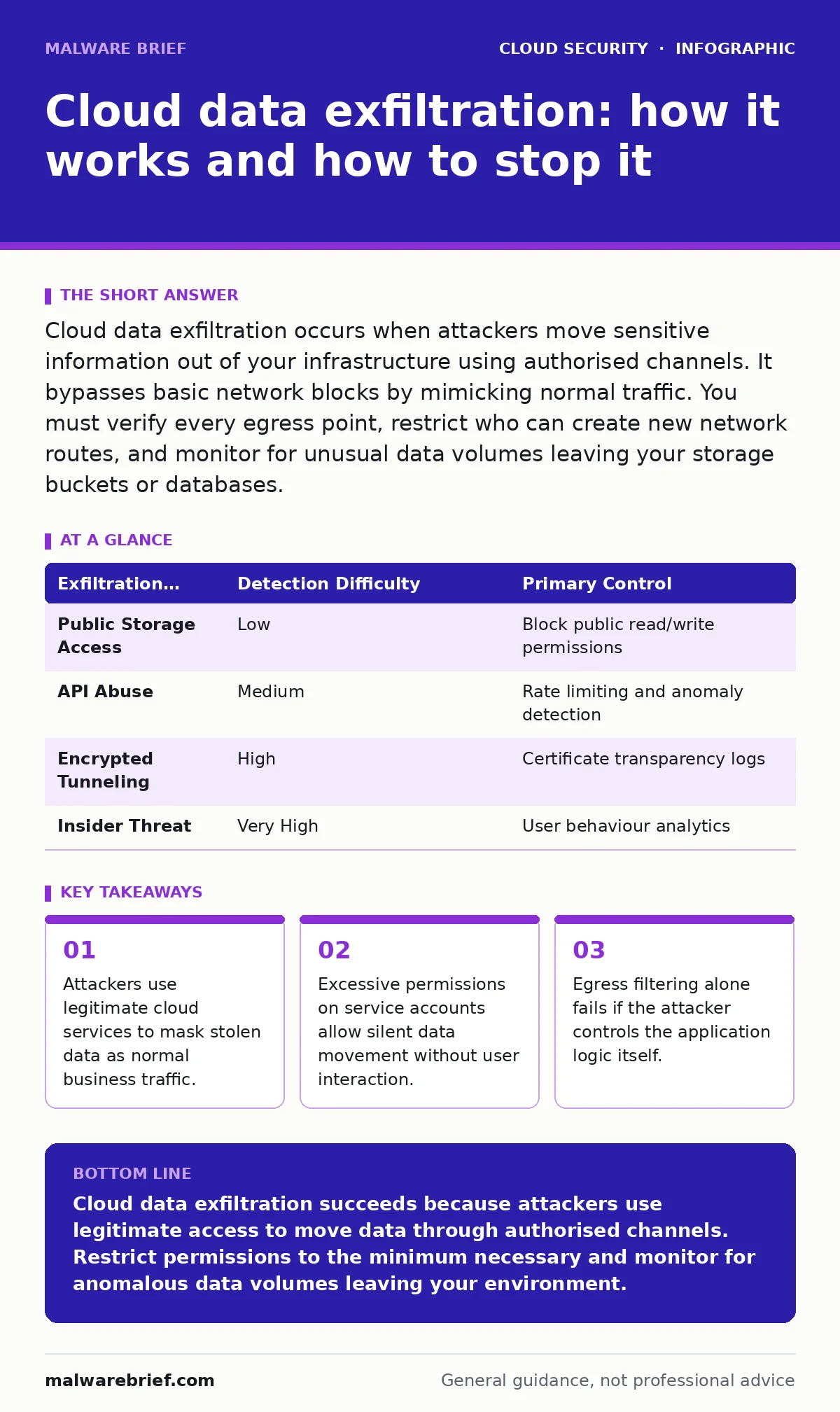
Cloud data exfiltration occurs when attackers move sensitive information out of your infrastructure using authorised channels. It bypasses basic network blocks by mimicking normal traffic. You must verify every egress point, restrict who can create new network routes, and monitor for unusual data volumes leaving your storage buckets or databases.
What is cloud data exfiltration?
Cloud data exfiltration is the unauthorised transfer of data from your cloud environment to an external location controlled by an attacker. It differs from traditional theft because the data often leaves through legitimate application pathways rather than exploiting a network vulnerability. The attacker uses existing access rights to copy files, query databases, or stream content to an outside server. This makes detection difficult because the traffic appears to be standard business activity.
How do attackers typically access the data?
Attackers rarely break into a secure vault; instead, they compromise an identity with permission to read the data. They target service accounts, developer credentials, or misconfigured storage buckets that allow public or broad read access. Once they hold valid credentials, they can query databases or download files just as a legitimate user would. The initial breach often happens via phishing or stolen keys, but the exfiltration relies on the scope of those permissions. See identity as the new perimeter for strategies on tightening these access controls.
Why does standard firewall protection fail?
Traditional firewalls inspect packet headers and block known malicious IP addresses, but they cannot easily judge the intent of encrypted application traffic. In the cloud, data often moves between services using internal APIs that bypass external firewalls entirely. An attacker can use these internal paths to move data to a compromised instance before sending it out. Furthermore, much cloud traffic is encrypted end-to-end, hiding the payload from standard inspection tools. You must look at who is sending data, not just where it is going.
What role do storage misconfigurations play?
Cloud storage services often default to private access, but human error frequently changes these settings to public or wide-open permissions. An attacker can scan for these exposed buckets and download terabytes of data without needing to hack any software. This is a configuration failure, not a software exploit. The data was always reachable; the attacker simply found the key. Refer to insecure cloud APIs for details on how these interfaces are often misused.
How can an attacker hide the stolen data?
Attackers often fragment large data transfers into many small requests to avoid triggering volume-based alerts. They may also encode the data within legitimate-looking HTTP headers or embed it in image files. This technique, known as steganography or low-and-slow exfiltration, blends the theft with normal background traffic. Defenders must analyse the pattern of requests, not just the size of individual packets. Small, frequent uploads to unfamiliar domains are a strong indicator of this behaviour.
| Exfiltration Method | Detection Difficulty | Primary Control |
|---|---|---|
| Public Storage Access | Low | Block public read/write permissions |
| API Abuse | Medium | Rate limiting and anomaly detection |
| Encrypted Tunneling | High | Certificate transparency logs |
| Insider Threat | Very High | User behaviour analytics |
See also: Identity as the New Perimeter: Why Firewalls No Longer Define Security · Policy as Code for Small Teams: Automate Cloud Rules
What is the impact of excessive permissions?
If a service account has the ability to read all database tables, an attacker who compromises that account can export everything. This is a direct consequence of failing to apply the principle of least privilege. The attacker does not need to escalate privileges; they already have the keys to the kingdom. They can create new virtual machines, attach them to public networks, and copy data directly. This highlights the need for policy as code to enforce strict permission boundaries automatically.
How do internal networks facilitate theft?
Cloud environments use private subnets for security, but attackers can pivot between these subnets if network segmentation is weak. They may compromise a public-facing web server and then move laterally to a private database server. Once inside the private zone, they can exfiltrate data to a cloud function or a compromised instance that has internet access. The data never touches the public internet until it is already in the attacker's hands. Review service mesh security to understand how to secure these internal communications.
Can serverless functions be used for exfiltration?
Yes, serverless functions are often used as stealthy exfiltration points because they run temporarily and leave minimal forensic evidence. An attacker can upload a malicious function that triggers on data updates, copying information to an external endpoint. Since these functions are stateless, they do not maintain persistent connections that traditional tools monitor. The code itself is the weapon, running only when needed. This requires strict validation of all code deployed to production environments.
How do you detect silent data movement?
Detection relies on establishing a baseline of normal data flows and identifying deviations from that pattern. You must monitor for unusual spikes in data volume, access from unfamiliar locations, or queries that return large result sets. Machine learning models can help identify these anomalies in real-time. However, no tool can replace human analysis of complex behaviour. You should also implement egress filtering that blocks all outbound traffic except for explicitly authorised destinations. See cloud compliance for frameworks that mandate these monitoring steps.
What is the most effective prevention strategy?
The most effective strategy is to limit the blast radius of any single compromised identity. This means using short-lived credentials, enforcing multi-factor authentication for all administrative actions, and restricting data access to only what is strictly necessary. You must also assume that the perimeter is breached and focus on protecting the data itself through encryption. If data is encrypted at rest and in transit, and keys are managed separately, the attacker cannot read what they steal. Explore cloud key management services to separate key storage from data storage. Additionally, consider SaaS security posture management if your data resides in third-party applications.
Key takeaways
- Attackers use legitimate cloud services to mask stolen data as normal business traffic.
- Excessive permissions on service accounts allow silent data movement without user interaction.
- Egress filtering alone fails if the attacker controls the application logic itself.
Cloud data exfiltration succeeds because attackers use legitimate access to move data through authorised channels. Restrict permissions to the minimum necessary and monitor for anomalous data volumes leaving your environment.
Frequently asked questions
Can I stop exfiltration by blocking all outbound traffic?
Blocking all outbound traffic breaks most cloud applications. You must allow necessary traffic but restrict it to known, authorised destinations and monitor for deviations.
Does encryption stop data theft?
Encryption prevents attackers from reading stolen data if they cannot access the keys. It does not prevent them from copying the encrypted files, which can still cause regulatory or reputational harm.
How do I find misconfigured storage buckets?
Use automated scanning tools that check for public access settings across your cloud account. Integrate these scans into your deployment pipeline to catch errors before they go live.
Is multi-factor authentication enough?
MFA protects against credential theft but does not stop an attacker who already has valid session tokens or service account keys. You must also limit what those tokens can do.
How this guide was produced: written by the Malware Brief editorial team with AI assistance, checked against the public references listed below, and reviewed when the facts change. See our editorial policy or report an error.