IOC Enrichment: Turning Raw Signals into Actionable Context
Raw indicators remain useless noise until you attach contextual metadata, revealing the true scope and intent behind every digital footprint.

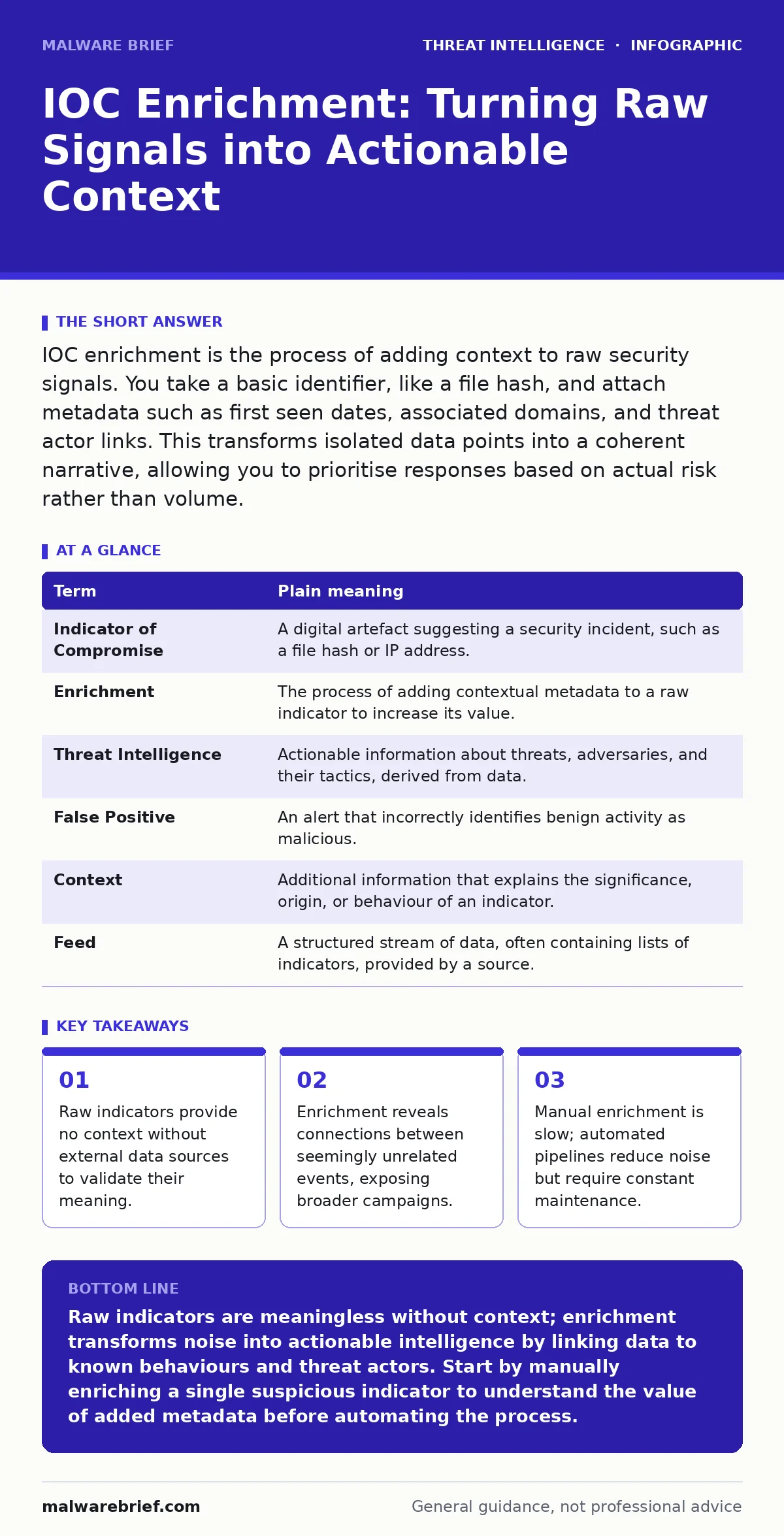
IOC enrichment is the process of adding context to raw security signals. You take a basic identifier, like a file hash, and attach metadata such as first seen dates, associated domains, and threat actor links. This transforms isolated data points into a coherent narrative, allowing you to prioritise responses based on actual risk rather than volume.
The Postcard Analogy
Imagine you receive a postcard from an unknown sender. The postcard contains only a single sentence and a return address. On its own, this message is ambiguous. It could be a friendly note, a marketing flyer, or a threat. You cannot determine the sender’s intent or risk level from the paper alone. You must research the return address, check if the postmark matches the location, and see if others have received similar cards. This research process is enrichment. Without it, you are reacting to ink on paper, not to the person behind it.
In cybersecurity, you rarely receive complete stories. You receive fragments. These fragments are known as indicators of compromise. An indicator of compromise is any observable artefact that suggests a security breach has occurred. Common examples include IP addresses, domain names, file hashes, and URLs. Like the postcard, a single IP address tells you very little. It might be a compromised server, a legitimate cloud provider, or a misconfigured printer. Enrichment is the act of gathering additional data to understand what that IP represents.
Defining the Components
Before you can enrich an indicator, you must understand the terminology. The following table clarifies the core concepts used in threat intelligence workflows.
| Term | Plain meaning |
|---|---|
| Indicator of Compromise | A digital artefact suggesting a security incident, such as a file hash or IP address. |
| Enrichment | The process of adding contextual metadata to a raw indicator to increase its value. |
| Threat Intelligence | Actionable information about threats, adversaries, and their tactics, derived from data. |
| False Positive | An alert that incorrectly identifies benign activity as malicious. |
| Context | Additional information that explains the significance, origin, or behaviour of an indicator. |
| Feed | A structured stream of data, often containing lists of indicators, provided by a source. |
The Hidden Cost of Volume
You might assume that more data equals better security. This is a common misconception. Raw data without context creates noise. When you ingest thousands of unenriched indicators, your security team spends most of their time filtering false positives. They are looking for the postcard in a stack of flyers. This leads to alert fatigue, where analysts ignore warnings because they rarely result in action.
Enrichment solves this by adding weight. If an IP address is linked to a known campaign involving credential dumping, it becomes high priority. If the same IP is merely hosting a benign blog, it is low priority. The mechanism here is correlation. You are connecting the indicator to known behaviours. This reduces the cognitive load on the analyst. You move from asking "is this malicious?" to "how dangerous is this?".
Practical Enrichment Steps
You can begin enriching indicators immediately, even with basic tools. The following steps outline a simple workflow.
- Collect the raw indicator: Identify a suspicious element, such as a domain name from a log entry.
- Query external sources: Use open-source intelligence platforms to check the domain’s age, registration details, and associated IP history.
- Apply context: Determine if the domain was created recently and points to a known malicious infrastructure. Document this context in your ticketing system.
The Non-Obvious Failure Mode
Enrichment is not a one-time event. Indicators decay over time. An IP address used for malware distribution today might be reassigned to a legitimate business next month. If you rely on stale data, you will block legitimate traffic. This is known as indicator churn. You must refresh your enrichment data regularly.
Another hidden cost is the assumption of neutrality. Some data sources have biases. They may flag certain regions or technologies more aggressively than others. If you do not understand the bias in your enrichment source, you may inadvertently discriminate against benign users. You must validate critical findings with multiple sources. Relying on a single feed is dangerous. It is like trusting one person’s opinion of the postcard sender.
See also: Threat Actors Explained: Motives, Methods and Misconceptions · Pass-the-Hash Attacks: Mechanics, Risks and Mitigation
Integrating with Broader Tactics
Enrichment helps you map indicators to specific tactics. For example, if you find a hash associated with a tool used for remote desktop abuse, you know the attacker is trying to gain persistent access. This changes your response. You do not just delete the file; you check all remote desktop sessions.
Similarly, if an indicator is linked to scheduled task abuse, you know the attacker is trying to maintain persistence by automating their access. This requires you to review task schedulers across your network. Understanding the tactic behind the indicator allows you to anticipate the next move. You are no longer just cleaning up; you are disrupting the attacker’s workflow.
The Human Element
Technology can gather data, but humans must interpret it. An enrichment tool might tell you that a file hash has been seen before. It might not tell you that the file is a common system library that has been slightly modified. This requires expert analysis. You must train your team to look beyond the label.
Consider the difference between a generic virus and a targeted attack. A generic virus might use common indicators. A targeted attack might use custom tools with no prior history. Enrichment helps you spot the anomaly. If an indicator has no history, it might be new. This requires a different response strategy. You must investigate deeper, rather than relying on historical data.
Moving Beyond Basics
As you become more proficient, you will notice that some threats operate in the shadows. Bulletproof hosting services often obscure the true location of malicious infrastructure. Enrichment data might point to a proxy, not the origin. You must dig deeper to find the root cause.
Also, be aware of hacktivism groups that may use compromised systems to launch attacks. These indicators might look different from state-sponsored threats. They may be less sophisticated but more numerous. Enrichment helps you categorise the threat actor. This categorisation informs your defensive posture. You do not defend against all threats in the same way.
Key takeaways
- Raw indicators provide no context without external data sources to validate their meaning.
- Enrichment reveals connections between seemingly unrelated events, exposing broader campaigns.
- Manual enrichment is slow; automated pipelines reduce noise but require constant maintenance.
Raw indicators are meaningless without context; enrichment transforms noise into actionable intelligence by linking data to known behaviours and threat actors. Start by manually enriching a single suspicious indicator to understand the value of added metadata before automating the process.
Frequently asked questions
What is the difference between an IOC and threat intelligence?
An IOC is a specific data point like an IP address. Threat intelligence is the broader context and analysis that explains why that IP is significant and what to do about it.
Can I automate IOC enrichment completely?
You can automate the data gathering, but human analysis is still required to interpret the context and handle edge cases where automated tools fail or produce false positives.
How often should I update my enrichment data?
You should update your data as frequently as possible, ideally in real-time, because indicators change status quickly and stale data leads to false positives and missed threats.
Is open-source enrichment reliable?
Open-source enrichment is valuable but varies in quality. You should cross-reference multiple sources to validate findings, as no single open-source provider is infallible or unbiased.
How this guide was produced: written by the Malware Brief editorial team with AI assistance, checked against the public references listed below, and reviewed when the facts change. See our editorial policy or report an error.