Incident Response Plans: Real Benefits and Hidden Costs
A written plan often slows down initial response by forcing rigid procedures that ignore the unique context of a live breach.

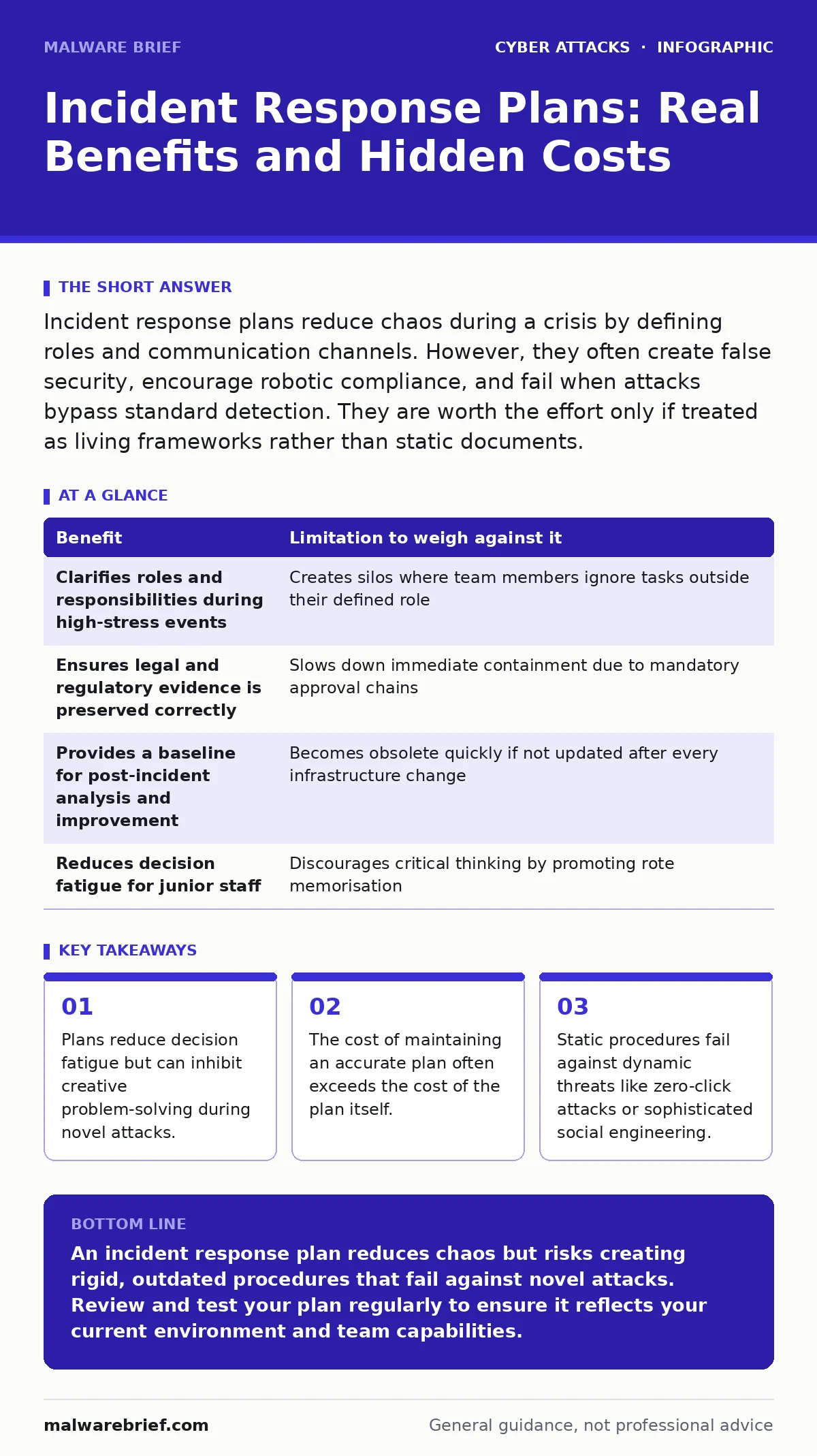
Incident response plans reduce chaos during a crisis by defining roles and communication channels. However, they often create false security, encourage robotic compliance, and fail when attacks bypass standard detection. They are worth the effort only if treated as living frameworks rather than static documents.
The Illusion of Control
An incident response plan is a documented set of procedures for handling a security breach. It aims to limit damage and reduce recovery time. Many organisations view this document as a shield against chaos. This view is incorrect. The plan does not stop the attack. It only dictates how you react after the breach has occurred.
The primary benefit is structure. When systems fail, human cognition degrades under stress. A plan provides a script for action. It tells you who calls whom and what evidence to preserve. This reduces panic. However, this structure comes with a hidden cost: rigidity. If the plan assumes a specific type of attack, it may lead you to ignore evidence that does not fit the model.
When Procedure Overrides Reality
Imagine a scenario where a server begins sending unusual outbound traffic. Your plan states you must isolate the server immediately. You follow the instruction. The isolation cuts off the attacker, but it also destroys the volatile memory evidence needed to identify the command and control server. You have contained the symptom but lost the cause.
This is the danger of prescriptive plans. They encourage checkbox compliance. You follow the steps, so you are "doing the right thing." Yet the outcome is suboptimal. The plan failed because it prioritised procedure over context. In security, context is everything. A rigid plan cannot account for every variable in a live environment.
| Benefit | Limitation to weigh against it |
|---|---|
| Clarifies roles and responsibilities during high-stress events | Creates silos where team members ignore tasks outside their defined role |
| Ensures legal and regulatory evidence is preserved correctly | Slows down immediate containment due to mandatory approval chains |
| Provides a baseline for post-incident analysis and improvement | Becomes obsolete quickly if not updated after every infrastructure change |
| Reduces decision fatigue for junior staff | Discourages critical thinking by promoting rote memorisation |
The Maintenance Trap
A plan is only useful if it reflects your current environment. This creates a continuous maintenance burden. Every time you add a new service, change a vendor, or update a firewall rule, the plan may become inaccurate. Most organisations fail to update their plans. They write the document once and file it away.
An outdated plan is worse than no plan. It gives false confidence. You believe you are prepared because the document exists. When a crisis hits, you follow instructions that no longer work. You try to contact a team that has been disbanded or reference a server that no longer exists. This delay increases the dwell time of the attacker.
When It Is Worth It
An incident response plan is worth the investment when your organisation has complex dependencies. If your systems interact with external partners, legal entities, or critical infrastructure, the communication aspect of the plan is valuable. It ensures that external stakeholders are notified in a coordinated manner. This prevents contradictory statements that damage trust.
It is also worth it for large teams. When many people are involved, ambiguity is dangerous. A plan defines who has the authority to shut down systems. This prevents conflicting actions. One person tries to restore service while another tries to preserve evidence. The plan establishes a chain of command that resolves these conflicts.
When It Is Not
For small, isolated systems, a formal plan is often a waste of resources. If you have a single server and a small team, the overhead of writing and maintaining a plan exceeds the benefit. In these cases, a simple runbook is sufficient. A runbook is a technical checklist for specific tasks. It is easier to maintain and more practical than a broad policy document.
It is not worth it if the culture does not support it. If your team is not trained to use the plan, it will sit unused. You cannot force adoption through documentation. If the team prefers ad-hoc reactions, a formal plan will be ignored. In such cases, focus on improving security culture first. Without buy-in, the plan is just paper.
See also: Scheduled Task Abuse Response: Containment and Recovery Steps · Web Shell Removal: Containment, Eradication and Recovery
Beyond the Document
A plan is not a static artifact. It is a framework for thinking. The value lies in the discussions it generates. When you write the plan, you identify gaps in your monitoring. You realise you do not have logs for a critical system. You discover that your backup process is untested. These insights are more valuable than the final document.
Treat the plan as a hypothesis. Test it through tabletop exercises. Simulate a breach and see where the plan breaks. Note where people hesitate or disagree. Update the plan based on these observations. This iterative process builds muscle memory. It prepares the team for the unpredictability of real attacks.
Adapting to Novel Threats
Standard plans often fail against novel attack vectors. Consider the rise of MFA fatigue attacks, where attackers bombard users with authentication requests. A standard plan might focus on detecting unusual login locations. It may not address the social engineering aspect of the attack. The plan fails because it assumes the breach is technical, not psychological.
Similarly, plans often overlook the human element of formjacking. This is when malicious scripts steal data from web forms. If your plan focuses only on server logs, you may miss the client-side compromise. You need to adapt your plan to include browser-level telemetry and user behaviour analysis. The plan must evolve to cover the entire attack surface, not just the perimeter.
The Role of Communication
The most critical part of any plan is communication. Technical steps are secondary. If you cannot communicate clearly, you cannot coordinate. The plan must define how information flows. Who speaks to the press? Who talks to legal? Who updates the technical team?
Miscommunication during a breach can cause more damage than the breach itself. Contradictory statements erode trust. Silence breeds speculation. A clear communication protocol ensures that everyone receives the same information at the same time. This reduces confusion and allows for faster decision-making.
Final Considerations
An incident response plan is a tool, not a solution. It does not prevent breaches. It only manages the aftermath. The goal is to minimise impact, not to achieve perfection. Accept that some breaches will slip through. The plan helps you recover faster and learn from the experience.
Focus on clarity and simplicity. A complex plan is rarely followed. A simple plan that is well-understood is powerful. Keep it concise. Remove jargon. Ensure every team member knows their role. Test it regularly. Update it constantly. The plan is only as good as the last time you reviewed it.
Key takeaways
- Plans reduce decision fatigue but can inhibit creative problem-solving during novel attacks.
- The cost of maintaining an accurate plan often exceeds the cost of the plan itself.
- Static procedures fail against dynamic threats like zero-click attacks or sophisticated social engineering.
An incident response plan reduces chaos but risks creating rigid, outdated procedures that fail against novel attacks. Review and test your plan regularly to ensure it reflects your current environment and team capabilities.
Frequently asked questions
How often should I update my incident response plan?
Update it after every significant infrastructure change, every tabletop exercise, and after every real or simulated incident. There is no fixed schedule; changes in your environment dictate the need for updates.
Do I need a plan if I use cloud services?
Yes. Cloud services shift responsibility but do not eliminate it. You still need to define how you respond to breaches within your layer of control. The plan must account for shared responsibility models.
What is the difference between a plan and a runbook?
A plan is a high-level strategy defining roles and communication. A runbook is a technical checklist for specific actions, such as resetting a password or isolating a server. You need both.
How do I handle SIM swapping in my response plan?
Include procedures for verifying identity through secondary channels. Assume phone-based verification is compromised. Use out-of-band communication methods to confirm critical actions.
How this guide was produced: written by the Malware Brief editorial team with AI assistance, checked against the public references listed below, and reviewed when the facts change. See our editorial policy or report an error.