Intelligence Cycle Diagram: How the Loop Drives Security Decisions
The intelligence cycle diagram reveals that analysis creates value, not collection, and that ignoring feedback loops guarantees repeated failures in defensive operations.
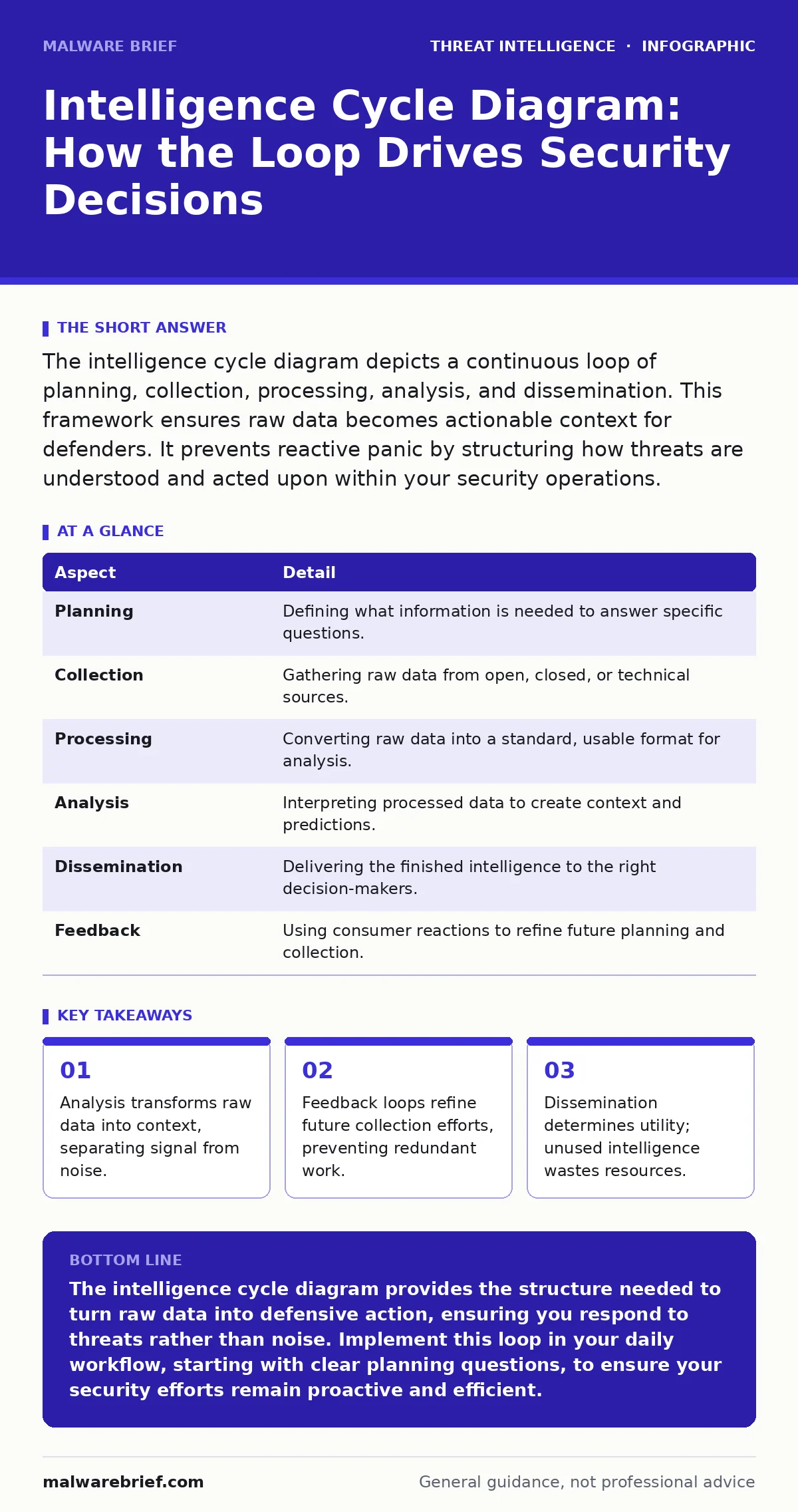
The intelligence cycle diagram depicts a continuous loop of planning, collection, processing, analysis, and dissemination. This framework ensures raw data becomes actionable context for defenders. It prevents reactive panic by structuring how threats are understood and acted upon within your security operations.
The Intelligence Cycle Diagram Explained
Imagine a chef preparing a complex meal. The chef does not simply buy every ingredient available. They plan the menu, select specific items, wash and chop them, cook them with precision, and serve the dish. If the guests dislike the saltiness, the chef notes this for next time. The intelligence cycle diagram maps this exact process onto security operations. It turns chaotic data into structured knowledge.
This loop prevents teams from drowning in alerts. It provides a repeatable method for understanding adversarial behaviour. The cycle is not linear. It is a continuous spiral. Each iteration improves the quality of the next. You start with a requirement. You end with an answer. Then you start again with a better question. This structure applies to any organisation facing persistent threats.
| Aspect | Detail |
|---|---|
| Planning | Defining what information is needed to answer specific questions. |
| Collection | Gathering raw data from open, closed, or technical sources. |
| Processing | Converting raw data into a standard, usable format for analysis. |
| Analysis | Interpreting processed data to create context and predictions. |
| Dissemination | Delivering the finished intelligence to the right decision-makers. |
| Feedback | Using consumer reactions to refine future planning and collection. |
The diagram often appears as a circle with arrows. Each arrow represents a hand-off. The value lies in the transitions. If one stage fails, the entire chain breaks. You cannot analyse what you did not collect. You cannot act on what you did not disseminate. This model removes ambiguity from security tasks. It clarifies who owns each step.
It highlights where bottlenecks occur. Most teams struggle at the analysis stage. They have too much data and too little context. The cycle forces you to define the problem before looking for solutions. This prevents confirmation bias. It stops you from searching for evidence that supports a pre-existing belief. You search for evidence that answers the question.
How the Cycle Works in Practice
The process begins with direction. You must know what you are looking for. This is the planning phase. You define the intelligence requirement. Is there a new vulnerability in your stack? Are there signs of remote desktop abuse in your logs? A vague requirement leads to vague results. Specific questions yield specific answers.
Once you have the question, you move to collection. You gather raw indicators. These might be network logs, public reports, or internal alerts. Collection is often the loudest phase. It generates the most noise. You must be disciplined here. Do not collect everything. Collect only what helps answer the question. Unnecessary data clutters your processing stage. It slows down the entire cycle.
Processing comes next. Raw data is rarely useful in its native form. Logs need parsing. Images need OCR. Encrypted traffic needs decryption keys. You normalise the data into a common format. This allows your tools and people to handle it consistently. Without processing, analysts spend their time fixing data rather than understanding it. Blue team operations rely heavily on this stage.
Automated pipelines can handle much of this work. Manual intervention is reserved for complex cases. The goal is efficiency. You want to spend minimal time cleaning data. You want to spend maximum time thinking. This balance is difficult to achieve. It requires robust tooling and clear standards.
Analysis is the core of the cycle. This is where data becomes intelligence. You connect the dots. You look for patterns. You assess likelihood and impact. You ask why an event happened. You ask what it means for your organisation. This stage requires human judgement. Algorithms can flag anomalies. They cannot explain intent. You must interpret the context.
Is this a known threat actors pattern? Is it a new technique? You compare the data against your baseline of normal activity. Deviations are interesting. Not all deviations are malicious. Context separates noise from signal. You produce a product. This product is a hypothesis or a conclusion. It answers the original question. It provides a basis for action.
Dissemination delivers the product to the consumer. The consumer might be a system administrator, a manager, or an automated system. The format must match the audience. A technical alert goes to an engineer. A risk summary goes to a director. Timing matters. Intelligence has a shelf life. Delayed information is often useless. You must trust the consumer to act. If they do not act, the cycle fails. You must ensure the product is accessible. It must be clear. It must be concise. Jargon alienates readers. Ambiguity causes hesitation. You want clarity. You want speed. The product should enable a decision. It should not create more questions. It should close the loop.
Who It Affects and Why It Matters
The intelligence cycle affects every role in security. It structures the work of analysts. It guides the actions of responders. It informs the decisions of leaders. It shapes the strategy of the organisation. Without this cycle, security is reactive. You wait for breaches. You patch after exploits. You fire after incidents. This approach is expensive. It damages reputation. It erodes trust. The cycle makes security proactive. You anticipate threats. You harden systems before attacks. You train staff on likely scenarios. You reduce the attack surface.
You improve your resilience. This matters for students entering the field. It teaches you to think systematically. It moves you beyond tool usage. It focuses on problem solving. You learn to ask the right questions. You learn to verify your answers. You learn to communicate effectively. These skills endure. Tools change. Techniques evolve. The cycle remains constant. It is the foundation of professional security. It separates amateurs from experts. It brings order to chaos. It provides a map for navigation. You need this map. The terrain is complex. The stakes are high.
What People Usually Get Wrong
Many teams treat collection as the end goal. They hoard data. They believe more data equals better security. This is false. Data without context is liability. It costs storage. It costs processing power. It creates alert fatigue. You must collect with purpose. You must discard what you do not need. Another common error is skipping analysis. Teams pass raw alerts to responders.
They expect responders to interpret the noise. This overwhelms responders. It leads to missed threats. Analysis must happen before dissemination. You must do the hard work upfront. You must provide context. You must offer recommendations. Do not dump data on your colleagues. Do not assume they have the bandwidth. Respect their time. Provide finished intelligence.
Feedback is often ignored. Teams run the cycle once. They do not revisit their assumptions. They do not ask consumers if the product was useful. This stagnation leads to drift. Your requirements become outdated. Your collection methods become inefficient. Your analysis becomes stale. You must close the loop. You must seek feedback. You must adapt. This requires humility. It requires a culture of continuous improvement. Do not defend your output. Improve it. Listen to criticism. Learn from mistakes. The cycle is a tool for learning. It is not a badge of honour. Use it to grow. Use it to refine. Use it to stay ahead.
Common Pitfalls in the Diagram
The intelligence cycle diagram can become a bureaucratic hurdle. Teams may focus on the process rather than the outcome. They may spend hours on planning when minutes suffice. They may over-engineer collection when simple checks work. Balance is key. Adapt the cycle to the threat. High-value threats require rigorous cycles. Low-value noise requires rapid, lightweight cycles.
Do not apply the same depth to every alert. Prioritise based on risk. Another pitfall is siloed execution. One team plans. Another collects. Another analyses. Hand-offs create delays. Information gets lost. Context evaporates. Integrate the cycle into your workflow. Use shared platforms. Use common language. Break down silos. Collaboration accelerates the cycle. It improves accuracy. It builds shared understanding.
Automation can distort the cycle. SOAR platforms can automate collection and processing. They can even assist with analysis. But they cannot replace human judgement. Over-automation leads to blind spots. You may miss novel threats. You may misclassify benign activity. Keep humans in the loop. Use automation for scale. Use humans for nuance. Validate automated decisions. Audit your logic. Ensure your rules reflect reality. Technology supports the cycle. It does not own it. You own it. You are responsible for the output. You are accountable for the decisions. Stay engaged. Stay critical. Stay curious.
See also: How Bulletproof Hosting Operates: The Technical Lifecycle · IOC Enrichment: Turning Raw Signals into Actionable Context
Integrating Related Security Concepts
The cycle connects to many other security practices. Understanding indicators of compromise is vital for the collection stage. These are artifacts of an attack. You must know what to look for. You must know how to recognise them. They feed into your analysis. They help you confirm hypotheses. Attack path analysis relies on the output of the cycle. You need intelligence to map potential paths. You need context to prioritise risks.
The cycle provides this foundation. It ensures your analysis is grounded in reality. It prevents guesswork. It ensures your defences target actual threats. It aligns your efforts with adversary behaviour. This integration creates a cohesive security posture. It eliminates gaps. It reduces redundancy. It maximises impact. You build a system that works together. Each part supports the others. The whole is greater than the sum of its parts.
Key takeaways
- Analysis transforms raw data into context, separating signal from noise.
- Feedback loops refine future collection efforts, preventing redundant work.
- Dissemination determines utility; unused intelligence wastes resources.
The intelligence cycle diagram provides the structure needed to turn raw data into defensive action, ensuring you respond to threats rather than noise. Implement this loop in your daily workflow, starting with clear planning questions, to ensure your security efforts remain proactive and efficient.
Frequently asked questions
How do I start using the intelligence cycle in my job?
Begin by defining one specific intelligence requirement for your current project. Follow the steps of collection, processing, and analysis for this single item. Document the outcome and seek feedback. Repeat this process until it becomes habitual.
Is the intelligence cycle only for large organisations?
No. The cycle is a logical framework that scales. Individuals can use it to personalise their research. Small teams can apply it to local incidents. The complexity of your tools may vary, but the logic remains the same.
What is the difference between data and intelligence?
Data is raw facts without context. Intelligence is processed and analysed data that answers a specific question. Data tells you what happened. Intelligence tells you why it matters and what to do next.
How does this relate to threat intelligence?
Threat intelligence is the product of the cycle. It is the output. The cycle is the process. You use the cycle to produce threat intelligence. Without the process, you only have data. With the process, you have actionable insights.
How this guide was produced: written by the Malware Brief editorial team with AI assistance, checked against the public references listed below, and reviewed when the facts change. See our editorial policy or report an error.