VPN Gateway and ADC Vulnerability Myths Explained
Security appliances often fail because administrators treat them as static network boundaries rather than complex application servers requiring constant code and configuration scrutiny.

VPN gateways and application delivery controllers are not immune to vulnerabilities simply because they sit at the network edge. False beliefs about their security posture often lead to neglected patches, weak configurations, and overlooked application-layer flaws that attackers exploit.
Myth: The device is secure because it is at the network perimeter
Reality: Placing a device at the network edge does not make it immune to compromise. Attackers actively target these components because they control access to internal resources. The perimeter is no longer a hard boundary; it is a point of intense scrutiny and attack surface exposure.
Imagine an attacker scanning for open ports on your public IP range. They find a VPN gateway management interface. If that interface has a known vulnerability, the attacker gains entry regardless of how strong your internal firewall rules are. The device itself becomes the breach point.
Myth: Only the operating system needs patching
Reality: The firmware, management console, and any embedded web applications require separate updates. These components often have distinct vulnerability lifecycles. A patch for the kernel does not fix a flaw in the login page or the SSL termination logic.
Many administrators focus solely on the base OS version. They ignore the web server running the administration panel. This oversight leaves critical entry points open. Regular updates for all components are necessary. See the guide on end-of-life software for details on managing unsupported components.
Myth: Default configurations are safe for production use
Reality: Factory settings often prioritise ease of setup over security. This includes default credentials, open management ports, and verbose error messages. Leaving these defaults in place provides attackers with immediate, known entry points.
Suppose you deploy a new application delivery controller. It ships with a default admin password. An attacker tries common credentials and gains full control. You must change defaults immediately. This practice mirrors the risks associated with hard-coded credentials in custom applications.
Myth: Encryption protects against all application-layer attacks
Reality: TLS encryption secures data in transit but does not validate the content of that data. Malicious payloads can be encrypted and sent directly to the application logic. The device processes the request, potentially executing code or crashing the service.
Consider an XML external entity (XXE) attack. The attacker sends a specially crafted XML document. The device parses it, leading to data leakage or server-side request forgery. Encryption hides the payload from network monitors, but the application still processes the malicious input. Proper input validation is required.
Myth: Internal networks are isolated from external threats
Reality: Compromised VPN gateways provide direct access to internal networks. Once an attacker is inside, lateral movement becomes possible. The assumption of internal safety fails when the gateway itself is the entry point.
Imagine a user connects via the VPN. The gateway is compromised. The attacker now has a foothold inside the trusted network. They can scan for other vulnerabilities, move laterally, and exfiltrate data. The internal network is only as secure as the gateway protecting it.
Myth: Security appliances do not run exploitable code
Reality: These devices run complex software stacks, including web servers, databases, and scripting engines. Any code that processes input is vulnerable to injection attacks, buffer overflows, and logic flaws. Treating them as "dumb" hardware is a dangerous misconception.
Suppose the device uses a JavaScript engine for its dashboard. A prototype pollution vulnerability could allow an attacker to modify object properties. This leads to privilege escalation or remote code execution. See the guide on prototype pollution for more details on this class of vulnerability.
Myth: Automated tools find all vulnerabilities
Reality: Scanners miss logic flaws, configuration errors, and business logic vulnerabilities. They also struggle with encrypted traffic and complex application flows. Manual review and threat modelling are necessary supplements to automated testing.
Imagine a scanner reports no high-severity issues. An attacker still finds a way to bypass authentication by manipulating session tokens. The scanner did not understand the application logic. You must combine automated scans with manual review. See the guide on software composition analysis for managing third-party code risks.
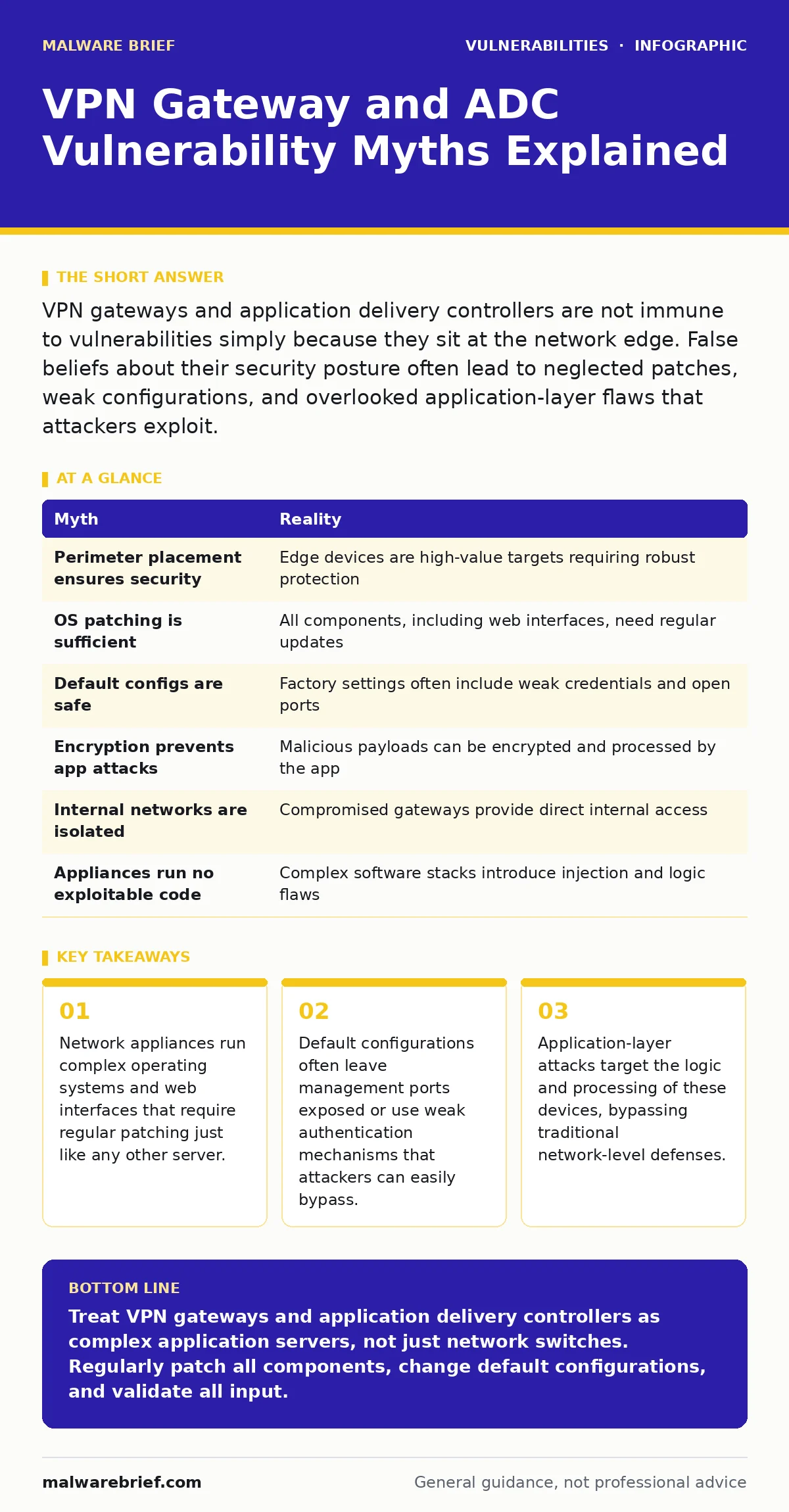
| Myth | Reality |
|---|---|
| Perimeter placement ensures security | Edge devices are high-value targets requiring robust protection |
| OS patching is sufficient | All components, including web interfaces, need regular updates |
| Default configs are safe | Factory settings often include weak credentials and open ports |
| Encryption prevents app attacks | Malicious payloads can be encrypted and processed by the app |
| Internal networks are isolated | Compromised gateways provide direct internal access |
| Appliances run no exploitable code | Complex software stacks introduce injection and logic flaws |
Key takeaways
- Network appliances run complex operating systems and web interfaces that require regular patching just like any other server.
- Default configurations often leave management ports exposed or use weak authentication mechanisms that attackers can easily bypass.
- Application-layer attacks target the logic and processing of these devices, bypassing traditional network-level defenses.
Treat VPN gateways and application delivery controllers as complex application servers, not just network switches. Regularly patch all components, change default configurations, and validate all input.
Frequently asked questions
How often should I patch VPN gateways?
Apply security patches as soon as they are available and tested. Critical vulnerabilities should be addressed immediately. Routine patches can follow a scheduled maintenance window.
Can I use a VPN gateway to hide my IP address?
VPNs mask your public IP address from websites you visit. However, your VPN provider can still see your traffic. This does not provide anonymity from the provider or law enforcement with a warrant.
What is the difference between a VPN and an ADC?
A VPN creates a secure tunnel for remote access. An ADC manages and optimises traffic for web applications. Both can have vulnerabilities, but their primary functions differ.
Are cloud-based VPNs more secure?
Cloud providers offer robust infrastructure, but security is a shared responsibility. You must still configure the service correctly, manage access controls, and keep client software updated.
How this guide was produced: written by the Malware Brief editorial team with AI assistance, checked against the public references listed below, and reviewed when the facts change. See our editorial policy or report an error.