Software Composition Analysis Checklist for Secure Dependencies
Most application vulnerabilities originate in third-party libraries rather than your own source code, making dependency tracking the primary defence against supply chain attacks.
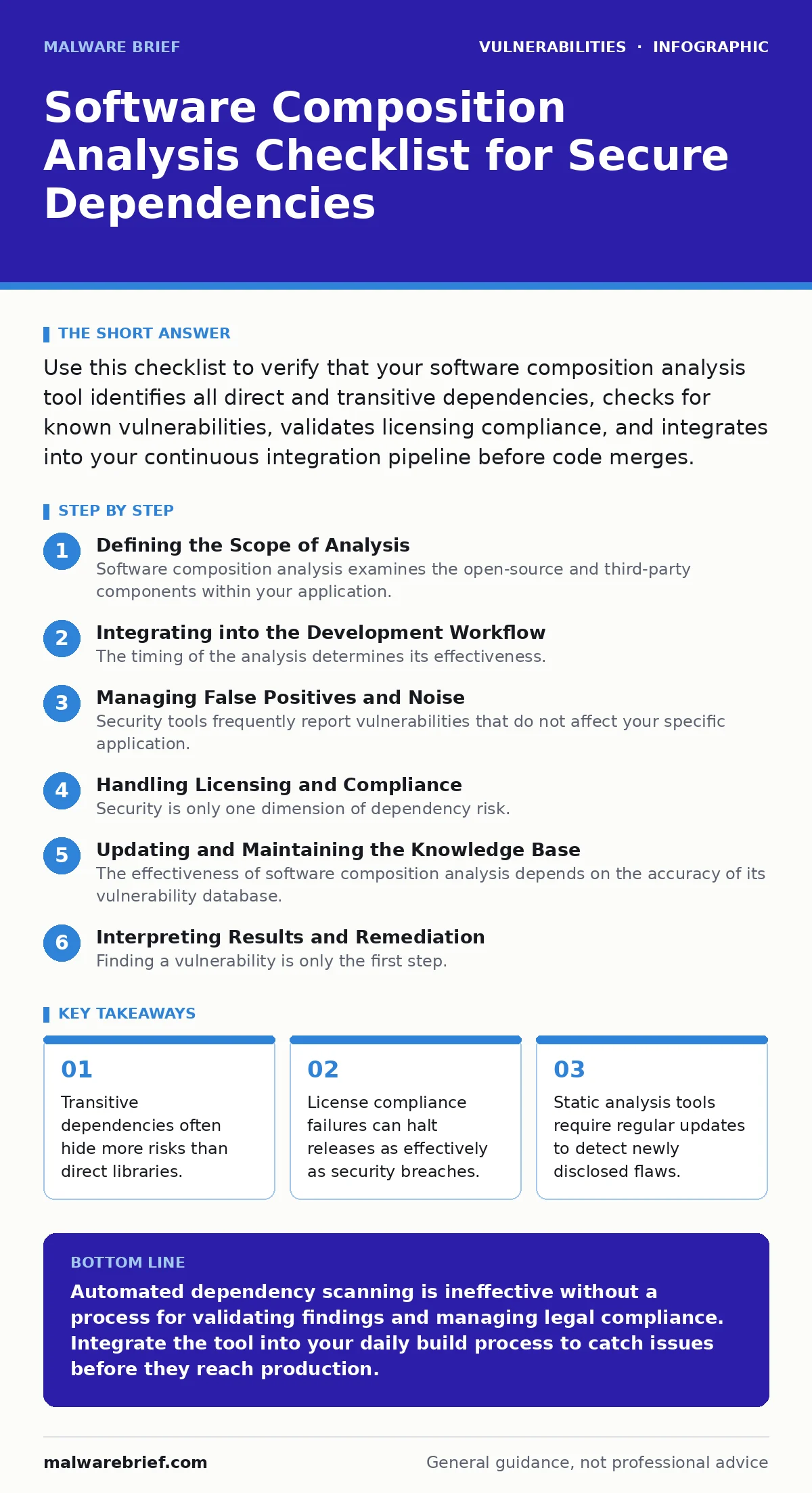
Use this checklist to verify that your software composition analysis tool identifies all direct and transitive dependencies, checks for known vulnerabilities, validates licensing compliance, and integrates into your continuous integration pipeline before code merges.
Defining the Scope of Analysis
Software composition analysis examines the open-source and third-party components within your application. You must determine whether the tool scans only direct dependencies or also traces transitive dependencies. Transitive dependencies are libraries required by the libraries you explicitly use. Ignoring these creates blind spots where a secure direct library relies on a vulnerable underlying component.
- Include transitive dependencies in the scan: Direct libraries often pull in older, unpatched sub-components that introduce risk.
- Cover all build artefacts: Scanning only source code misses vulnerabilities present in compiled binaries or container images.
- Identify internal private repositories: Commercial tools often miss internal packages that are not published to public registries.
Integrating into the Development Workflow
The timing of the analysis determines its effectiveness. Running checks only before production deployment allows vulnerabilities to persist through development and testing phases. You should integrate the scanner into your continuous integration pipeline. This ensures that every code commit triggers an assessment. Developers receive immediate feedback rather than facing a backlog of issues at release time.
- Trigger scans on every pull request: Early detection prevents vulnerable code from merging into the main branch.
- Set strict policy gates: Configure the pipeline to fail builds when critical vulnerabilities are detected, enforcing security standards.
- Exclude non-production environments from blocking: Preventing local development builds from failing due to minor issues maintains developer velocity.
Managing False Positives and Noise
Security tools frequently report vulnerabilities that do not affect your specific application. A library may contain a vulnerable function, but your code never calls that function. This is known as a false positive in the context of usage. If you do not filter these out, your team will ignore legitimate alerts due to fatigue. You must establish a process for validating findings. This involves checking whether the vulnerable code path is actually reachable in your application logic.
- Verify reachability of vulnerable code: Confirm that your application actually invokes the affected functions or classes.
- Maintain a suppression list for known false positives: Document why specific alerts are ignored to prevent future confusion.
- Review component usage context: A vulnerability in a command-line tool library is irrelevant if you only use it for data processing.
Handling Licensing and Compliance
Security is only one dimension of dependency risk. Legal exposure from incompatible licences can stop a product launch. Some open-source licences require you to release your own source code if you distribute the software. Others prohibit commercial use entirely. Your analysis tool must track licence types for every component. You need to map these licences against your organisation’s legal requirements. This prevents accidental inclusion of copyleft or restrictive software.
- Audit licence compatibility: Ensure third-party licences do not conflict with your proprietary distribution model.
- Track licence changes over time: Open-source projects sometimes change their licences, altering legal obligations for existing users.
- Document approved licence categories: Create a whitelist of acceptable licences to streamline the review process for developers.
Updating and Maintaining the Knowledge Base
The effectiveness of software composition analysis depends on the accuracy of its vulnerability database. These databases update frequently as new flaws are disclosed. If your tool uses an outdated index, it will miss recent threats. You must ensure the scanner connects to live sources or updates its local database regularly. This relates directly to how you handle patch management for the tooling itself. You should also consider how backported security fixes might affect your assessment, as some vendors apply patches without changing version numbers.
- Automate database updates: Configure the tool to fetch the latest vulnerability data without manual intervention.
- Verify source of intelligence: Ensure the tool draws from recognised standards like the Common Vulnerabilities and Exposures list.
- Schedule regular re-scans: Dependencies may change subtly over time, requiring periodic full re-evaluations.
See also: Mitigations and Workarounds: Security Controls Without Patches · Backported Security Fixes: How They Work and Why They Matter
Interpreting Results and Remediation
Finding a vulnerability is only the first step. You must decide how to address it. Upgrading the component is the preferred solution, but it may break your application. In such cases, you might need to apply mitigations and workarounds to reduce risk until a proper fix is available. You should also check for end-of-life software in your dependency tree, as unsupported components will never receive security patches. This process connects closely with secure code review, as manual inspection can sometimes find issues that automated tools miss.
- Prioritise fixes by exploitability: Address vulnerabilities that are actively exploited or easily reachable first.
- Plan for component upgrades: Schedule time to test and integrate newer versions of vulnerable libraries.
- Document risk acceptance: If you cannot fix an issue immediately, record the decision and the compensating controls.
Validating Against Known Attack Vectors
Your analysis should extend beyond simple version checks. Some vulnerabilities require specific configurations to be exploitable. For example, XML external entity (XXE) attacks depend on how a parser is configured, not just its version. Your tool should be able to detect insecure configurations within third-party components. This requires a deeper level of analysis than basic signature matching. You should also review hard-coded credentials in dependencies, as some libraries may contain default or sample keys that attackers can exploit.
- Check for insecure default configurations: Identify libraries that enable dangerous features by default.
- Scan for embedded secrets: Detect API keys or passwords accidentally left in third-party source code.
- Evaluate dependency provenance: Verify that libraries are downloaded from trusted, official sources to prevent tampering.
Key takeaways
- Transitive dependencies often hide more risks than direct libraries.
- License compliance failures can halt releases as effectively as security breaches.
- Static analysis tools require regular updates to detect newly disclosed flaws.
Automated dependency scanning is ineffective without a process for validating findings and managing legal compliance. Integrate the tool into your daily build process to catch issues before they reach production.
Frequently asked questions
How often should I run software composition analysis?
Run it on every code commit and pull request to catch issues early, and perform full re-scans regularly to account for new vulnerability disclosures.
Can I trust open-source vulnerability databases?
They are generally reliable but may contain inaccuracies. Always validate findings by checking if the vulnerable code is actually used in your application.
What is the difference between SCA and SAST?
Software composition analysis checks third-party libraries, while static application security testing analyses your own source code for bugs.
Does SCA replace manual code review?
No, SCA handles dependencies, but you still need manual review for custom code logic and complex security architectures.
How this guide was produced: written by the Malware Brief editorial team with AI assistance, checked against the public references listed below, and reviewed when the facts change. See our editorial policy or report an error.