Dependency Updates for Small Teams: Practical Maintenance
Updating third-party code reveals hidden technical debt and configuration flaws that standard vulnerability scanners miss entirely.
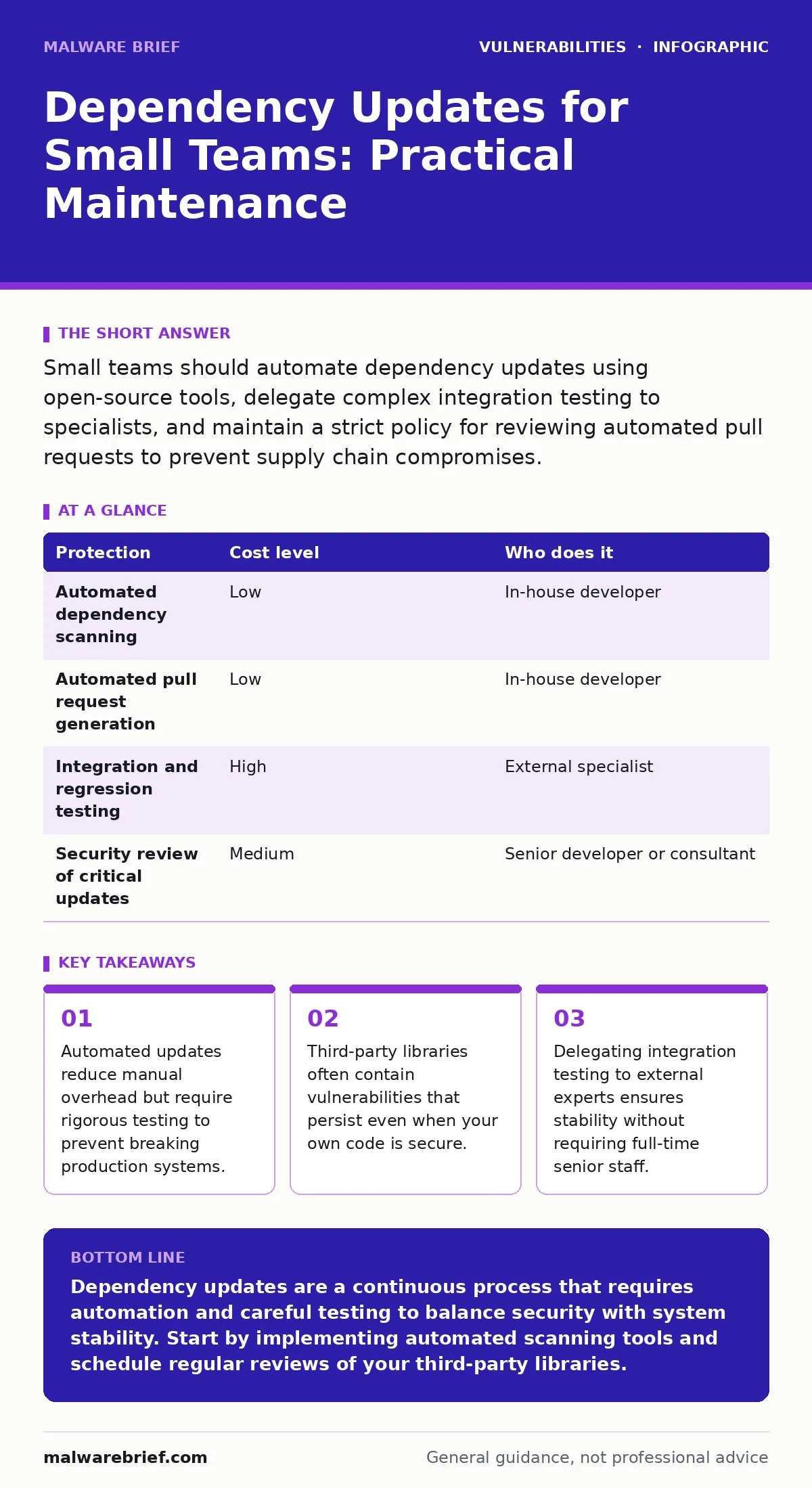
Small teams should automate dependency updates using open-source tools, delegate complex integration testing to specialists, and maintain a strict policy for reviewing automated pull requests to prevent supply chain compromises.
The Hidden Weight of Third-Party Code
When you build software or configure servers, you rarely write every line of code yourself. You rely on libraries, frameworks, and modules created by others. These are dependencies. In a small business, this reliance creates a specific risk profile. You do not control the security posture of the authors who maintain these components. If a dependency contains a flaw, your application inherits that flaw.
The scale of the problem is often misunderstood. Small teams assume that because their own codebase is small, their attack surface is manageable. This is incorrect. A ten-person company might use fewer internal scripts than a corporation, but their web application may depend on dozens of external packages. Each package is a potential entry point. The maintenance burden does not scale linearly with headcount. It scales with the number of external components you trust.
Why Manual Updates Fail at Scale
Relying on staff to manually check for updates is inefficient and prone to human error. Developers have finite attention. Security updates are often buried in changelogs or release notes that are easy to overlook. When an update arrives, it may introduce breaking changes. These are changes that alter how the software behaves, potentially causing your application to crash or behave unexpectedly.
Without a systematic approach, updates are delayed. Delays create windows of exposure. Attackers frequently exploit known vulnerabilities in popular libraries before many users have applied the fix. This period between the disclosure of a flaw and its widespread remediation is called the patch window. Small teams often lack the resources to monitor these windows actively. The result is a gradual accumulation of outdated software, known as technical debt, which becomes harder to resolve over time.
Affordable Automation Strategies
You do not need expensive commercial tools to manage dependencies. Open-source ecosystems provide robust solutions for detecting and proposing updates. Tools that scan your project’s configuration files can identify outdated packages. They can then create automated pull requests. A pull request is a mechanism in version control systems that allows developers to propose changes to a codebase for review.
These tools offer different levels of automation. Some simply alert you when an update is available. Others attempt to update the dependency and run your test suite automatically. For small teams, the latter is more valuable. It shifts the workload from discovery to verification. You still need to review the changes, but the tool handles the mechanical work of downloading and installing the new version. This approach is cost-effective and leverages existing development workflows.
| Protection | Cost level | Who does it |
|---|---|---|
| Automated dependency scanning | Low | In-house developer |
| Automated pull request generation | Low | In-house developer |
| Integration and regression testing | High | External specialist |
| Security review of critical updates | Medium | Senior developer or consultant |
The Cost of Breaking Changes
Automated updates are not foolproof. A library update might fix a security issue but change its API. An API, or application programming interface, defines how different software components interact. If the API changes, your code may no longer understand the new library. This leads to runtime errors. Your application might fail to start, or specific features might stop working.
This is the hidden cost of dependency management. The security benefit of an update can be negated if it breaks your service. Downtime affects customer trust and revenue. Small businesses often lack the redundancy to absorb significant outages. Therefore, you cannot simply apply every update blindly. You must verify that the update functions correctly within your specific environment. This verification process is called testing. Without it, automation becomes a liability rather than an asset.
What to Delegate to Specialists
Not all tasks require internal expertise. Testing is a prime candidate for delegation. If your team lacks the time or skill to perform thorough regression testing, consider hiring a specialist for periodic reviews. Regression testing ensures that new changes have not reactivated old bugs or broken existing functionality.
You can also delegate the initial assessment of complex updates. When a major version of a library is released, it may require significant code changes. A specialist can perform a secure code review of the integration points. This is distinct from a full audit. It focuses on how your code interacts with the new dependency. This targeted approach is more affordable than a complete security overhaul. It provides peace of mind without the overhead of a full-time security engineer.
See also: Policy as Code for Small Teams: Automate Cloud Rules · Mitigations and Workarounds: Security Controls Without Patches
Integrating with Patch Management
Dependency updates are a subset of broader patch management. Patch management refers to the process of installing updates to operating systems and applications. While they are related, they require different approaches. Operating system patches are usually binary files applied by the system administrator. Dependency updates are code changes applied by the developer.
Small teams often conflate these two processes. They may apply OS patches automatically but neglect library updates. This creates an imbalance in security posture. Your server might be secure, but your application remains vulnerable. You should treat dependency updates with the same discipline as OS patches. Schedule regular maintenance windows. Prioritise critical security fixes over feature updates. Refer to our guide on patch management for broader strategies on handling system-level updates.
Questions for IT Providers
If you outsource your IT support, you need clear questions to assess their capability. Vague promises are insufficient. You need to know how they handle the specific risks of third-party code. Ask these questions to ensure your provider understands the nuance of dependency management.
- How do you detect outdated dependencies in our web applications?
- What is your process for testing updates before applying them to production?
- Do you monitor for end-of-life software that no longer receives security updates?
- How do you handle updates that introduce breaking changes to our code?
- Can you provide a report of recent dependency updates and any issues encountered?
Building a Sustainable Routine
Sustainability comes from routine. Schedule dependency reviews as part of your regular development cycle. Do not treat them as ad-hoc tasks. Integrate automated scanning into your continuous integration pipeline. This ensures that every code change is checked for outdated dependencies.
You must also plan for end-of-life software. When a library is abandoned, it will no longer receive security fixes. You must replace it or fork it. A fork is a copy of the source code that you maintain independently. This is a significant commitment. It is better to identify abandoned dependencies early and plan for their replacement. Refer to our guide on end-of-life software for strategies on managing unsupported components.
By automating detection, delegating complex testing, and maintaining a strict review process, small teams can manage dependency risks effectively. The goal is not perfection. It is resilience. You accept that vulnerabilities will exist. You minimise the window of exposure and ensure that your systems remain functional during updates.
Key takeaways
- Automated updates reduce manual overhead but require rigorous testing to prevent breaking production systems.
- Third-party libraries often contain vulnerabilities that persist even when your own code is secure.
- Delegating integration testing to external experts ensures stability without requiring full-time senior staff.
Dependency updates are a continuous process that requires automation and careful testing to balance security with system stability. Start by implementing automated scanning tools and schedule regular reviews of your third-party libraries.
Frequently asked questions
How often should I update my dependencies?
Aim to update dependencies as soon as security patches are released. For non-critical updates, a monthly or quarterly schedule is usually sufficient to manage workload.
Can I automate all dependency updates?
No. Automated tools can propose updates, but you must review and test them. Blind automation risks breaking your application with incompatible changes.
What is the difference between a patch and a dependency update?
A patch usually refers to an update for an operating system or standalone application. A dependency update refers to changing a library or module used within your own code.
How do I know if a library is abandoned?
Check the repository for recent commits and issue responses. If there has been no activity for over a year and no active community fork, consider it abandoned.
How this guide was produced: written by the Malware Brief editorial team with AI assistance, checked against the public references listed below, and reviewed when the facts change. See our editorial policy or report an error.