3 Types of Insider Threats: Classifications, Detection and Mitigation Strategies
Most security controls assume external attackers, yet insiders bypass perimeter defences because they already hold valid credentials and system trust.
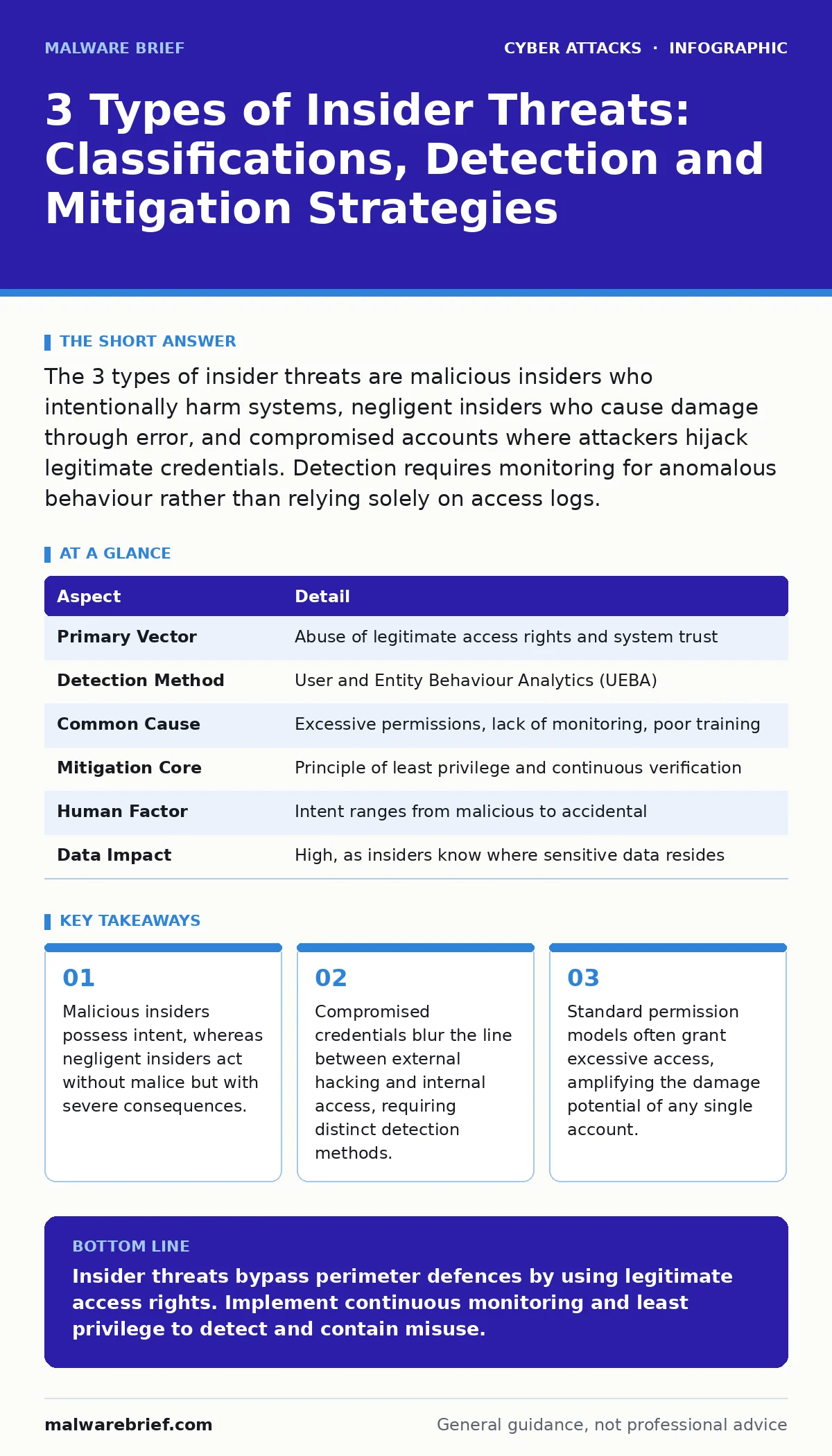
The 3 types of insider threats are malicious insiders who intentionally harm systems, negligent insiders who cause damage through error, and compromised accounts where attackers hijack legitimate credentials. Detection requires monitoring for anomalous behaviour rather than relying solely on access logs.
The Trust Boundary in Modern Security
Imagine a hotel where the cleaning staff holds master keys to every room. An external thief must break a window or pick a lock to enter. The cleaner walks in through the front door, uses a valid key, and closes it behind them. Security cameras record a legitimate entry. This analogy illustrates the fundamental problem with insider threats. You cannot secure a system by locking the doors if the people inside already have keys.
Insider threats arise from individuals who have legitimate access to an organisation’s data, networks, or physical infrastructure. This definition includes employees, contractors, vendors, and anyone granted temporary or permanent access rights. The threat is not defined by their employment status but by their ability to bypass perimeter defences using authorised credentials. Understanding this distinction changes how you design security controls. You stop looking for break-ins and start looking for misuse.
| Aspect | Detail |
|---|---|
| Primary Vector | Abuse of legitimate access rights and system trust |
| Detection Method | User and Entity Behaviour Analytics (UEBA) |
| Common Cause | Excessive permissions, lack of monitoring, poor training |
| Mitigation Core | Principle of least privilege and continuous verification |
| Human Factor | Intent ranges from malicious to accidental |
| Data Impact | High, as insiders know where sensitive data resides |
What Are the 3 Types of Insider Threats?
The 3 types of insider threats are malicious, negligent, and compromised. This classification helps you tailor detection and response strategies. Each type operates differently and requires a specific technical approach to identify and contain. You cannot treat a disgruntled employee the same way you treat a worker who forgot to lock their laptop.
Malicious insiders act with intent to cause harm. They may steal intellectual property, sabotage systems, or sell data to competitors. Their actions are deliberate and often planned. They know the security rules because they helped write them or work within them. They exploit blind spots in monitoring to hide their activities. Detection relies on spotting deviations from their normal baseline behaviour.
Negligent insiders cause damage through carelessness. They might click a link in a phishing kit email, leave a workstation unlocked, or misconfigure a cloud storage bucket. They do not intend to harm the organisation. Their actions create openings for external attackers or result in accidental data exposure. Training and automated guardrails reduce this risk, but human error remains unpredictable.
Compromised accounts involve external attackers who hijack legitimate credentials. The attacker is not an insider, but they operate as one. They use stolen passwords, session tokens, or MFA fatigue attacks to gain access. To the security system, the traffic looks like a legitimate user logging in from an unusual location. This type blurs the line between external intrusion and internal threat. You must monitor for impossible travel and credential anomalies.
How Insider Threats Bypass Traditional Defences
Traditional security focuses on perimeter defence. Firewalls and intrusion detection systems look for traffic from untrusted networks. Insiders originate from trusted networks. Their traffic matches expected patterns. This creates a visibility gap. You see valid logins and authorised file transfers. You do not see the context of why the action occurred.
Insiders know the architecture. They know which servers hold sensitive data. They know which monitoring tools are in place and which are not. A malicious insider can time their exfiltration during maintenance windows when alerts are suppressed. A negligent insider might use a personal USB drive because the official file transfer tool is slow. Both actions bypass standard controls because they use authorised methods.
The cost of this visibility gap is high. You assume safety because the user is known. This assumption fails when credentials are stolen or when trust is abused. You must implement defense in depth strategies that verify every action, not just every identity. Continuous monitoring checks whether the action makes sense for that role, at that time, from that device.
Who Is Affected by Insider Threats?
Every organisation with employees and digital data is affected. Small teams with shared credentials face higher risks because one person’s negligence exposes everyone. Large enterprises face complexity. Hundreds of roles mean hundreds of permission sets. Keeping track of who should access what becomes difficult.
Critical infrastructure sectors face severe consequences. A negligent configuration in a power grid control system can cause widespread outages. Financial institutions face regulatory penalties for data leaks. Healthcare providers risk patient privacy. The impact is not limited to data loss. Reputation damage and legal liabilities follow every incident.
Students entering the field often underestimate this risk. They focus on external exploits. Real-world security requires balancing protection with usability. You cannot lock down systems so tightly that employees cannot do their jobs. Friction leads to workarounds. Workarounds create new vulnerabilities.
What to Do About Insider Threats
Start with access control. Apply the principle of least privilege. Users should only access the data necessary for their current tasks. Review permissions regularly. Remove access for employees who change roles or leave. Automated provisioning and de-provisioning reduce human error in access management.
Implement User and Entity Behaviour Analytics (UEBA). These tools establish a baseline for normal user activity. They flag deviations such as large data downloads at 2 AM or access to files never previously opened. UEBA does not replace human analysis. It provides context for alerts. You investigate anomalies rather than every login.
Separate duties for high-risk actions. No single user should be able to approve and execute a financial transfer or a code deployment. Requiring two people to authorise critical changes prevents both malicious intent and accidental errors. This control adds friction but reduces the impact of a single compromised account.
Monitor email traffic and authentication logs. Insider threats often start with compromised credentials. Look for signs of social engineering attempts targeting staff. Ensure email authentication protocols are enforced to prevent spoofed internal messages. Verify that email filtering catches malicious attachments before they reach users. These layers reduce the chance of account takeover.
See also: Employee Data Breaches: Causes, Impacts and Prevention
What People Usually Get Wrong
Many organisations assume that monitoring employee activity violates privacy. While privacy concerns are valid, security requires balance. You do not need to read every email. You need to detect anomalies in data movement. Clear policies define what is monitored and why. Transparency reduces legal risk and builds trust.
Another mistake is focusing only on disgruntled employees. Most insider incidents are not caused by hatred. They are caused by negligence or credential theft. A happy employee can fall for a zero-click attack that compromises their workstation. A loyal worker can misconfigure a server. Your detection systems must catch error and abuse, not just intent.
Organisations also fail to segment networks. If a marketing intern can access the finance database, the damage potential is high. Network segmentation limits lateral movement. Even if an account is compromised, the attacker cannot reach critical systems. This containment strategy reduces the blast radius of any insider incident.
Integrating Insider Threat Mitigation
Insider threat mitigation is not a product. It is a process. You combine technical controls with policy and culture. Technical controls enforce limits. Policy defines expectations. Culture encourages reporting of errors without fear of punishment. When employees report mistakes early, you can fix them before they become breaches.
Regular training reinforces these concepts. Employees must understand their role in security. They must know how to recognise phishing attempts and report suspicious activity. Training should be ongoing, not a one-time event. Refresh knowledge regularly to keep security top of mind.
Audit your controls periodically. Test whether UEBA systems catch simulated insider activities. Verify that least privilege is enforced. Check that network segmentation holds. Testing reveals gaps before attackers do. Continuous improvement ensures your defences evolve with new tactics.
Key takeaways
- Malicious insiders possess intent, whereas negligent insiders act without malice but with severe consequences.
- Compromised credentials blur the line between external hacking and internal access, requiring distinct detection methods.
- Standard permission models often grant excessive access, amplifying the damage potential of any single account.
Insider threats bypass perimeter defences by using legitimate access rights. Implement continuous monitoring and least privilege to detect and contain misuse.
Frequently asked questions
How do you distinguish between a malicious insider and a compromised account?
Malicious insiders show patterns of deliberate data staging or exfiltration. Compromised accounts often show sudden changes in location, device, or time of access. UEBA tools help identify these behavioural shifts.
Can insider threats occur in remote work environments?
Yes. Remote work expands the attack surface. Users connect from unsecured networks and personal devices. Zero Trust architectures verify every request regardless of location, reducing risk.
What is the role of data loss prevention in insider threat mitigation?
Data loss prevention tools monitor and block unauthorized data transfers. They prevent sensitive information from leaving the network via email, cloud storage, or USB drives. This containment limits the impact of negligence.
How often should access rights be reviewed?
Access rights should be reviewed quarterly or upon role changes. Automated systems can trigger reviews when job titles change. Regular audits ensure permissions align with current job functions.
How this guide was produced: written by the Malware Brief editorial team with AI assistance, checked against the public references listed below, and reviewed when the facts change. See our editorial policy or report an error.