Employee Data Breaches: Causes, Impacts and Prevention
Most employee data breaches stem from routine operational errors rather than targeted attacks, making procedural controls more effective than technical barriers alone.

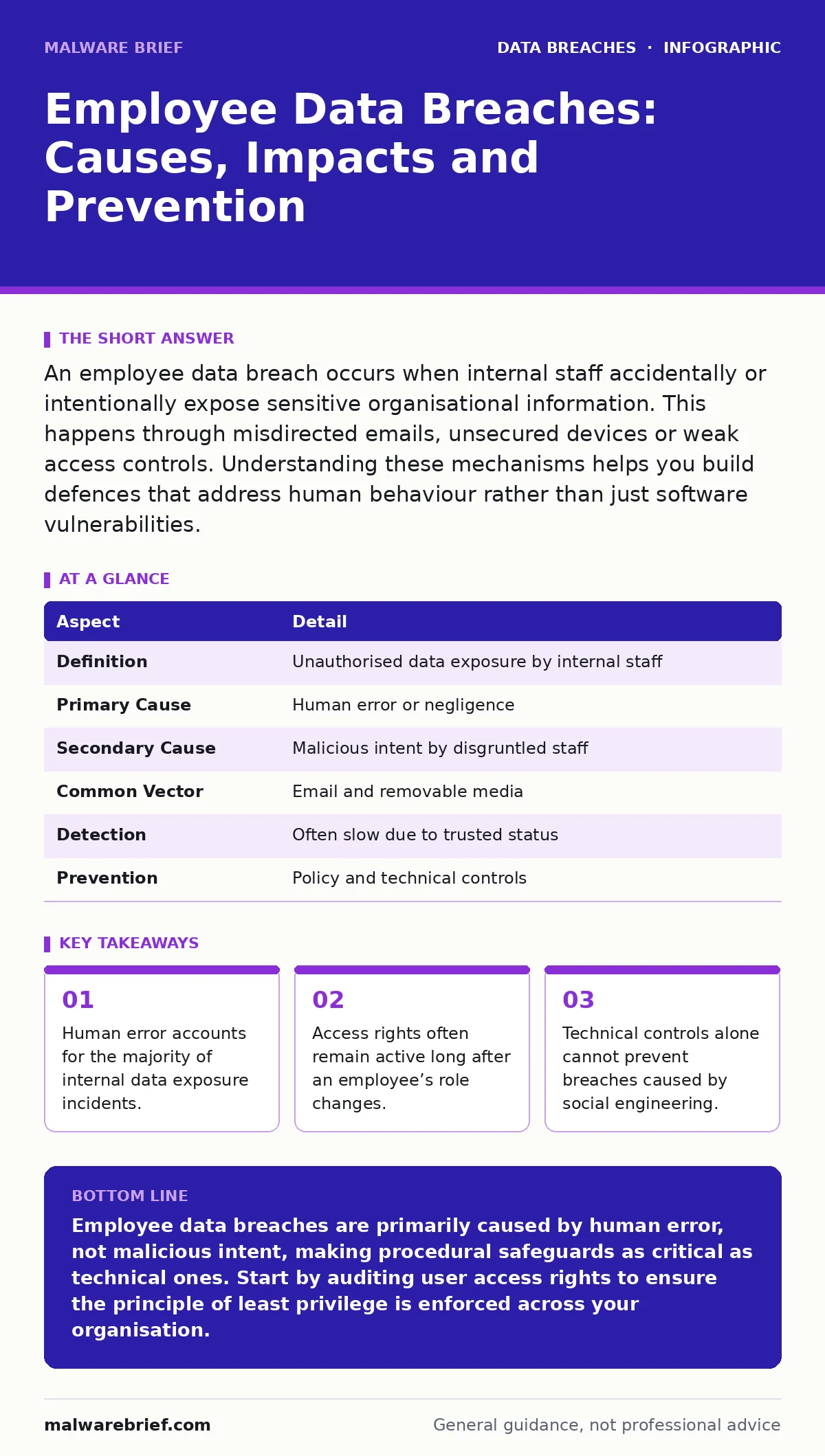
An employee data breach occurs when internal staff accidentally or intentionally expose sensitive organisational information. This happens through misdirected emails, unsecured devices or weak access controls. Understanding these mechanisms helps you build defences that address human behaviour rather than just software vulnerabilities.
The Anatomy of Internal Exposure
Think of an employee data breach like leaving a library book on a public train. The book was meant for a specific reader, but it ended up in the hands of strangers. In a business context, the "book" is sensitive data, and the "train" is any channel where that data travels outside its intended boundary.
An employee data breach is the unauthorised access, acquisition or disclosure of data by someone inside the organisation. This differs from external hacking where an intruder breaks through defences. Here, the person with the data exists within the trusted perimeter. The breach occurs because the data moves to a place or person who should not have it.
| Aspect | Detail |
|---|---|
| Definition | Unauthorised data exposure by internal staff |
| Primary Cause | Human error or negligence |
| Secondary Cause | Malicious intent by disgruntled staff |
| Common Vector | Email and removable media |
| Detection | Often slow due to trusted status |
| Prevention | Policy and technical controls |
How Routine Tasks Turn Into Risks
Most breaches do not involve dramatic theft. They happen during normal work. An employee tries to be efficient and bypasses a security step. This creates a gap in the protection layer.
Consider the email system. It is designed for speed and convenience, not security. When you send a file to a client, you might accidentally include a colleague’s email address in the carbon copy field. Or you might attach the wrong document. Once that email leaves your organisation, you lose control of it. The recipient can forward it, print it or store it on an unsecured device.
Another common scenario involves removable storage. Employees use USB drives to move files between computers. If that drive is lost or stolen, the data on it is exposed. Even if the drive is encrypted, the encryption key might be stored on the same machine, rendering the protection useless.
The Hidden Cost of Trust
Organisations trust employees to handle data correctly. This trust is necessary for productivity but dangerous for security. When you grant an employee access to a system, you assume they will only use it for their job. You rarely verify that assumption continuously.
This trust leads to a phenomenon called privilege creep. Over time, employees accumulate access rights. They keep permissions from previous roles even after they move to new tasks. A former finance employee might still have access to payroll systems. If their account is compromised, an attacker gains access to more data than necessary.
The cost of this exposure is not just financial. It includes reputational damage and loss of customer trust. When people learn that an organisation cannot protect their data, they withdraw their business. This erosion of trust takes years to rebuild.
Common Forms of Internal Exposure
Internal breaches take several forms. Understanding these helps you recognise the signs.
Misdirection: Sending data to the wrong recipient. This includes wrong email addresses, wrong fax numbers or wrong physical delivery locations.
Insecure Storage: Leaving sensitive documents on shared drives without proper permissions. Anyone with network access can view or copy the file.
Device Loss: Losing laptops, phones or tablets that contain unencrypted data. Even if the device is recovered, the data may have been copied before recovery.
Shadow IT: Using unapproved applications to store or process data. Employees might use personal cloud accounts or messaging apps for work tasks, bypassing organisational security controls.
Insider Threat: A deliberate attempt to steal or damage data. This is less common than error but more damaging. It often involves employees who are leaving the organisation or are dissatisfied with their role.
What People Usually Get Wrong
There is a widespread belief that technical controls can stop all breaches. This is incorrect. You can have the best firewall and the strongest encryption, but if an employee sends the decrypted data to the wrong person, the breach occurs. Technology protects the data at rest and in transit, but it cannot stop a human from making a mistake.
Another misconception is that training alone solves the problem. Training raises awareness, but it does not change behaviour permanently. People get tired, stressed or rushed. In these states, they revert to old habits. Training must be reinforced by technical controls that make the secure choice the easy choice.
People also assume that only senior staff pose a risk. In reality, junior staff and contractors often have access to sensitive data and may lack the experience to handle it securely. They are also more likely to be targeted by social engineering attacks because they are less suspicious.
See also: Protected Health Information: Why It Changes Security Decisions · Data Breach Costs: The Hidden Mechanics of Financial Impact
Reducing the Risk Through Design
To reduce the risk of employee data breaches, you must design your systems to assume failure. This is known as the principle of least privilege. Give employees only the access they need to do their job, and no more. Review these permissions regularly.
Implement data classification policies. This helps employees understand what requires extra care. It also allows you to apply stricter controls to high-value data. For example, you might block the printing of classified documents or require multi-factor authentication to open them.
Use data loss prevention tools. These monitor data movement and block transfers that violate policy. If an employee tries to email a file containing credit card numbers, the tool can intercept the message and alert the security team. This adds a layer of protection against accidental exposure.
The Role of Culture and Process
Security is not just a technology issue. It is a cultural one. If your organisation punishes mistakes harshly, employees will hide them. This makes it harder to detect and respond to breaches. Instead, create a culture where reporting mistakes is encouraged.
Regular audits help identify gaps in your defences. Check who has access to what. Look for unused accounts. Review logs for unusual activity. The concept of breach dwell time refers to how long an attacker remains undetected. Reducing this time limits the damage.
Consider the impact of oversharing on social media. Employees might post photos of their workspace, revealing sensitive information on screens or whiteboards. This is a form of data exposure that technical controls cannot stop. It requires awareness and policy.
Finally, remember that backup data exposure is a real risk. Backups contain copies of all your data. If they are not protected with the same rigor as primary data, they become a target. Ensure backups are encrypted and access is strictly controlled.
Moving Forward
Protecting against employee data breaches requires a balanced approach. You need technical controls, clear policies and a supportive culture. No single measure is sufficient. You must layer defences to cover the gaps left by others.
Start by assessing your current access controls. Identify where privilege creep has occurred. Then, implement data classification and loss prevention tools. Train your staff regularly, but focus on practical scenarios rather than theory. By addressing the human element, you build a more resilient organisation.
Key takeaways
- Human error accounts for the majority of internal data exposure incidents.
- Access rights often remain active long after an employee’s role changes.
- Technical controls alone cannot prevent breaches caused by social engineering.
- Regular training reduces risk but does not eliminate the possibility of mistakes.
Employee data breaches are primarily caused by human error, not malicious intent, making procedural safeguards as critical as technical ones. Start by auditing user access rights to ensure the principle of least privilege is enforced across your organisation.
Frequently asked questions
What is the difference between an insider threat and an employee data breach?
An insider threat is a deliberate act by someone inside the organisation to harm or steal data. An employee data breach is a broader term that includes accidental exposures, such as sending an email to the wrong person.
Can encryption prevent all employee data breaches?
No. Encryption protects data if it is stolen, but it does not prevent an employee from intentionally or accidentally sharing the decrypted data with unauthorised people.
How often should access rights be reviewed?
Access rights should be reviewed regularly, ideally when employees change roles or leave the organisation. Many organisations conduct quarterly or annual reviews to remove unnecessary permissions.
Is it possible to completely eliminate the risk of employee data breaches?
No. As long as humans handle data, there will be a risk of error or malice. The goal is to reduce the likelihood and impact of breaches through layered controls and monitoring.
How this guide was produced: written by the Malware Brief editorial team with AI assistance, checked against the public references listed below, and reviewed when the facts change. See our editorial policy or report an error.