Data Breach Costs: The Hidden Mechanics of Financial Impact
Most breach expenses occur long after the initial intrusion, driven by legal friction and operational paralysis rather than the theft itself.
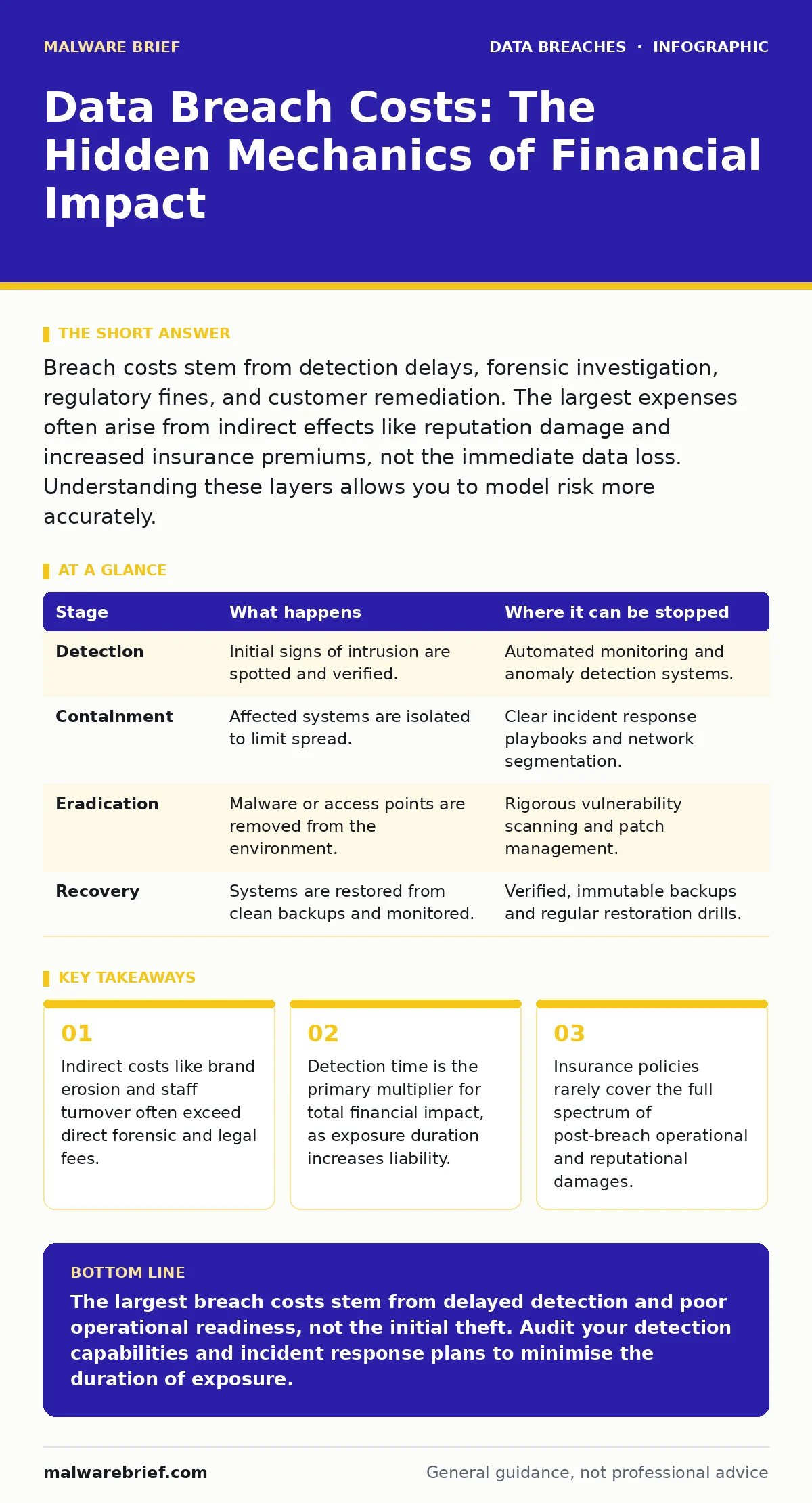
Breach costs stem from detection delays, forensic investigation, regulatory fines, and customer remediation. The largest expenses often arise from indirect effects like reputation damage and increased insurance premiums, not the immediate data loss. Understanding these layers allows you to model risk more accurately.
The Anatomy of Financial Exposure
When a data breach occurs, the financial impact is rarely a single invoice. It is a cascading series of expenses that unfold over months or years. You might assume the cost is defined by the value of the stolen data, but the data itself often has negligible immediate market value. The true expense lies in the response required to contain the incident and the subsequent legal and operational fallout.
Imagine a scenario where a single compromised credential allows an attacker to read customer records. The data is not sold on a dark web forum. Instead, the attacker deletes the logs to hide their tracks. The cost here is not the loss of the records, but the time spent discovering the deletion, restoring the system, and proving to regulators that you did not intentionally destroy evidence.
Stage 1: Detection and Containment
The first financial hit occurs the moment the breach is identified. Until detection, the breach is expanding silently. Every hour of undetected activity increases the scope of compromised data and the complexity of the required response. This phase involves immediate technical triage. You must isolate affected systems to prevent lateral movement, which is the process of an attacker moving from one part of a network to another.
This isolation often disrupts business operations. If you shut down a critical server to contain a threat, revenue generation stops. The cost here is a combination of emergency forensic fees and lost productivity. Many organisations fail to plan for this operational pause, leading to chaotic decision-making under pressure.
| Stage | What happens | Where it can be stopped |
|---|---|---|
| Detection | Initial signs of intrusion are spotted and verified. | Automated monitoring and anomaly detection systems. |
| Containment | Affected systems are isolated to limit spread. | Clear incident response playbooks and network segmentation. |
| Eradication | Malware or access points are removed from the environment. | Rigorous vulnerability scanning and patch management. |
| Recovery | Systems are restored from clean backups and monitored. | Verified, immutable backups and regular restoration drills. |
Stage 2: Forensic Investigation and Remediation
Once contained, you must understand what happened. This requires forensic analysis. Forensics is the scientific method of collecting, analysing, and preserving digital evidence. You need to determine the entry point, the extent of the data accessed, and the duration of the breach. This is often the most expensive technical phase. External experts are usually required to provide an unbiased report that can be used in legal proceedings.
The cost scales with the complexity of your environment. If you have poor visibility into your network, investigators must spend more time mapping connections. This is where practices like data classification become relevant. If you do not know what data resides where, you cannot accurately assess the impact. This uncertainty forces you to assume the worst-case scenario, which triggers more expensive remediation steps than might otherwise be necessary.
Stage 3: Notification and Legal Liability
After the investigation, you must notify affected individuals and regulators. Notification requirements vary by jurisdiction, but the process is universally costly. You must identify who was affected, what data was exposed, and provide remediation services such as credit monitoring. This phase introduces legal fees. Lawyers must review your response for compliance and manage potential lawsuits.
The financial impact here is driven by the type of data exposed. If protected health information is involved, the regulatory fines are typically higher and the legal scrutiny more intense. Even if no fines are issued, the administrative burden of managing notifications is significant. You may also face class-action lawsuits, which can drain resources for years. The mere threat of litigation often forces organisations to settle, adding to the cost.
Stage 4: Operational and Reputational Fallout
The final and often largest cost category is indirect. This includes the loss of customer trust, decreased revenue, and increased insurance premiums. Customers may leave for competitors, and acquiring new customers becomes more expensive as your brand reputation suffers. This is not a line item on a balance sheet, but it is a real financial loss.
Additionally, your cyber insurance premiums will likely rise. Insurers view a breach as a marker of higher risk. You may also face stricter policy terms or reduced coverage limits. This creates a long-term financial burden that persists long after the technical issue is resolved. The cost of backup data exposure is a specific subset of this, where attackers encrypt backups to ensure you cannot recover without paying a ransom, forcing you to rebuild systems from scratch rather than restoring them.
See also: Scheduled Task Abuse Response: Containment and Recovery Steps · Incident Response Plans: Real Benefits and Hidden Costs
Stage 5: Long-Term Structural Changes
Organisations often respond to breaches by overhauling their security posture. This includes hiring new staff, implementing new technologies, and revising policies. While these changes improve security, they represent a direct cost incurred due to the breach. You might implement encryption key management controls that were previously deemed too complex. You might deploy data loss prevention tools to monitor outbound traffic.
These investments are necessary, but they are reactive. The cost is the capital that must be diverted from innovation or growth to remediation. This opportunity cost is rarely calculated but is significant. You are paying for the privilege of learning a lesson that could have been avoided with proactive measures.
Reading the Cost Model
To apply this understanding, you must look beyond the headline figures. Media reports often cite a "average cost of a breach," but this number is misleading. It averages small, contained incidents with massive, catastrophic failures. Your cost will depend on your specific context.
Focus on the duration of detection. This is the variable you can control. Faster detection reduces the scope of the breach, which reduces the cost of forensics, notification, and remediation. Imagine you have a system that alerts you to unusual data access patterns. This tool pays for itself by reducing the window of exposure.
Applying the Insights
You can reduce costs by investing in visibility and response capability. This is not about buying the most expensive security tools. It is about knowing what you have and how to respond when something goes wrong. Regularly test your incident response plan. Identify gaps in your monitoring. Ensure your backups are isolated and tested.
Consider the concept of synthetic identity fraud. If your data is used to create fake identities, the financial impact may not be immediate. It may take years for these identities to surface in credit systems. This delayed impact makes it difficult to attribute costs to a specific breach, but it does not make them less real. You must account for this long-tail risk in your financial planning.
The Hidden Cost of Silence
Some organisations attempt to hide breaches to avoid reputational damage. This is a high-risk strategy. If the breach is discovered later, the legal penalties are often harsher. Regulators view concealment as aggravating. The cost of a covered-up breach is almost always higher than the cost of a transparently managed one. Transparency allows you to control the narrative and demonstrate responsibility.
The financial impact of a breach is a function of preparation. If you are prepared, the cost is manageable. If you are not, it can be existential. You must treat breach response as a business continuity issue, not just an IT problem. This shift in perspective ensures that you allocate the necessary resources to detect, contain, and recover effectively.
Key takeaways
- Indirect costs like brand erosion and staff turnover often exceed direct forensic and legal fees.
- Detection time is the primary multiplier for total financial impact, as exposure duration increases liability.
- Insurance policies rarely cover the full spectrum of post-breach operational and reputational damages.
The largest breach costs stem from delayed detection and poor operational readiness, not the initial theft. Audit your detection capabilities and incident response plans to minimise the duration of exposure.
Frequently asked questions
How do I calculate the potential cost of a breach for my organisation?
Estimate the cost of downtime, forensic investigation, legal fees, and notification. Multiply these by the estimated time to detect and contain a breach. Add a factor for reputational damage and insurance premium increases.
Does cyber insurance cover all breach costs?
No. Policies often exclude reputational damage, business interruption beyond a certain period, and fines resulting from negligence. Read the exclusions carefully.
What is the most effective way to reduce breach costs?
Reduce the time to detection. Implement monitoring and alerting systems that identify anomalies quickly. This limits the scope of the breach and the subsequent response effort.
How do indirect costs impact small businesses?
Small businesses are more vulnerable to indirect costs like reputational damage. A single breach can destroy customer trust, leading to a loss of revenue that may be fatal to the business.
How this guide was produced: written by the Malware Brief editorial team with AI assistance, checked against the public references listed below, and reviewed when the facts change. See our editorial policy or report an error.