Detecting Synthetic Identity Fraud: Signals, Logs and Blind Spots
Synthetic identities hide in plain sight by blending real data fragments with fabricated details, evading standard verification checks that rely on single-point validation.

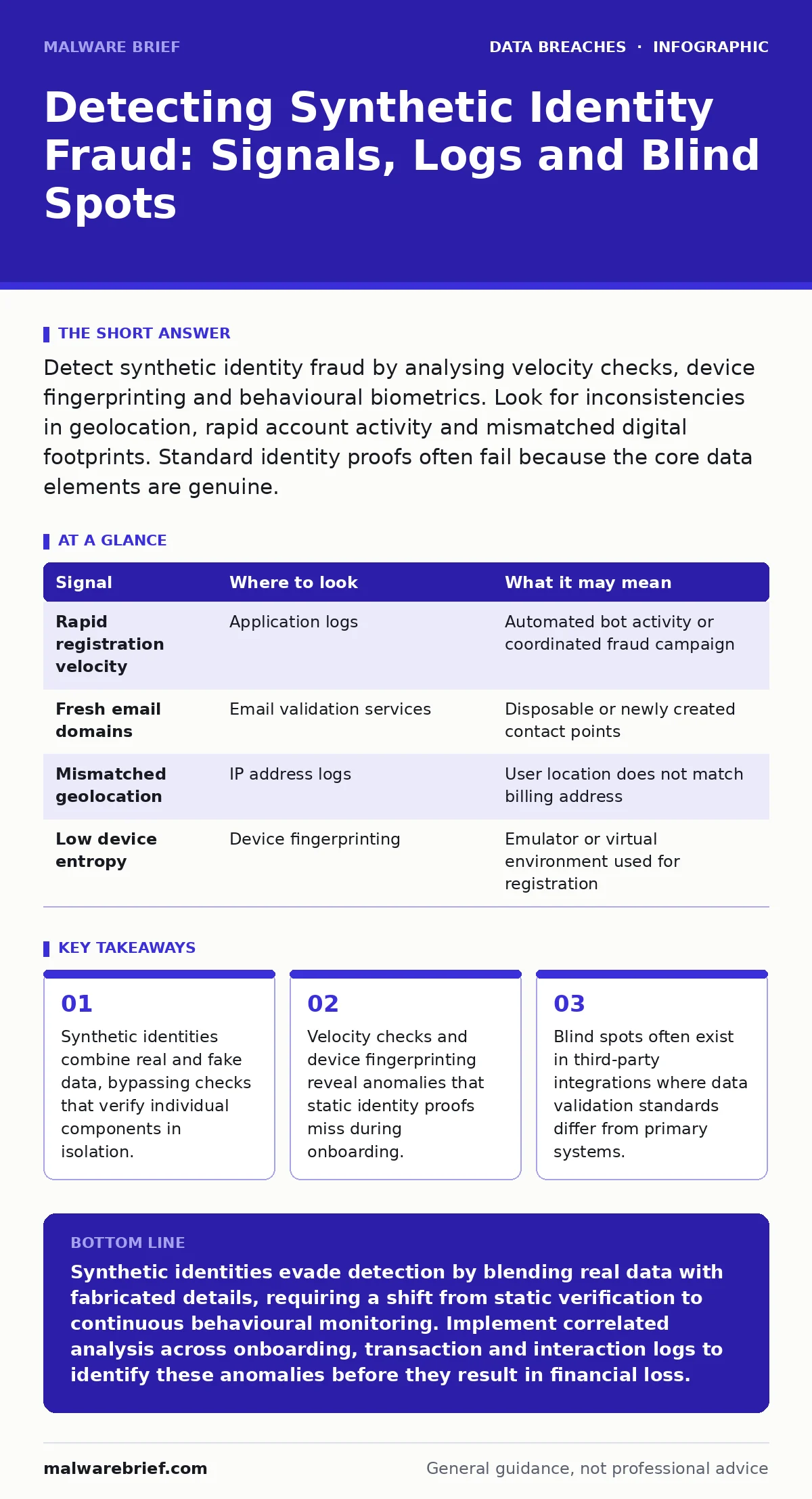
Detect synthetic identity fraud by analysing velocity checks, device fingerprinting and behavioural biometrics. Look for inconsistencies in geolocation, rapid account activity and mismatched digital footprints. Standard identity proofs often fail because the core data elements are genuine.
The Anatomy of a Constructed Persona
Synthetic identity fraud involves creating a persona using a mixture of real and fabricated information. Attackers often use genuine National Insurance numbers or credit reference details that belong to real people, pairing them with invented names, addresses or phone numbers. This hybrid approach means the identity does not exist in any official registry as a coherent whole, yet its components pass individual validation checks.
Traditional verification methods often fail here because they validate data points in isolation. A system might confirm that a National Insurance number exists and belongs to a specific name, but it cannot easily determine if that combination was manufactured for fraudulent purposes. The result is an identity that appears legitimate to automated systems but has no true historical footprint.
Early Signals in Onboarding Logs
The first opportunity to detect these identities occurs during the account creation phase. You should examine the logs for velocity anomalies. Velocity checks measure the rate at which new accounts are created or changes are made. A sudden spike in registrations from a single IP address, device ID or proxy network is a strong indicator of automated fraud attempts.
Look for inconsistencies in the digital footprint provided. If an email address was registered recently, or if the phone number has no history of usage, the identity may be synthetic. These accounts often lack the natural entropy of human behaviour. The timing of the registration, combined with the freshness of the contact details, creates a pattern that differs significantly from organic user growth.
| Signal | Where to look | What it may mean |
|---|---|---|
| Rapid registration velocity | Application logs | Automated bot activity or coordinated fraud campaign |
| Fresh email domains | Email validation services | Disposable or newly created contact points |
| Mismatched geolocation | IP address logs | User location does not match billing address |
| Low device entropy | Device fingerprinting | Emulator or virtual environment used for registration |
Behavioural Biometrics and Session Analysis
Once an account is active, the behaviour of the user becomes the primary source of evidence. Synthetic identities are often managed by bots or humans using scripts to mimic human interaction. However, these scripts struggle to replicate the subtle nuances of natural human movement.
Behavioural biometrics capture how a user interacts with the interface. This includes mouse movements, typing speed, scroll patterns and touch dynamics. A bot will often move the cursor in straight lines or at constant speeds, lacking the micro-jitter and hesitation of a human hand. By analysing these patterns, you can distinguish between a genuine user and an automated process controlling the synthetic identity.
Session analysis also reveals anomalies. A synthetic identity might log in from multiple locations in a short period, which is physically impossible for a single human. These impossible travel scenarios are a classic red flag. While VPNs can mask location, they often introduce latency patterns or IP reputation scores that differ from residential connections.
Financial Transaction Patterns
For financial services, the transaction history is the most reliable indicator. Synthetic identities are typically built up over time to establish a credit history before the fraud occurs. This process, known as binging, involves small, legitimate-looking transactions that gradually increase in size.
Monitor for sudden changes in transaction behaviour. A long-dormant account that suddenly begins high-value purchases or transfers is a significant risk. Look for transactions that exceed the established spending pattern of the account. Even if the transactions are processed successfully, the deviation from the baseline behaviour suggests the account may be under the control of a fraudster rather than the nominal holder.
Data loss prevention systems can help here by monitoring for the exfiltration of sensitive financial data. If an account begins to download large volumes of transaction history or personal data, it may be preparing for a larger fraud operation. Integrating these signals with your fraud detection logic adds another layer of visibility.
The Role of Third-Party Data
Many organisations rely on third-party data providers for identity verification. These providers often use their own rules and data sources, which may not align with your internal risk thresholds. A major blind spot is assuming that a "verified" status from a third party means the identity is genuine.
You must validate the confidence scores provided by these vendors. A high confidence score might simply mean the data matches a database, not that the identity is real. Cross-reference the third-party data with your own internal signals. If the third-party verification passes but your behavioural biometrics fail, the synthetic identity may have slipped through the initial gate.
Protected health information and other sensitive data require even stricter validation. If a synthetic identity is used to access medical records, the consequences are severe. Ensure that your access controls are based on continuous verification, not just a one-time check at login.
See also: Data Loss Prevention: Real Benefits and Hidden Costs · How to Prevent Data Extortion: Prioritised Defence Measures
Common Blind Spots and Integration Gaps
One of the most persistent blind spots is the disconnect between onboarding and ongoing monitoring. Many organisations invest heavily in initial identity verification but neglect continuous monitoring. This creates a window where synthetic identities can operate undetected once they have passed the initial hurdles.
Another gap exists in the integration of fraud signals across different systems. If your customer relationship management system, payment gateway and security information and event management platform do not share data, you lose the ability to see the full picture. A synthetic identity might look normal in each system individually, but the combination of signals across platforms reveals the fraud.
Encryption key management is also relevant here. If the keys used to encrypt customer data are compromised, attackers can harvest real data elements to create more sophisticated synthetic identities. Protecting these keys is not just about data privacy; it is about preventing the raw materials of fraud from being stolen.
Building a Detection Framework
To effectively detect synthetic identity fraud, you need a framework that combines multiple signals. Start by defining what normal behaviour looks like for your users. Establish baselines for registration velocity, transaction patterns and interaction styles. Then, set thresholds for deviations from these baselines.
Integrate data from your logs, behavioural biometrics and third-party providers into a centralised analysis platform. This allows you to correlate events and identify patterns that would be invisible in isolated systems. Regularly review and update your rules to adapt to new fraud techniques.
Breach dwell time is a critical metric. The longer a synthetic identity remains undetected, the more damage it can cause. By reducing the time between fraud initiation and detection, you limit the exposure of your systems and data. This requires not just better detection tools, but faster response processes.
Key takeaways
- Synthetic identities combine real and fake data, bypassing checks that verify individual components in isolation.
- Velocity checks and device fingerprinting reveal anomalies that static identity proofs miss during onboarding.
- Blind spots often exist in third-party integrations where data validation standards differ from primary systems.
Synthetic identities evade detection by blending real data with fabricated details, requiring a shift from static verification to continuous behavioural monitoring. Implement correlated analysis across onboarding, transaction and interaction logs to identify these anomalies before they result in financial loss.
Frequently asked questions
Can behavioural biometrics be spoofed by advanced bots?
Advanced bots can mimic some human behaviours, but they struggle to replicate the full complexity of human interaction patterns consistently over time. Combining biometrics with other signals reduces this risk.
How do I balance detection accuracy with user experience?
Use risk-based authentication. Apply stricter checks only to high-risk transactions or anomalous behaviour, allowing low-risk users to proceed with minimal friction.
What is the role of machine learning in detection?
Machine learning models can identify complex patterns and anomalies that rule-based systems miss. They adapt to new fraud techniques by learning from historical data, improving detection over time.
Should I block all accounts with fresh email addresses?
No, this would block many legitimate users. Instead, flag these accounts for additional verification or monitoring, such as requiring phone verification or limiting initial transaction limits.
How this guide was produced: written by the Malware Brief editorial team with AI assistance, checked against the public references listed below, and reviewed when the facts change. See our editorial policy or report an error.