Phishing vs Spear Phishing: Key Differences and Detection Tactics
Spear phishing trades the low cost of mass spraying for high yield by exploiting specific social connections and professional roles within your organisation.
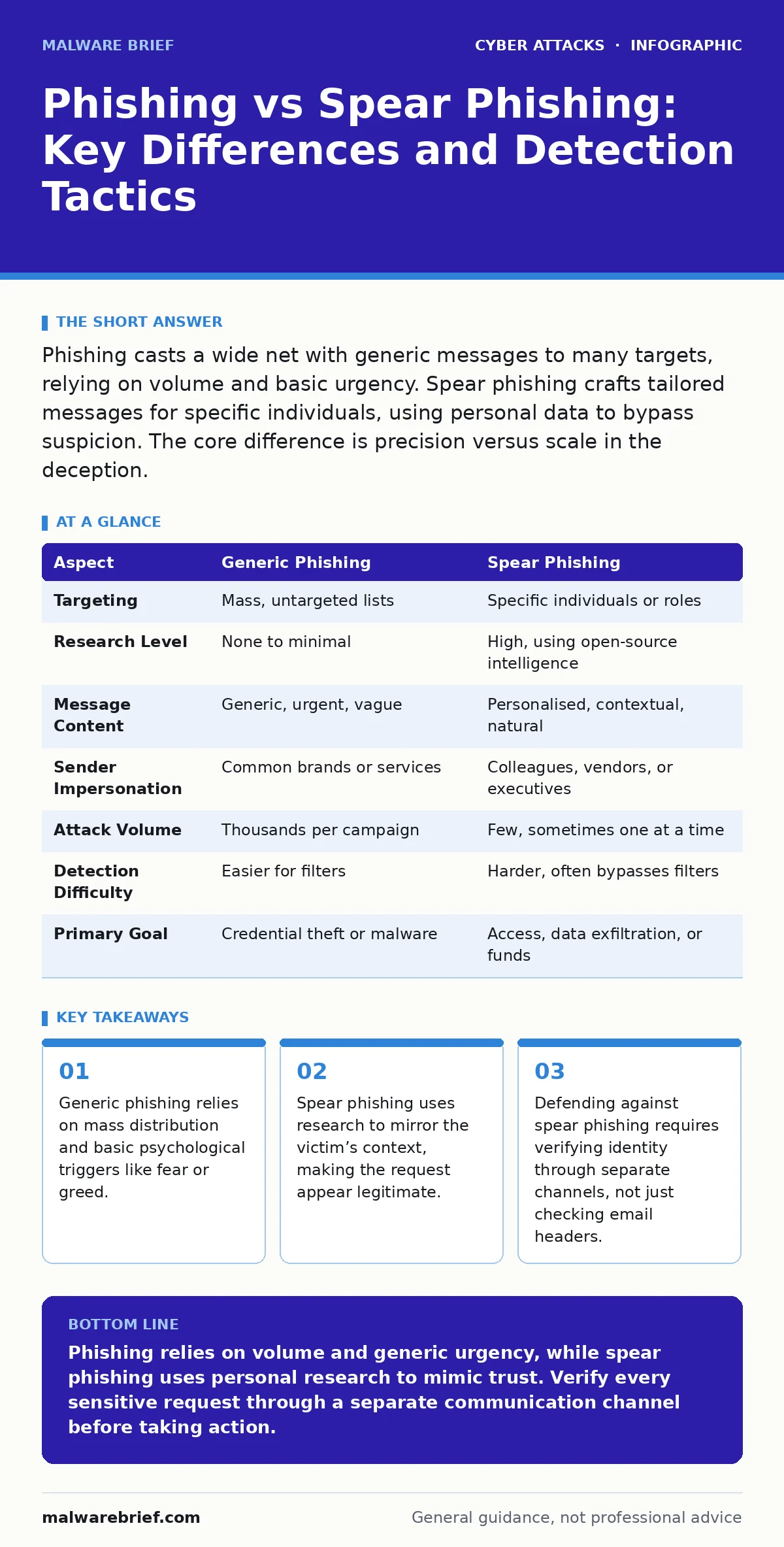
Phishing casts a wide net with generic messages to many targets, relying on volume and basic urgency. Spear phishing crafts tailored messages for specific individuals, using personal data to bypass suspicion. The core difference is precision versus scale in the deception.
The Core Distinction in Deception
The fundamental difference lies in scope and preparation. Phishing is a broadcast attack where the sender hopes a small fraction of recipients will comply. Spear phishing is a targeted assault where the attacker has already identified you and tailored the message to your specific role or habits. One relies on luck; the other relies on intelligence.
Anatomy of Generic Phishing
Generic phishing operates on volume. Attackers send thousands of nearly identical messages, often using phishing kits that contain pre-built templates and fake login pages. The content is vague enough to apply to many people, such as a notice about an inactive account or a delivery delay. You are not chosen for who you are, but because you appeared in a purchased list.
The goal is simplicity. The message creates immediate pressure, forcing you to click before you can think. If you pause to check the sender’s address or the URL, the attack usually fails. This method is cheap to execute, which is why you see so many of them.
Anatomy of Spear Phishing
Spear phishing requires effort before the first message is sent. The attacker researches your public profiles, recent activities, or organisational structure. They might note that you recently promoted a colleague or attended a specific conference. The message then references these details to build false trust.
This personalisation lowers your guard. A message from "HR" asking for a password change is suspicious. A message from your manager, using your nickname and referencing a project you both worked on, feels routine. The attacker mimics the tone and context of your daily work.
Point-by-Point Comparison
| Aspect | Generic Phishing | Spear Phishing |
|---|---|---|
| Targeting | Mass, untargeted lists | Specific individuals or roles |
| Research Level | None to minimal | High, using open-source intelligence |
| Message Content | Generic, urgent, vague | Personalised, contextual, natural |
| Sender Impersonation | Common brands or services | Colleagues, vendors, or executives |
| Attack Volume | Thousands per campaign | Few, sometimes one at a time |
| Detection Difficulty | Easier for filters | Harder, often bypasses filters |
| Primary Goal | Credential theft or malware | Access, data exfiltration, or funds |
Where the Tactics Overlap
Both methods rely on social engineering, which is the manipulation of people into performing actions or disclosing information. They both use email as the primary delivery vector, though SMS and messaging apps are increasingly common. The psychological triggers are identical: urgency, authority, and curiosity.
The difference is the wrapper. Generic phishing uses a blunt instrument. Spear phishing uses a scalpel. Both aim to bypass your technical defences by attacking your human judgement. Understanding this overlap helps you recognise that the medium does not dictate the threat level.
See also: SIM Swapping Explained: How Attackers Steal Your Identity · How Zero-Click Attacks Work: Step-by-Step Analysis
Choosing Your Defence Strategy
Choose the first approach to defence when you are dealing with high-volume, obvious spam. Automated filters and bulk reporting handle these effectively. You rely on pattern recognition here, where the system identifies known bad domains or URLs.
Choose the second approach to defence when dealing with subtle, personalised requests. Technical filters often miss these because the content looks legitimate. You must rely on verification. If a request involves money, data, or access, you verify it through a separate channel, such as a phone call or callback verification.
Hidden Costs and Edge Cases
A non-obvious consequence of spear phishing is the erosion of internal trust. When attackers successfully impersonate colleagues, teams may become hesitant to share information or respond to requests, slowing down operations. This friction is a hidden cost that persists long after the incident.
Another edge case is the use of compromised accounts. If an attacker gains access to a legitimate email account, their messages originate from a trusted source. This bypasses almost all technical filters because the email is genuinely "from" your colleague. This is why account takeover prevention is critical. It shifts the battle from the inbox to the identity layer.
Imagine a scenario where an attacker uses a legitimate cloud storage link to share a document. The link is real, hosted on a service your company uses. The danger is not the link, but what you do after clicking. If you disable macro warnings or install a requested extension, the breach occurs. The platform is safe; your action is not.
Beyond the Inbox
Defence is not solely technical. It requires a shift in security culture where questioning requests is normal, not rude. Employees should feel empowered to delay action to verify a request. This cultural shift reduces the success rate of both phishing and spear phishing.
When an incident occurs, your incident response plans must account for identity compromise. Resetting a password is not enough. You must assess what data was accessed and whether the attacker established persistence. The response must be swift and thorough.
Final Considerations
The line between phishing and spear phishing is blurring as attackers automate research. Tools can now scrape public data to personalise messages at scale. This means the volume of targeted attacks is increasing, while the effort per attack decreases.
You cannot block all attempts. The goal is to increase the cost for the attacker and reduce your reaction time. By understanding the mechanics, you move from passive recipient to active verifier. This mindset is the strongest defence against deception.
Key takeaways
- Generic phishing relies on mass distribution and basic psychological triggers like fear or greed.
- Spear phishing uses research to mirror the victim’s context, making the request appear legitimate.
- Defending against spear phishing requires verifying identity through separate channels, not just checking email headers.
Phishing relies on volume and generic urgency, while spear phishing uses personal research to mimic trust. Verify every sensitive request through a separate communication channel before taking action.
Frequently asked questions
How do I tell if an email is spear phished?
Look for subtle inconsistencies in tone, unexpected requests for sensitive data, or pressure to act quickly despite the personalised content.
Can email filters stop spear phishing?
Filters often miss spear phishing because the content appears legitimate and originates from trusted domains or compromised accounts.
What is the best way to verify a suspicious request?
Contact the person using a different method than the one used in the request, such as a phone call or in-person conversation.
Does two-factor authentication help?
Yes, it adds a layer of security, but it does not stop you from voluntarily giving away credentials or performing actions requested by the attacker.
How this guide was produced: written by the Malware Brief editorial team with AI assistance, checked against the public references listed below, and reviewed when the facts change. See our editorial policy or report an error.