Protected Health Information: Why It Changes Security Decisions
Treating protected health information differently forces teams to build defences that withstand long-term data retention and complex supply chains.
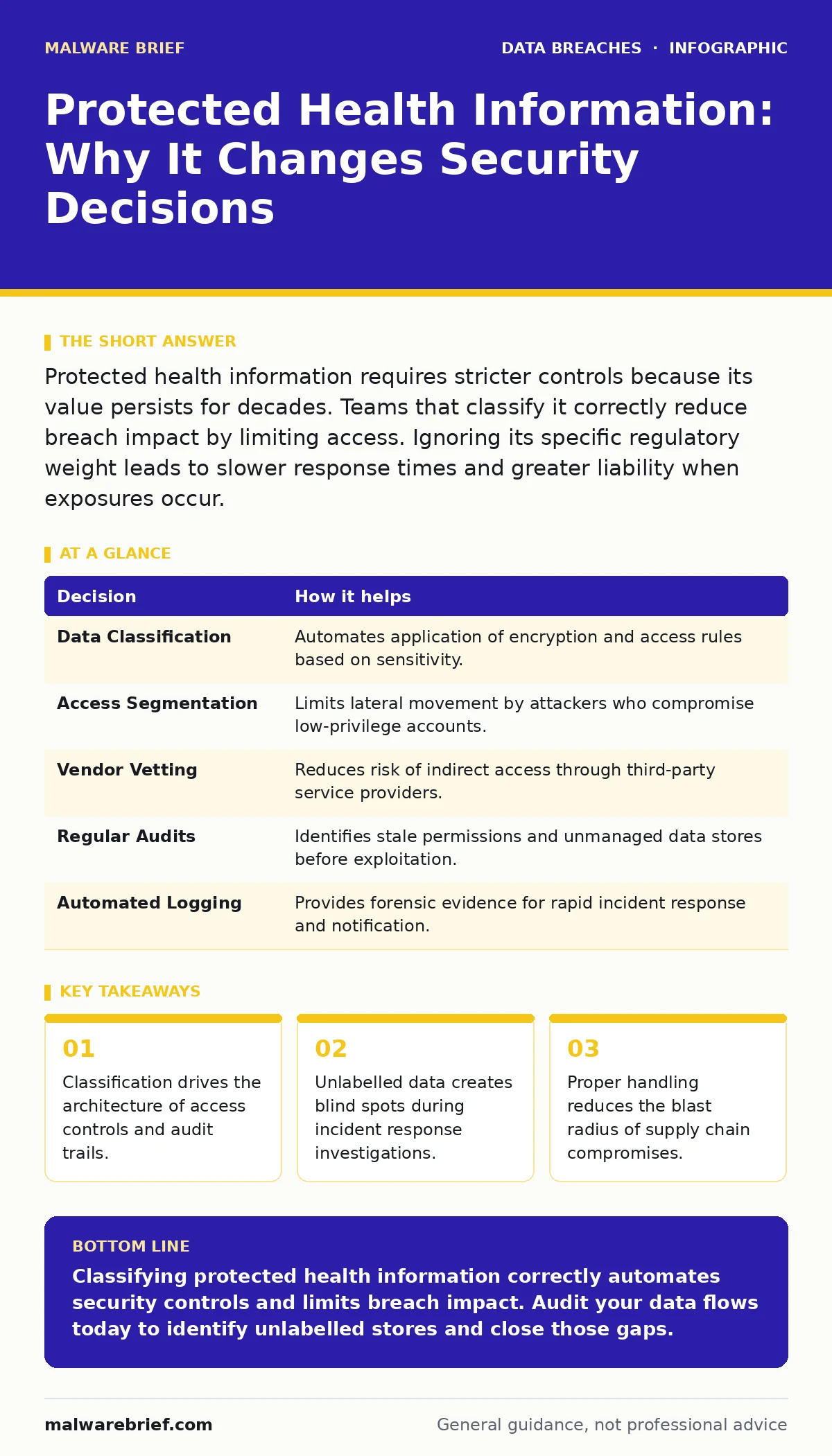
Protected health information requires stricter controls because its value persists for decades. Teams that classify it correctly reduce breach impact by limiting access. Ignoring its specific regulatory weight leads to slower response times and greater liability when exposures occur.
The Weight of Long-Term Liability
Protected health information carries a unique burden compared to standard corporate data. It remains sensitive for the lifetime of the patient and often beyond. This longevity changes how you design storage and access systems. You cannot simply archive it in the same bucket as general business records. The data must remain secure while remaining accessible for care continuity. This tension creates specific architectural challenges. You must balance ease of retrieval for clinicians with strict separation for administrative staff. Failure to account for this duration often leads to legacy systems retaining data far longer than necessary. These stale repositories become easy targets for attackers. They sit on the periphery of your network, monitored less frequently than active databases. Understanding this temporal risk is the first step in securing these assets.
Classification Drives Control Design
You cannot protect what you do not define. Many teams treat all patient data as equally sensitive, which dilutes their security focus. Protected health information requires explicit tagging at the point of creation. This tag triggers automated policies for encryption, access logging, and retention. Without this classification, your security tools operate blindly. They apply the same rules to a clinical note and a public brochure. This lack of granularity wastes resources and leaves high-value data exposed. You must map the data flow from entry to disposal. Each hop in that journey needs a corresponding control. If a system does not support tagging, you must isolate it physically or logically. This isolation adds operational friction but reduces risk. The trade-off is clear: convenience versus containment.
The Hidden Cost of Unlabelled Data
When data lacks proper classification, incident response becomes guesswork. Responders must manually inspect files to determine their sensitivity. This manual inspection slows down the containment phase significantly. Every minute spent identifying data is a minute the threat actor remains active. Furthermore, unlabelled data often resides in shadow IT systems. Departments create their own spreadsheets or cloud folders to bypass rigid central systems. These shadow repositories rarely have the same security controls. They become the weakest link in your defences. Attackers know this. They target these unmanaged stores first. You must conduct regular audits to find these hidden stores. Integrating them into your central security posture is non-negotiable. The effort required to find them is far less than the cost of a breach.
Access Controls and Least Privilege
Access to protected health information must follow the principle of least privilege. Users should only see the data necessary for their specific task. A billing clerk does not need to read clinical notes. A radiologist does not need access to psychiatric history. Segregating these duties reduces the impact of a compromised account. If an attacker gains access to a billing role, they cannot pivot to clinical data. This segmentation limits the blast radius. You must implement role-based access controls that enforce these boundaries. Regular reviews ensure that permissions remain aligned with job functions. Employees change roles, but their access rights often do not. Stale permissions are a common entry point for insider threats. Reviewing these rights quarterly is a standard practice. It prevents privilege creep over time.
Supply Chain and Third-Party Risk
Healthcare organisations rarely operate in isolation. They rely on vendors for cloud storage, analytics, and support. These third parties often have access to protected health information. Their security posture becomes your security posture. You must vet these partners rigorously. Contracts must specify how data is handled, stored, and destroyed. Vague clauses provide no legal recourse in a breach. You need technical evidence of their controls, not just assurances. Regular audits of their security practices are necessary. This includes checking their own supply chain. A weak vendor can be the gateway into your network. You must assume that any partner with data access is a potential threat vector. Monitoring their access logs is as important as monitoring your own.
See also: How to Prevent Data Extortion: Prioritised Defence Measures · Data Breach Costs: The Hidden Mechanics of Financial Impact
Incident Response and Data Breach Costs
When a breach occurs, the presence of protected health information changes the response timeline. Regulatory requirements often mandate notification within strict windows. You must know exactly what was accessed and who was affected. Accurate classification speeds up this determination. Without it, you may have to notify everyone, increasing reputational damage. The costs associated with these breaches extend beyond fines. They include legal fees, credit monitoring for patients, and loss of trust. These costs compound over time. Proper security controls reduce the likelihood of a breach and limit its scope. Investing in these controls is an investment in organisational resilience. It reduces the financial and operational shock of an incident.
| Decision | How it helps |
|---|---|
| Data Classification | Automates application of encryption and access rules based on sensitivity. |
| Access Segmentation | Limits lateral movement by attackers who compromise low-privilege accounts. |
| Vendor Vetting | Reduces risk of indirect access through third-party service providers. |
| Regular Audits | Identifies stale permissions and unmanaged data stores before exploitation. |
| Automated Logging | Provides forensic evidence for rapid incident response and notification. |
Integrating with Broader Security Strategies
Protecting this data is not an isolated task. It intersects with many other security domains. For instance, encryption key management is critical. If you encrypt the data but lose the keys, you lose the data. If an attacker steals the keys, the encryption is useless. You must separate key storage from data storage. Similarly, backup data exposure is a common blind spot. Backups often contain the same sensitive data but lack the same monitoring. Treat backups with the same security rigor as live systems. Data loss prevention tools can help detect unauthorised transfers of this information. They act as a final check before data leaves your network. Employee data breaches often stem from weak internal controls. Training staff to recognise social engineering attacks is vital. Finally, understanding data breach costs helps justify security investments to leadership. It provides a clear business case for improved protections.
Key takeaways
- Classification drives the architecture of access controls and audit trails.
- Unlabelled data creates blind spots during incident response investigations.
- Proper handling reduces the blast radius of supply chain compromises.
Classifying protected health information correctly automates security controls and limits breach impact. Audit your data flows today to identify unlabelled stores and close those gaps.
Frequently asked questions
How long must protected health information be retained?
Retention periods vary by jurisdiction and data type, but generally extend for decades. Consult local regulations for specific timelines.
Can encryption alone protect this data?
Encryption protects data at rest and in transit, but it does not control who accesses it once decrypted. Access controls remain necessary.
What is the biggest risk in cloud environments?
Misconfigured storage buckets and shared access keys are common risks. Ensure cloud providers support granular access controls.
How do I handle data shared with researchers?
De-identification or anonymisation processes must remove all direct identifiers. This allows safe sharing while maintaining privacy.
How this guide was produced: written by the Malware Brief editorial team with AI assistance, checked against the public references listed below, and reviewed when the facts change. See our editorial policy or report an error.