IP Spoofing Response: Containment, Recovery and Prevention Steps
Source address validation fails at the edge, meaning your internal network trusts traffic that originated outside your control.
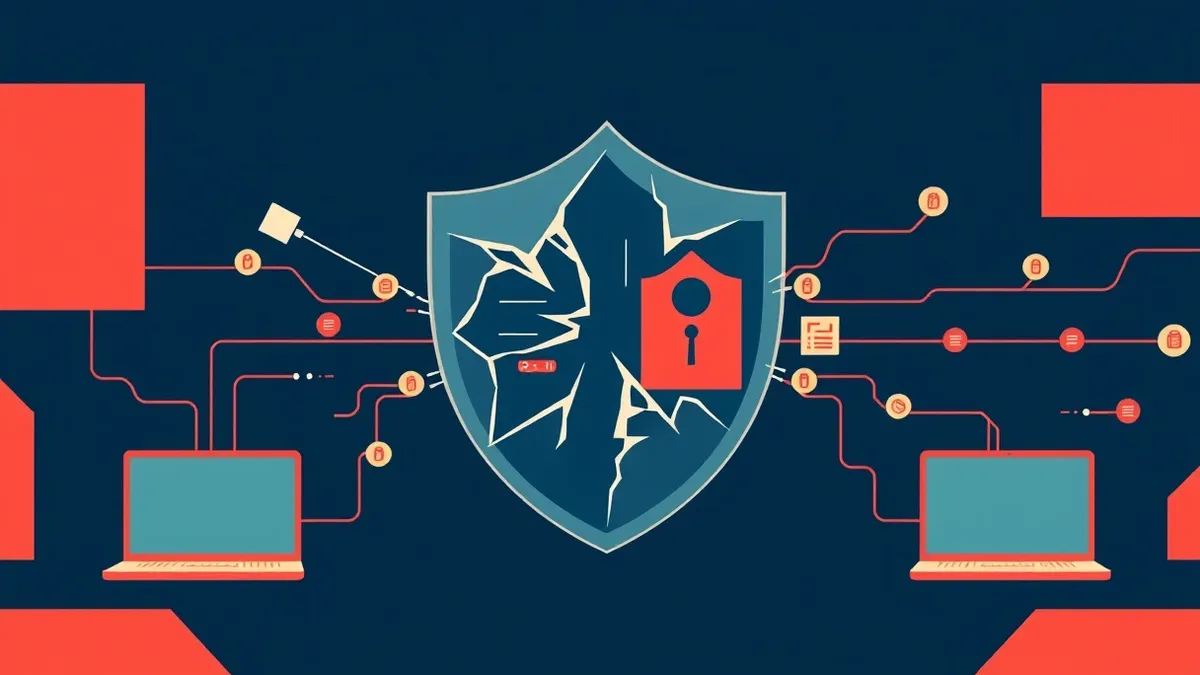
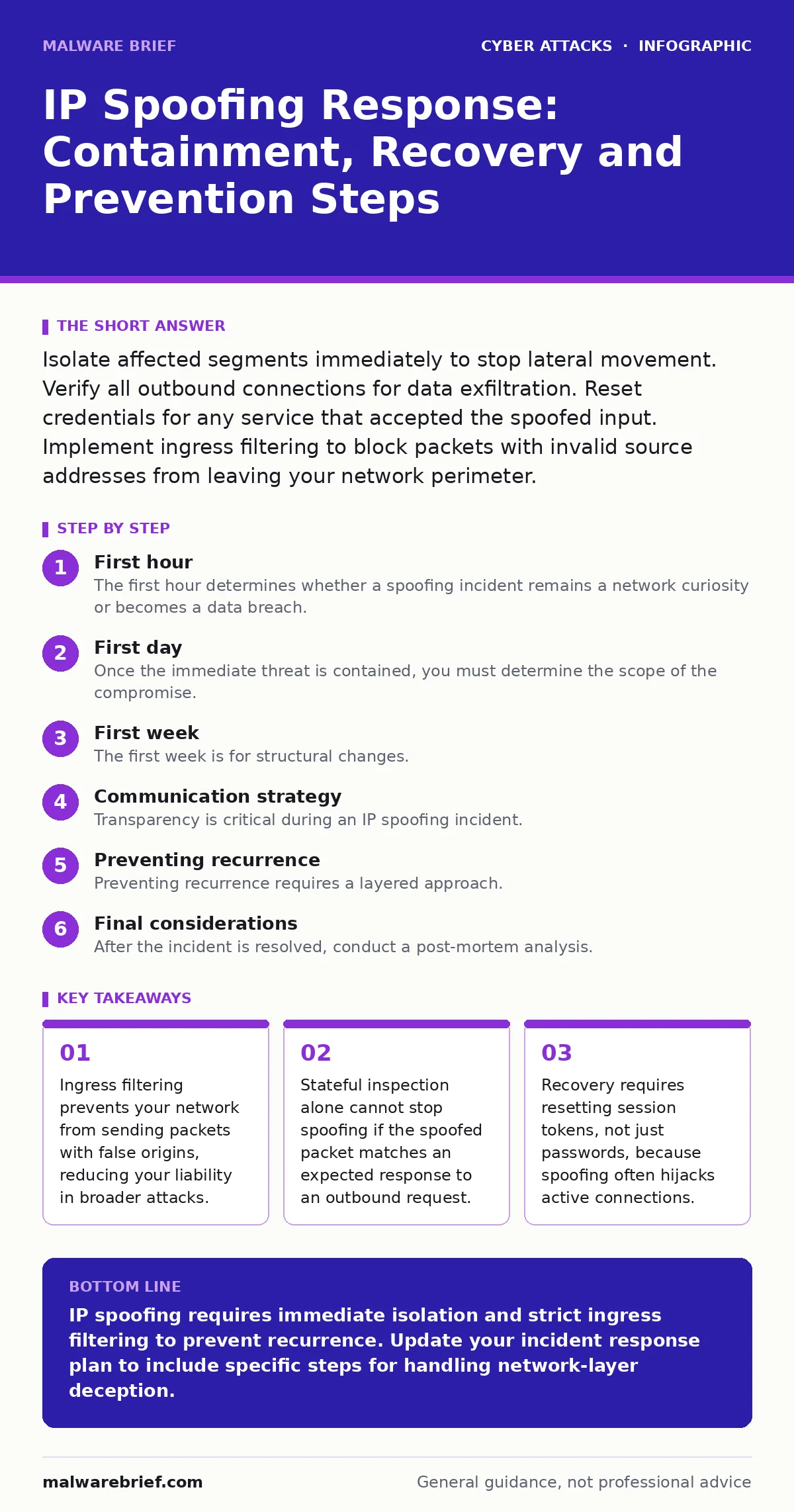
Isolate affected segments immediately to stop lateral movement. Verify all outbound connections for data exfiltration. Reset credentials for any service that accepted the spoofed input. Implement ingress filtering to block packets with invalid source addresses from leaving your network perimeter.
First hour
Immediate containment actions
The first hour determines whether a spoofing incident remains a network curiosity or becomes a data breach. IP spoofing involves crafting packets with a falsified source address to disguise the origin of traffic. Attackers use this to bypass simple address filters or to launch denial-of-service floods. Your immediate priority is to stop the spoofed traffic from influencing internal systems.
You must isolate the affected network segment. If the spoofing targets a specific server, disconnect that server from the network. If the spoofing is part of a broader scan, restrict ingress traffic to known-good subnets. Do not rely on your firewall to block the spoofed IP alone, as the attacker can change the source address rapidly. Instead, block the application-layer traffic that the spoofed packets are trying to initiate.
- Identify the targeted service by checking logs for unexpected connection attempts.
- Isolate the compromised host or segment from the wider network.
- Preserve memory dumps and packet captures from the affected devices.
- Disable any automated responses that might trigger further interaction with the spoofed source.
- Notify the incident response team and security operations centre immediately.
First day
Analysis and initial recovery
Once the immediate threat is contained, you must determine the scope of the compromise. IP spoofing is rarely the end goal. It is usually a precursor to session hijacking or a smokescreen for other activities. You need to verify if the spoofed traffic successfully established a connection. If it did, the attacker may have injected data or taken over an existing session.
Check your application logs for anomalies. Look for requests that originate from the spoofed IP but carry valid session tokens. This indicates a session hijacking attempt. If the spoofing was used for a denial-of-service attack, check for service degradation during the incident window. Even if the service remained up, the attacker may have used the traffic flood to hide other malicious activities.
Review your outbound traffic as well. IP spoofing often involves reflection attacks, where your servers send large responses to the victim. You may have been unwittingly used as an amplifier. This is a key concept in defense in depth. Relying solely on perimeter defenses leaves you vulnerable to being used as a weapon against others. You must monitor outbound traffic for unsolicited responses to spoofed sources.
Reset credentials for any service that accepted traffic from the spoofed source. This includes administrative interfaces and public-facing applications. Do not assume that the attacker only accessed the network layer. If they spoofed an IP to bypass an access control list, they may have reached the application layer. Treat all sessions initiated during the incident window as compromised.
First week
Long-term remediation and prevention
The first week is for structural changes. You must implement technical controls that make IP spoofing ineffective against your network. The most effective measure is ingress filtering. This involves configuring your edge routers to drop incoming packets that claim to originate from your own network. This stops attackers from using your IP addresses as sources.
Implement egress filtering as well. This ensures that outgoing packets have valid source addresses from your network. This prevents your infrastructure from being used in reflection attacks. Both filters rely on Border Gateway Protocol route announcements to determine valid address ranges. You must keep your routing tables updated to ensure these filters work correctly.
Consider implementing email authentication protocols if the spoofing involved email headers. While IP spoofing affects network packets, email spoofing affects message headers. Protocols like SPF, DKIM and DMARC help receivers verify the origin of emails. These mechanisms do not prevent IP spoofing but reduce the impact of social engineering campaigns that use spoofed identities.
Review your monitoring capabilities. Ensure your intrusion detection systems are configured to alert on impossible geolocations. If a user logs in from London and then from Tokyo within minutes, the system should flag this. While not definitive proof of spoofing, it indicates potential session hijacking or credential theft. Combine this with cyber hygiene practices to reduce the attack surface.
Communication strategy
Who to tell and when
Transparency is critical during an IP spoofing incident. You must inform internal stakeholders about the potential risks. If the spoofing led to a service outage, communicate the cause and expected recovery time. If the spoofing resulted in data exposure, you may have legal obligations to notify affected individuals.
Inform your upstream internet service provider. They can implement global ingress filtering to prevent your IP addresses from being used in attacks elsewhere. This is a community effort. No single organization can stop IP spoofing alone. Collaboration with providers and industry peers helps identify trends and improve collective defences.
Do not disclose specific technical details of your security architecture to the public. This could help attackers refine their methods. Instead, focus on the impact and the steps you are taking to mitigate risk. Provide regular updates to keep stakeholders informed. This reduces speculation and maintains trust.
Preventing recurrence
Hardening your infrastructure
Preventing recurrence requires a layered approach. You must combine technical controls with process improvements. Regularly audit your network configurations to ensure ingress and egress filtering are active. Check for misconfigurations that might allow spoofed packets to pass through.
Implement network segmentation. This limits the blast radius of a successful attack. If an attacker spoofs an IP to gain access to one segment, they cannot easily move to others. This aligns with the principle of least privilege. Each segment should only have the access it needs to function.
Train your staff to recognize signs of compromise. While IP spoofing is a technical attack, the consequences often involve human interaction. For example, a spoofed email might lead to a social engineering attack. Awareness training helps staff identify suspicious communications and report them promptly.
Consider the impact of insider threats. An insider might use IP spoofing to bypass monitoring or to hide malicious activities. Implement strict access controls and monitor for anomalous behaviour. This includes unusual network traffic patterns and access to sensitive data outside of normal working hours.
See also: MFA Fatigue Attack Response: Stop, Contain and Recover · Responding to Bulletproof Hosting: Recovery and Containment Steps
Final considerations
Evaluating your response
After the incident is resolved, conduct a post-mortem analysis. Identify what worked and what failed. Did your containment measures stop the attack quickly? Did your recovery steps restore services without introducing new vulnerabilities? Use this information to improve your incident response plan.
Update your documentation to reflect the lessons learned. This includes technical procedures and communication templates. Ensure that all team members are familiar with the updated plan. Regular drills help maintain readiness and identify gaps in knowledge or resources.
Remember that security is an ongoing process. New techniques emerge constantly. Stay informed about the latest threats and best practices. Engage with the security community to share knowledge and learn from others. This continuous improvement mindset is key to maintaining a strong security posture.
Key takeaways
- Ingress filtering prevents your network from sending packets with false origins, reducing your liability in broader attacks.
- Stateful inspection alone cannot stop spoofing if the spoofed packet matches an expected response to an outbound request.
- Recovery requires resetting session tokens, not just passwords, because spoofing often hijacks active connections.
IP spoofing requires immediate isolation and strict ingress filtering to prevent recurrence. Update your incident response plan to include specific steps for handling network-layer deception.
Frequently asked questions
Can IP spoofing be used to bypass multi-factor authentication?
No, IP spoofing cannot bypass MFA directly. However, it can be used to redirect traffic to a malicious server that then attempts **MFA fatigue attacks** to trick users into approving login requests.
Does using a VPN prevent IP spoofing?
A VPN encrypts traffic but does not validate the source IP address at the network layer. Spoofed packets can still reach your network before the VPN tunnel is established. You still need ingress filtering.
How do I know if my network is being used for reflection attacks?
Monitor outbound traffic for large responses to unsolicited requests. If you see high volumes of traffic leaving your network without corresponding inbound requests, you may be an amplifier. Contact your ISP immediately.
Is IP spoofing illegal?
The legality varies by jurisdiction. In many countries, sending packets with false source addresses is illegal if it causes harm or disrupts services. However, enforcement is challenging due to the global nature of the internet.
How this guide was produced: written by the Malware Brief editorial team with AI assistance, checked against the public references listed below, and reviewed when the facts change. See our editorial policy or report an error.