CVSS Environmental Scores Explained: Context Over Raw Numbers
Base scores ignore your specific infrastructure, meaning a low-rated flaw can become critical when environmental modifiers are applied correctly.

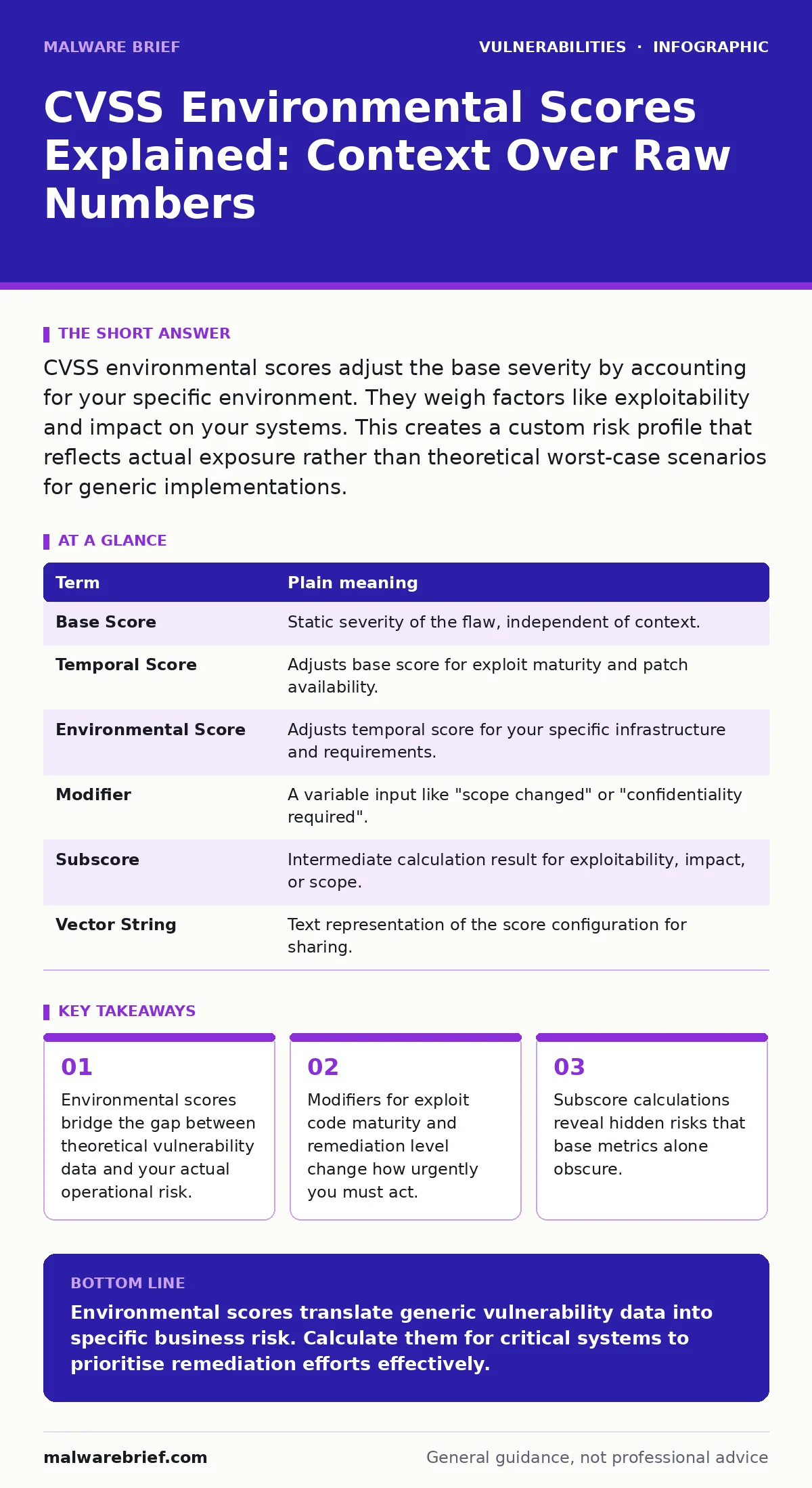
CVSS environmental scores adjust the base severity by accounting for your specific environment. They weigh factors like exploitability and impact on your systems. This creates a custom risk profile that reflects actual exposure rather than theoretical worst-case scenarios for generic implementations.
The Lock and The Storm
Imagine a standard padlock. The manufacturer rates its strength against a generic attacker with average tools. This rating never changes. It is the lock's base quality. Now imagine the lock is on a door exposed to a hurricane. The wind pressure and debris change the risk entirely. The lock has not changed, but the context has. CVSS environmental scores work like this weather report. They tell you how the storm affects the lock.
You cannot change the lock's base rating. You can, however, adjust the environmental modifiers. These modifiers reflect your reality. They include whether an attacker needs physical access or can strike remotely. They include whether a fix is available. They include whether the target system is protected by other controls. The base score is static. The environmental score is dynamic.
Key Terms Defined
Understanding the mechanics requires clear definitions. The Common Vulnerability Scoring System (CVSS) is a framework for rating vulnerabilities. It splits ratings into three vectors. The base vector is constant. The temporal vector changes over time. The environmental vector changes per deployment. You must distinguish these to avoid confusion.
| Term | Plain meaning |
|---|---|
| Base Score | Static severity of the flaw, independent of context. |
| Temporal Score | Adjusts base score for exploit maturity and patch availability. |
| Environmental Score | Adjusts temporal score for your specific infrastructure and requirements. |
| Modifier | A variable input like "scope changed" or "confidentiality required". |
| Subscore | Intermediate calculation result for exploitability, impact, or scope. |
| Vector String | Text representation of the score configuration for sharing. |
Common Points of Confusion
Many practitioners mix up temporal and environmental scores. Both adjust the base number. Temporal scores reflect the state of the vulnerability itself. Is exploit code available? Is a vendor fix released? These are universal facts. Environmental scores reflect your state. Do you have local user authentication? Is your system behind a firewall? These are local facts. Confusing them leads to incorrect prioritisation.
Another confusion involves the scope. If a vulnerability allows a low-privilege user to affect a high-privilege system, the scope changes. This dramatically increases the base score. Environmental modifiers then apply to this new base. If you ignore scope changes, your environmental calculation will be wrong. The math depends on the correct starting point.
Configuring Exploitability Modifiers
Exploitability modifiers assess how easy it is to attack you. You consider the attack vector. If your system is only accessible via local console, the score drops significantly. If it is internet-facing, the score rises. You also consider the attack complexity. Some flaws require specific conditions to trigger. Others trigger automatically.
You must also weigh the privileges required. Does the attacker need to log in first? If your system has broken access control, the required privileges might be lower than expected. This increases the risk. You should also check if user interaction is needed. Phishing relies on user interaction. Drive-by downloads do not. Your environment determines which is more likely.
Configuring Impact Modifiers
Impact modifiers assess the damage if the attack succeeds. You evaluate confidentiality, integrity, and availability. Not all data is equally sensitive. In one system, leaking user profiles is critical. In another, it is minor. You adjust the confidentiality requirement accordingly. The same applies to integrity and availability.
Consider a service that processes financial transactions. Availability is paramount. A denial-of-service attack here has a higher environmental score than against a static brochure site. You must align these modifiers with your business logic. If you treat all systems as equally critical, you waste resources. If you treat critical systems as low priority, you face disaster.
See also: Mitigations and Workarounds: Security Controls Without Patches · Patch Management: Eight Questions Answered for Stability
Practical Application Steps
You need a systematic approach to apply these scores. Do not guess. Document your assumptions. Use the following steps to calculate your environmental scores accurately.
- Identify the base score and temporal score from a trusted source. Ensure the temporal score reflects the current state of exploit code and patches.
- Map your infrastructure to the environmental modifiers. Determine if local access is possible. Define the confidentiality and integrity requirements for the affected component.
- Calculate the environmental score using a standard calculator. Review the resulting vector string. Verify that the modifiers match your documented infrastructure.
This process turns abstract numbers into actionable intelligence. It helps you prioritise fixes based on actual risk. It prevents you from ignoring low-base-score flaws that are high-risk in your context.
Integrating With Broader Security
Environmental scores do not exist in isolation. They inform your broader security strategy. For instance, IoT device vulnerabilities often have low base scores due to limited functionality. However, their environmental scores may be high due to physical accessibility and lack of patching. Understanding this nuance prevents oversight.
Similarly, secure code review processes should consider environmental context. A flaw in a library used only internally may have a lower environmental score than one in a public API. This allows you to allocate review resources more effectively. You focus on the highest environmental risk first.
Related Vulnerability Classes
Some vulnerability types inherently skew environmental scores. XML external entity (XXE) attacks often depend on server configuration. If your parser is hardened, the environmental score drops. If not, it rises. Python pickle deserialization flaws are dangerous because they allow arbitrary code execution. The environmental score here depends heavily on trust boundaries.
WordPress plugin vulnerabilities are common. Their environmental scores vary wildly depending on whether the site is public or private. Vulnerability embargoes complicate temporal scores, as patches are not yet public. Backported security fixes may not address the root cause, affecting the temporal modifier. Backed access control issues often change the scope, impacting the base score before environmental modifiers apply.
Key takeaways
- Environmental scores bridge the gap between theoretical vulnerability data and your actual operational risk.
- Modifiers for exploit code maturity and remediation level change how urgently you must act.
- Subscore calculations reveal hidden risks that base metrics alone obscure.
Environmental scores translate generic vulnerability data into specific business risk. Calculate them for critical systems to prioritise remediation efforts effectively.
Frequently asked questions
Do I need to recalculate environmental scores for every vulnerability?
No. Focus on critical systems and high-base-score vulnerabilities. Routine flaws on non-critical systems can use default assumptions.
Can environmental scores be lower than base scores?
Yes. If your environment has strong mitigations like strict access controls or isolated networks, the environmental score will decrease.
How do I handle missing information for modifiers?
Assume the worst-case scenario for missing data. If you do not know if a patch is available, assume it is not. This ensures conservative risk estimation.
Are environmental scores standardised across organisations?
No. Each organisation defines its own modifiers based on its specific infrastructure and risk appetite. Scores are not directly comparable between different entities.
How this guide was produced: written by the Malware Brief editorial team with AI assistance, checked against the public references listed below, and reviewed when the facts change. See our editorial policy or report an error.