CVE Numbering Authorities: What Small Businesses Must Verify
Small businesses often pay for vulnerability data that is already free, because they skip checking the source of the CVE identifier.
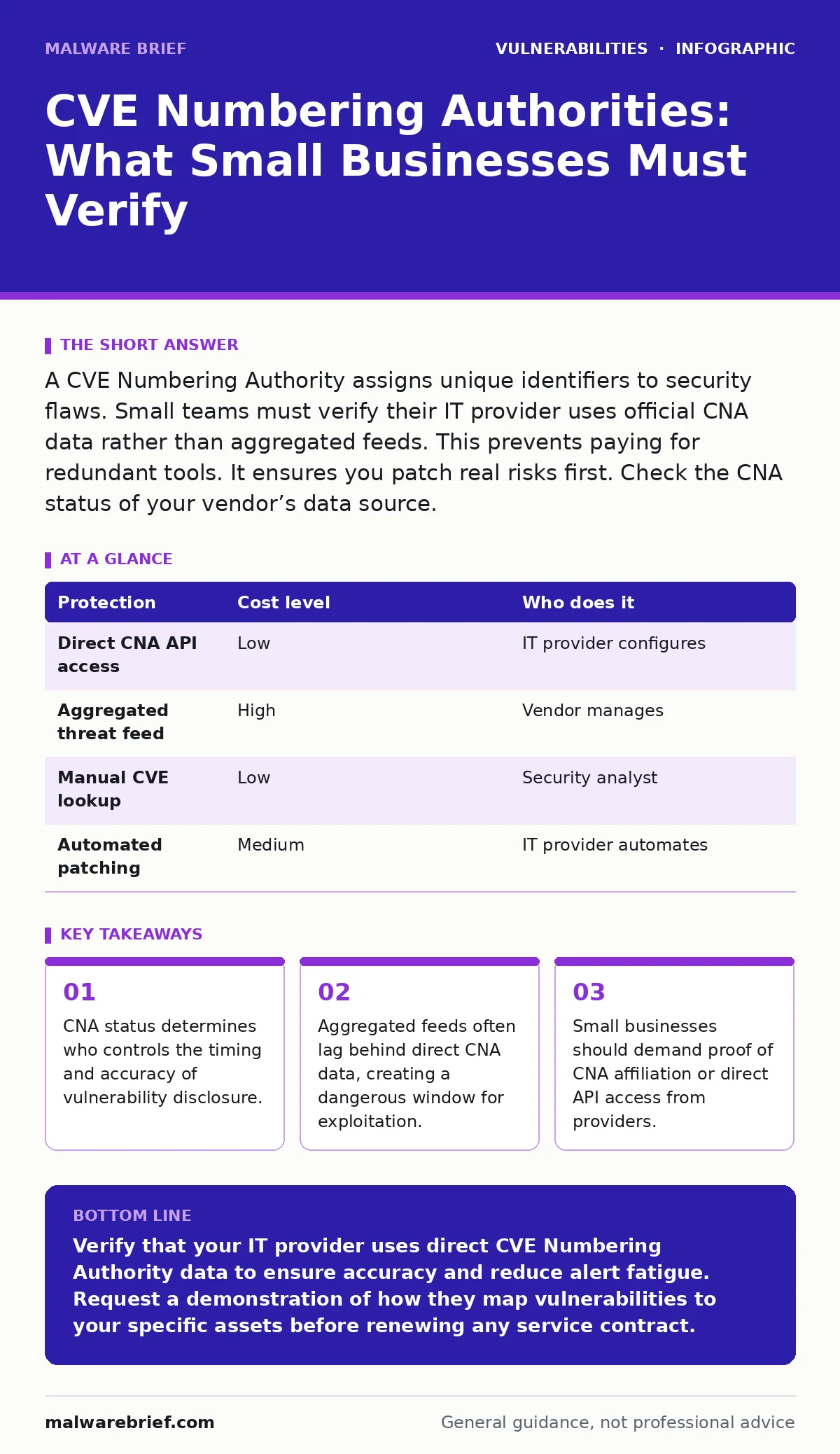
A CVE Numbering Authority assigns unique identifiers to security flaws. Small teams must verify their IT provider uses official CNA data rather than aggregated feeds. This prevents paying for redundant tools. It ensures you patch real risks first. Check the CNA status of your vendor’s data source.
What Is a CVE Numbering Authority
A CVE Numbering Authority is an organisation approved by the MITRE Corporation to assign Common Vulnerabilities and Exposures identifiers. The CVE system provides a standard language for discussing security flaws. Without this standard, two vendors might use different names for the same bug. This creates confusion in patch management. The CNA is the gatekeeper of this standard. They also assign the severity score. This score drives your prioritisation. If your IT provider does not understand CNA roles, they are buying processed data. You are paying for someone else’s interpretation of the raw signal. Direct access to CNA data removes that middleman.
Why Scale Changes the Risk Profile
Large enterprises have dedicated threat intelligence teams. They can cross-reference multiple feeds and filter noise. Small businesses rely on automated alerts. These alerts are only as good as their source. If the source is a secondary aggregator, the data is stale. Stale data means you patch low-risk items while ignoring active threats. This is a hidden cost of convenience.
The aggregator adds value by formatting data, not by improving accuracy. In many cases, the formatting introduces errors. You lose the ability to verify the origin of the alert. You also lose the context of the disclosure timeline. Early disclosure often provides mitigation steps before a patch exists. Aggregators rarely surface this nuance. They simply show a red dot.
The Cost of Unverified Data Sources
Imagine your network is scanned by an automated tool. The tool reports a critical vulnerability in your web server. You rush to update. The update fails. You spend hours troubleshooting. Later, you discover the tool flagged a default configuration as a vulnerability. This is a false positive. False positives erode trust in your security process. Staff begin to ignore alerts.
This is called alert fatigue. When a real attack occurs, the team misses it because they have tuned out the noise. The noise comes from poor data hygiene. Using a non-CNA source increases the likelihood of noise. CNA data is curated. It undergoes validation before publication. Aggregated data is scraped. It is fast, but it is dirty. You pay for speed at the expense of accuracy.
| Protection | Cost level | Who does it |
|---|---|---|
| Direct CNA API access | Low | IT provider configures |
| Aggregated threat feed | High | Vendor manages |
| Manual CVE lookup | Low | Security analyst |
| Automated patching | Medium | IT provider automates |
What to Ask Your IT Provider
You must interrogate your IT provider about their data pipeline. Do not accept vague answers about "advanced threat intelligence". Ask for specifics. The following questions reveal whether they are adding value or just reselling data.
- Which CVE Numbering Authority provides the raw data for your alerts?
- How often is the data refreshed, and is it real-time or batched?
- Do you filter alerts based on our specific asset inventory, or do we receive generic warnings?
- Can you provide a sample report showing the source of a recent high-severity alert?
- How do you handle false positives reported by our team?
These questions force transparency. If the provider cannot name the CNA, they are likely using a third-party aggregator. This is not inherently bad, but it is a cost you should not bear blindly. You should know the trade-off. If they use a CNA directly, you get faster, cleaner data. If they use an aggregator, you get more noise. You must decide which risk you prefer.
Integrating CNA Data into Patch Management
Patch management is the process of applying updates to fix vulnerabilities. It is not enough to patch everything. You must patch the right things first. CNA data provides the Common Vulnerability Scoring System score. This score helps you prioritise. However, the score is only a starting point. You must combine it with your asset inventory. A critical flaw in an unused server is lower risk than a moderate flaw in a public-facing gateway.
This is where contextual risk matters. Your IT provider must map CVEs to your specific hardware and software. This mapping is difficult. It requires accurate inventory data. If your inventory is wrong, your prioritisation is wrong. This is a common failure point in small businesses. They have the data, but they do not know what they own.
See also: IoT Device Vulnerabilities Explained for Beginners · Spot Broken Access Control: Warning Signs and Remediation Steps
The Role of Dependency Updates
Modern applications rely on libraries and frameworks. These are dependencies. A vulnerability in a dependency affects every application that uses it. This is known as supply chain risk. CVEs are assigned to these dependencies too. Your IT provider must track these. It is not enough to patch the operating system. You must patch the code libraries. This requires a different approach. You cannot simply click "update".
You must test the update. A dependency update can break your application. This is why dependency updates must be tested in a staging environment. Small businesses often skip staging. They update directly in production. This causes outages. The outage is often more damaging than the vulnerability. Balance is required. You need to know the risk of the vulnerability and the risk of the fix.
Mitigations and Workarounds
Not all vulnerabilities have patches. Some are in legacy systems that cannot be updated. In these cases, you need mitigations and workarounds. These are temporary fixes. They might involve firewall rules, access controls, or configuration changes. CNA data often lists these mitigations. Aggregated feeds rarely do. They just show the vulnerability.
You need the workaround details to protect yourself. This is another reason to prefer direct CNA data. It provides the full picture. It tells you what to do when you cannot patch. Your IT provider should document these workarounds. They should review them regularly. Workarounds are not permanent. They degrade over time. You must plan to remove them when a patch becomes available.
Avoiding Common Misconfigurations
Misconfigurations often mimic vulnerabilities. A default password is not a CVE. It is a mistake. But scanners often flag it as a high-risk issue. This creates confusion. You waste time fixing a config error that is not a software flaw. Your IT provider should distinguish between these. They should use input validation techniques in their scanning tools. This reduces false positives. It also helps you focus on real threats. If your provider cannot distinguish between a CVE and a misconfiguration, their data is noisy. You need clean data. Clean data leads to better decisions. Bad data leads to panic and wasted resources.
Key takeaways
- CNA status determines who controls the timing and accuracy of vulnerability disclosure.
- Aggregated feeds often lag behind direct CNA data, creating a dangerous window for exploitation.
- Small businesses should demand proof of CNA affiliation or direct API access from providers.
Verify that your IT provider uses direct CVE Numbering Authority data to ensure accuracy and reduce alert fatigue. Request a demonstration of how they map vulnerabilities to your specific assets before renewing any service contract.
Frequently asked questions
How often should I check for new CVEs?
You should not check manually. Your IT provider should automate this. Alerts should be real-time or daily. Manual checks are too slow for modern threats.
Do I need a CNA if I use a managed service provider?
You do not need to become a CNA. You need your provider to use CNA data. Ask them to prove this. It ensures you are not paying for stale information.
What if a vulnerability has no patch?
Use mitigations and workarounds. Isolate the affected system. Reduce access. Plan for a replacement. Document the risk and accept it formally.
Can I trust automated scanners?
Trust them, but verify. Scanners are tools, not experts. They miss context. Always review high-severity alerts with a human. Do not automate every response.
How this guide was produced: written by the Malware Brief editorial team with AI assistance, checked against the public references listed below, and reviewed when the facts change. See our editorial policy or report an error.