DCSync Attack Prevention Checklist for Active Directory Security
DCSync abuse requires only read permissions on the directory service replication interface, meaning standard password policies offer no defence against this specific extraction method.
Secure your domain controllers by applying the principle of least privilege to directory service access. Restrict Replicating Directory Changes permissions to domain controllers only, enforce strict account lifecycle management, and monitor for unusual replication requests that indicate credential harvesting.
Understanding the DCSync Mechanism
DCSync is not a traditional exploit that targets a software vulnerability. It abuses a legitimate feature of Active Directory called Directory Service Replication. Domain controllers use this protocol to synchronise user accounts and password hashes across the network. An attacker who possesses the correct permissions can impersonate a domain controller and request this data. The result is a complete copy of password hashes from the directory.
This method bypasses many traditional defences. It does not require local access to a server. It does not need to dump memory from a running process. The attacker simply needs network access and specific directory rights. Understanding this distinction is the first step in building effective controls. You are defending against an authorised action, not an unauthorised one.
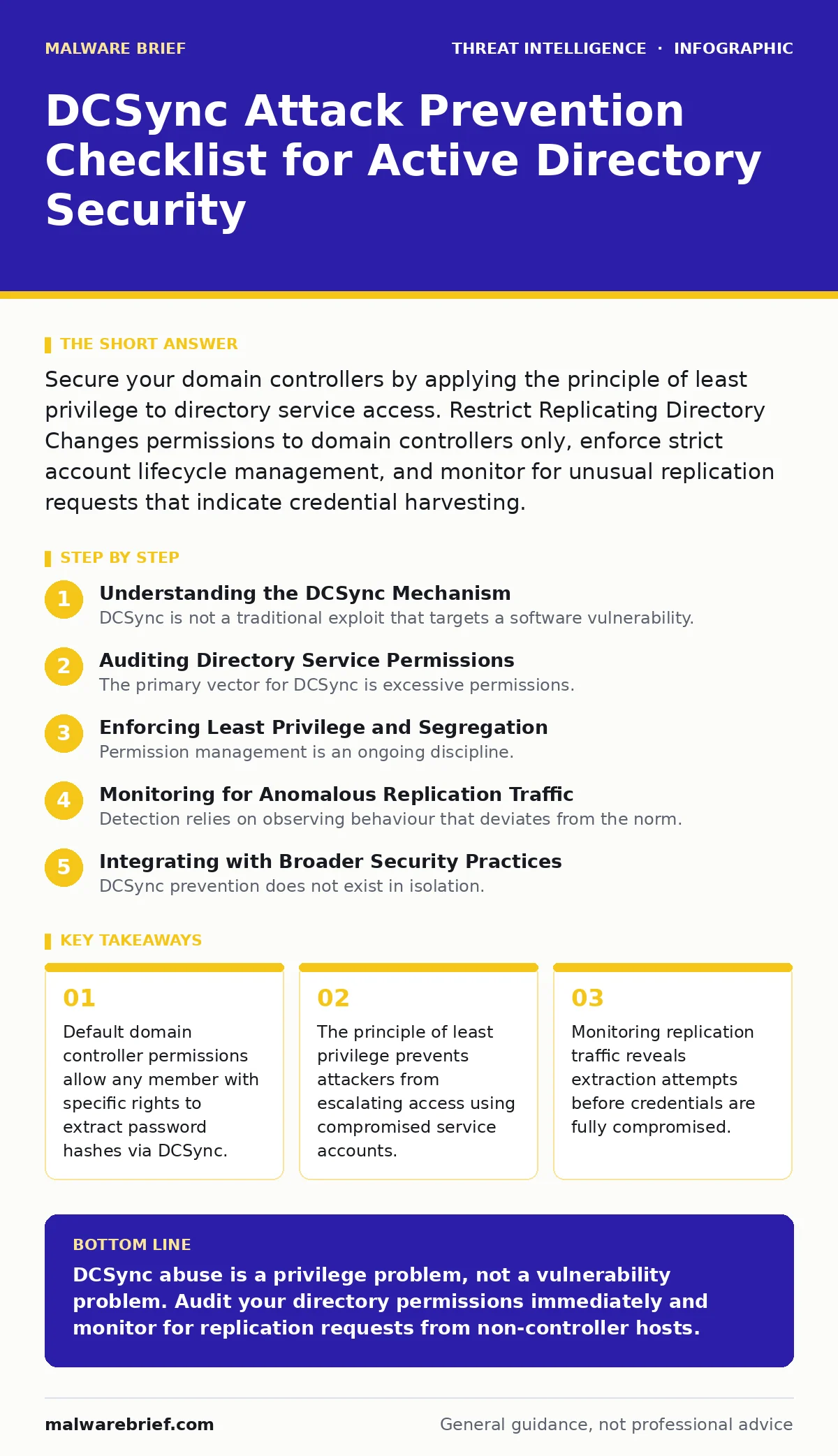
Auditing Directory Service Permissions
The primary vector for DCSync is excessive permissions. By default, certain built-in groups have the right to replicate directory changes. Attackers often target these groups or accounts with delegated administration rights. You must audit who holds these permissions.
- Review members of the Domain Admins group: excessive membership increases the attack surface for credential theft.
- Audit the Enterprise Admins group: these accounts can modify permissions across the entire forest structure.
- Check for accounts with DCSync rights: only domain controllers should possess Replicating Directory Changes permissions.
- Remove standalone servers from DCSync rights: non-controller servers should never replicate directory data.
- Verify Read Permission for User Objects: this allows attackers to discover which accounts have valuable privileges.
Imagine a scenario where a helpdesk administrator is added to Domain Admins for a temporary fix. If that account is compromised, the attacker gains immediate DCSync capabilities. This is a common failure point in organisations that struggle with offboarding processes.
Enforcing Least Privilege and Segregation
Permission management is an ongoing discipline. You must separate duties to limit the blast radius of a compromised account. Service accounts often run with higher privileges than necessary. These accounts are attractive targets because they are rarely monitored closely.
- Implement AdminSDHolder protection: this ensures standard security descriptors are applied to protected groups.
- Separate management and operational accounts: administrators should never log in with their daily use credentials.
- Restrict delegation of administrative rights: use fine-grained permissions instead of broad group membership.
- Disable unused built-in accounts: default accounts like Guest or IUSR_MACHINE should be disabled and renamed.
- Audit service account permissions: ensure services run with minimal required rights rather than local admin access.
This approach reduces the likelihood that a single compromised credential leads to full domain control. It also complicates the path for threat actors who rely on lateral movement. You are forcing them to overcome multiple barriers rather than one wide gate.
Monitoring for Anomalous Replication Traffic
Detection relies on observing behaviour that deviates from the norm. DCSync requests generate specific events in the security logs. These events are easy to miss if you are only looking for failed logins. You must tune your monitoring to catch successful replication requests from unexpected sources.
- Monitor Event ID 4662 for directory service access: this log entry records attempts to read or write directory objects.
- Alert on Replicating Directory Changes requests: any source other than a domain controller should trigger an alert.
- Track replication source addresses: identify which IPs are initiating directory synchronisation tasks.
- Baseline normal replication patterns: understand the frequency and volume of legitimate sync events.
- Correlate with account login times: replication during off-hours from a workstation is highly suspicious.
Suppose a compromised workstation initiates a DCSync request. The traffic looks like normal domain replication to a casual observer. However, the source IP belongs to a user machine, not a controller. This discrepancy is the key indicator. You must act on these signals before the attacker extracts the KRBTGT hash.
See also: Threat Actors Definition: Who They Are and How They Operate
Integrating with Broader Security Practices
DCSync prevention does not exist in isolation. It intersects with other areas of identity security. If an attacker can perform credential dumping on a local machine, they may obtain credentials that have DCSync rights. If they can abuse scheduled task abuse mechanisms, they may persist with elevated privileges.
You should align your DCSync controls with your wider detection strategy. IOC enrichment helps you identify compromised accounts faster. Understanding how pass-the-hash attacks work clarifies why protecting password hashes is critical. Threat actors often combine these techniques to maintain access.
- Align with credential dumping prevention: reduce the number of high-privilege credentials stored on endpoints.
- Enhance incident response playbooks: include specific steps for investigating DCSync indicators of compromise.
- Regularly test detection rules: ensure your monitoring catches simulated DCSync attempts accurately.
- Review red teaming findings: use simulated attacks to validate the effectiveness of your permission controls.
This holistic view ensures that closing one door does not simply push the attacker to another weak point. Security is a system of interconnected controls. You must maintain the integrity of the entire identity infrastructure.
Key takeaways
- Default domain controller permissions allow any member with specific rights to extract password hashes via DCSync.
- The principle of least privilege prevents attackers from escalating access using compromised service accounts.
- Monitoring replication traffic reveals extraction attempts before credentials are fully compromised.
DCSync abuse is a privilege problem, not a vulnerability problem. Audit your directory permissions immediately and monitor for replication requests from non-controller hosts.
Frequently asked questions
What is the DCSync attack?
DCSync is an attack technique that abuses the directory service replication protocol to extract password hashes from Active Directory by impersonating a domain controller.
How do I stop DCSync attacks?
You stop DCSync attacks by strictly limiting Replicating Directory Changes permissions to domain controllers only and monitoring for replication requests from other sources.
Can antivirus software detect DCSync?
Antivirus software typically cannot detect DCSync because it uses legitimate system APIs and network protocols, making it invisible to signature-based detection methods.
What permissions are needed for DCSync?
An account needs either Replicating Directory Changes or Replicating Directory Changes All permissions, which are usually held by domain controllers and domain admins.
How this guide was produced: written by the Malware Brief editorial team with AI assistance, checked against the public references listed below, and reviewed when the facts change. See our editorial policy or report an error.