Threat Actors Definition: Who They Are and How They Operate
Threat actors range from curious students to state-sponsored groups, making attribution difficult and requiring defenders to focus on behaviour rather than identity.
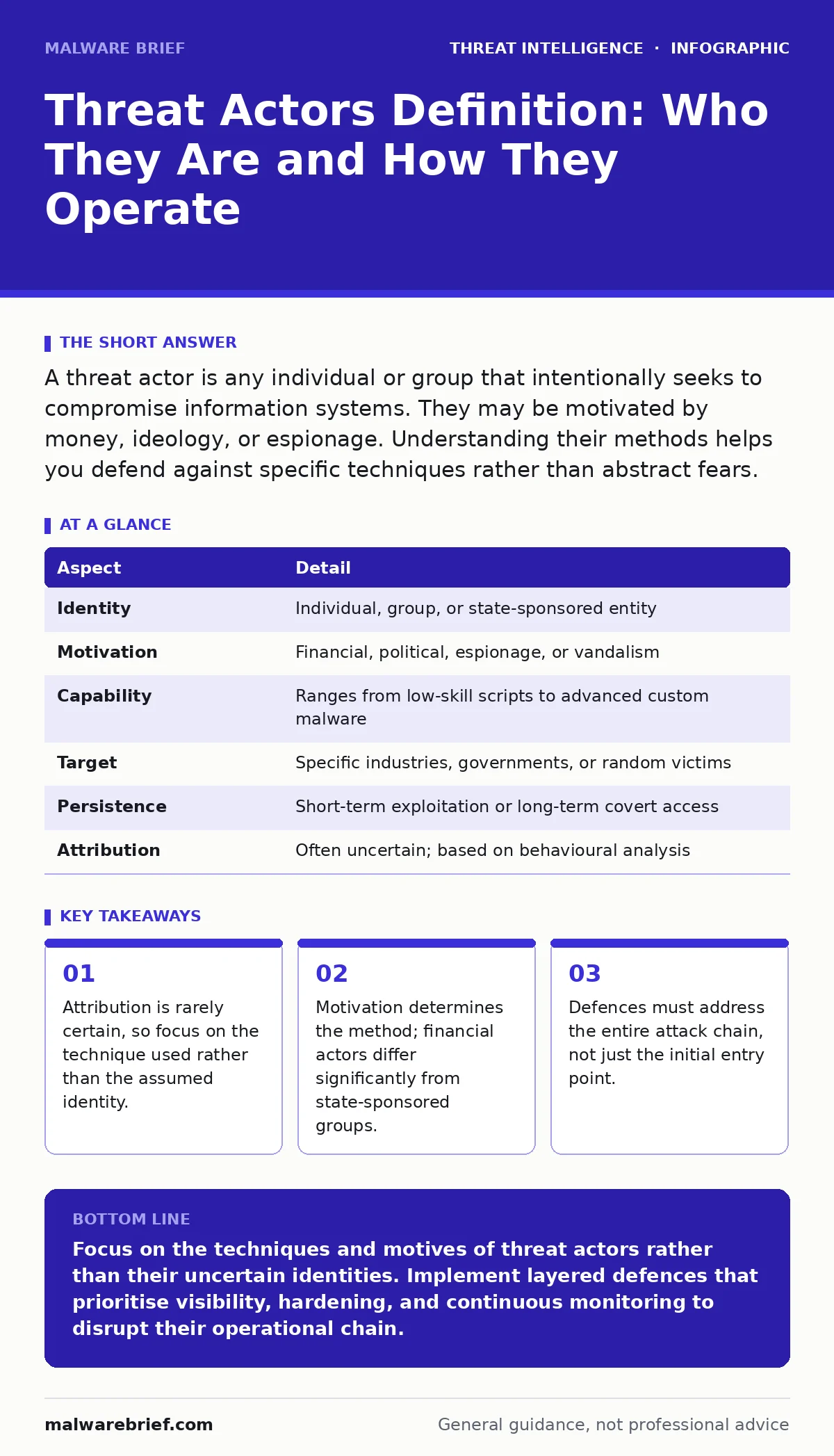
A threat actor is any individual or group that intentionally seeks to compromise information systems. They may be motivated by money, ideology, or espionage. Understanding their methods helps you defend against specific techniques rather than abstract fears.
Threat Actors Definition and Core Concept
A threat actor is any person, group, or entity that has the motive, intent, and capability to cause harm to an information system. They are not merely hackers; they are adversaries with specific goals that drive their technical choices. The term covers a wide spectrum of behaviour. Some actors seek financial gain through ransomware. Others pursue political change through hacktivism. Still others conduct espionage for national security purposes.
The definition matters because it shifts the focus from the tool to the user. A script kiddie using a downloaded exploit differs fundamentally from a state-sponsored team writing custom code. Both may breach a server, but their persistence, sophistication, and end goals diverge sharply. You must identify the actor to predict their next move.
| Aspect | Detail |
|---|---|
| Identity | Individual, group, or state-sponsored entity |
| Motivation | Financial, political, espionage, or vandalism |
| Capability | Ranges from low-skill scripts to advanced custom malware |
| Target | Specific industries, governments, or random victims |
| Persistence | Short-term exploitation or long-term covert access |
| Attribution | Often uncertain; based on behavioural analysis |
How Threat Actors Operate
Threat actors follow a structured approach to compromise systems. They rarely act on impulse. Most follow a kill chain model, moving from reconnaissance to action on objectives. This structure allows them to minimise detection while maximising impact. Understanding this flow is critical for defence.
The process begins with intelligence gathering. Actors research their targets to find vulnerabilities. They may scrape websites for employee names or scan for exposed services. This phase is silent and leaves few traces. Next, they attempt initial access. This might involve phishing emails or exploiting unpatched software. Once inside, they establish persistence to survive reboots or credential changes.
From there, they perform privilege escalation. They seek higher-level permissions to access sensitive data. Lateral movement follows, as they traverse the network to reach high-value targets. Finally, they execute their goal, whether exfiltrating data, encrypting files, or destroying records. Each stage offers opportunities for detection if you monitor the right signals.
Who Threat Actors Affect
Threat actors select targets based on value and vulnerability. Large organisations with sensitive data are prime targets for espionage and extortion. Small businesses often face automated attacks because they lack defences. The impact varies by sector. Healthcare providers face threats to patient safety. Financial institutions risk capital loss.
Critical infrastructure is a frequent target for state-sponsored actors. Disrupting power grids or water supplies creates societal chaos. Retailers face data theft for resale. Educational institutions suffer from credential dumping due to lax security practices. No sector is immune. The scale of impact depends on the actor’s resources and the victim’s preparedness.
You must assess your own value proposition. Do you hold data that is valuable on the dark web? Are you a stepping stone to a larger partner? Understanding your attractiveness to adversaries helps prioritise defences. It also informs the type of threat actor you are most likely to face.
What People Usually Get Wrong
Many defenders fixate on attribution. They want to know exactly who attacked them. This is often impossible. Threat actors use proxies, compromised servers, and false flags to hide their identity. Focusing on the "who" distracts from the "how". The technique used is a more reliable indicator of risk.
Another common error is assuming all actors are equally sophisticated. Script kiddies use automated tools with predictable behaviour. Advanced persistent threats (APTs) write custom code and operate with patience. Treating all breaches the same leads to wasted resources. You should tailor responses to the observed sophistication level.
People also overlook the human element. Technical controls fail when users bypass them. Social engineering remains a primary entry point. Defenders often invest heavily in firewalls while neglecting user training. This imbalance leaves the weakest link exposed. A balanced approach combines technical and human defences.
Motives Drive Methods
Motivation dictates the tactics used by threat actors. Financial actors seek quick returns. They use ransomware and data theft. Their methods are often automated and widespread. They target many victims to maximise profit. State-sponsored actors have different goals. They seek long-term access for espionage.
Ideological actors, such as hacktivists, aim for publicity. They deface websites or leak data. Their attacks are often loud and disruptive. Vandalists cause damage for the sake of it. They lack a clear agenda beyond destruction. Understanding the motive helps predict behaviour. Financial actors may negotiate. State actors rarely do.
This distinction influences incident response. A ransomware attack requires containment and recovery. An espionage campaign requires forensic analysis to determine what was taken. Misidentifying the motive can lead to inappropriate actions. For instance, paying a ransom might be considered for financial actors, but never for state-sponsored groups.
See also: Social Engineering Prevention Checklist: Stop Manipulation Before Access · Ransomware Incident Response: Steps to Contain and Recover
Defending Against Unknown Adversaries
Defence requires a layered approach. You cannot block all attacks. You must slow them down and detect them early. Start with visibility. You cannot protect what you cannot see. Implement logging and monitoring across your environment. Look for anomalies in user behaviour and network traffic.
Harden your systems. Patch vulnerabilities promptly. Use least privilege principles. Limit the damage a compromised account can cause. This reduces the effectiveness of lateral movement. Implement multi-factor authentication. This stops many credential-based attacks. Even if an actor steals a password, they cannot access the account without the second factor.
Conduct regular exercises. Simulate attacks to test your defences. Identify gaps in your detection and response capabilities. Update your playbooks based on lessons learned. Threat actors evolve, and so must you. Static defences fail against dynamic adversaries. Continuous improvement is the only sustainable strategy.
The Role of Intelligence
Threat intelligence transforms raw data into actionable insights. It helps you understand the tactics, techniques, and procedures (TTPs) of relevant actors. This knowledge allows you to anticipate attacks. You can configure your defences to detect specific behaviours. IOC enrichment adds context to indicators of compromise.
Intelligence is not just about external threats. It includes understanding your own environment. What assets are most valuable? What vulnerabilities exist? Internal intelligence complements external data. It provides a complete picture of your risk landscape. Share intelligence within your organisation. Ensure all teams understand the threats.
Collaboration is key. Share information with trusted partners. Learn from their experiences. Do not reinvent the wheel. The intelligence cycle guides this process. It involves planning, collection, processing, analysis, and dissemination. Following this cycle ensures consistent and high-quality intelligence.
Practical Steps for Implementation
Implementing a defence strategy requires discipline. Start with an asset inventory. Know what you have and where it is. Prioritise protection for critical assets. Apply security controls based on risk. Not all systems need the same level of defence. Focus resources where they matter most.
Monitor for anomalies. Set up alerts for suspicious activity. Investigate alerts promptly. False positives are common, but do not ignore them. Every alert is a potential indicator of compromise. Document your findings. Build a knowledge base of your environment. This speeds up future investigations.
Train your staff. Human error is a major risk. Educate users on recognising phishing and social engineering. Encourage a culture of security. Make it easy for users to report suspicious activity. Reward good behaviour. Security is a team effort. Everyone plays a role in defending the organisation.
Key takeaways
- Attribution is rarely certain, so focus on the technique used rather than the assumed identity.
- Motivation determines the method; financial actors differ significantly from state-sponsored groups.
- Defences must address the entire attack chain, not just the initial entry point.
Focus on the techniques and motives of threat actors rather than their uncertain identities. Implement layered defences that prioritise visibility, hardening, and continuous monitoring to disrupt their operational chain.
Frequently asked questions
How do I identify a threat actor?
You cannot always identify the specific individual or group. Focus on analysing the tactics, techniques, and procedures used during the attack to categorise the type of actor and their likely motives.
Are all threat actors sophisticated?
No. Many actors use automated, low-skill tools. Others are highly sophisticated state-sponsored groups. The level of sophistication varies widely and should not be assumed based on a single incident.
What is the difference between a hacker and a threat actor?
"Hacker" is a broad term that can include ethical security researchers. "Threat actor" specifically refers to individuals or groups with malicious intent to compromise systems or data.
How does hacktivism differ from other threats?
Hacktivism is driven by political or social ideology. Actors seek publicity and change rather than financial gain or espionage. Their methods often include defacement and data leaks to attract attention.
How this guide was produced: written by the Malware Brief editorial team with AI assistance, checked against the public references listed below, and reviewed when the facts change. See our editorial policy or report an error.