Reading Security Advisories: How to Priorise Patching and Risk
Security advisories contain hidden context about exploit complexity and business impact that raw vulnerability scores ignore.

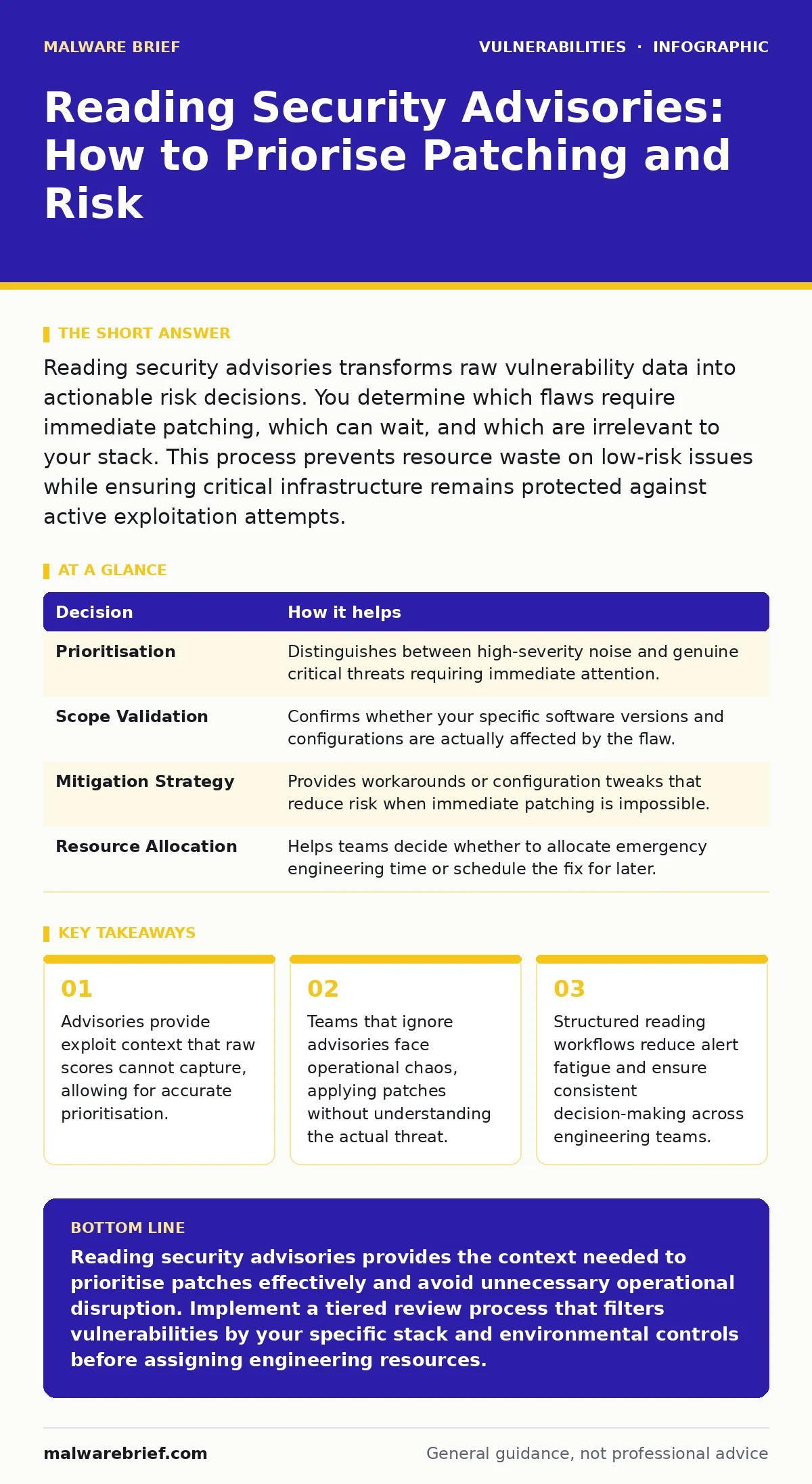
Reading security advisories transforms raw vulnerability data into actionable risk decisions. You determine which flaws require immediate patching, which can wait, and which are irrelevant to your stack. This process prevents resource waste on low-risk issues while ensuring critical infrastructure remains protected against active exploitation attempts.
The Information Gap in Vulnerability Data
Raw vulnerability identifiers lack context. A Common Vulnerabilities and Exposures identifier, or CVE, is merely a label for a flaw. It tells you nothing about how difficult it is to exploit, whether an attack requires user interaction, or if a workaround exists. Security advisories fill this gap. They are structured documents published by vendors or researchers that explain the nature of the flaw, the affected versions, and the severity. Without reading these documents, you are making decisions based on incomplete information. This leads to either panic-driven patching or dangerous neglect.
Decisions Informed by Advisory Content
You use advisory content to make three specific types of decisions. First, you determine urgency. An advisory might state that a flaw is theoretical, meaning no working exploit exists in the wild. This allows you to defer patching until your next scheduled maintenance window. Second, you assess scope. The advisory lists affected components. If your system does not use that component, the vulnerability is irrelevant. Third, you choose mitigation. Some advisories suggest configuration changes that reduce risk without requiring a code update. These decisions save engineering hours and reduce service disruption.
| Decision | How it helps |
|---|---|
| Prioritisation | Distinguishes between high-severity noise and genuine critical threats requiring immediate attention. |
| Scope Validation | Confirms whether your specific software versions and configurations are actually affected by the flaw. |
| Mitigation Strategy | Provides workarounds or configuration tweaks that reduce risk when immediate patching is impossible. |
| Resource Allocation | Helps teams decide whether to allocate emergency engineering time or schedule the fix for later. |
The Cost of Ignoring Advisories
Suppose a team receives a notification about a high-severity flaw in a library they use. They do not read the advisory. They assume the worst and deploy a patch immediately. The patch breaks a critical production service because it introduces a compatibility issue with another dependency. The team spends days debugging the outage. Meanwhile, the advisory would have stated that the flaw only affects systems with a specific, rarely used feature enabled. Their system was not at risk. The patching effort was wasted. This is a common failure mode. Acting on headlines rather than details creates more risk than the vulnerability itself.
How Teams Structure Advisory Reading
Effective teams do not read every advisory in full. They use a tiered approach. Security engineers scan headlines and severity scores first. They filter for vulnerabilities that affect their specific technology stack. For those that match, they read the technical details. They check for exploit availability and required conditions. If the risk is high and the exploit is easy, they escalate to engineering. If the risk is low, they log it for future review. This process requires tooling that aggregates advisories from multiple sources. It also requires a culture where engineers trust the security team’s prioritisation.
The Role of Contextual Scoring
A base score alone is misleading. The Common Vulnerability Scoring System, or CVSS, includes environmental metrics. These metrics allow you to adjust the score based on your specific environment. For example, a flaw in a database server might have a high base score. However, if that server is not internet-facing and requires local authentication, the environmental score drops significantly. Reading the advisory helps you determine these factors. You might find that the flaw requires network access that your firewall already blocks. This contextual understanding is vital for accurate risk assessment. It prevents you from treating all high scores as emergencies.
See also: CVE Numbering Authorities: What Small Businesses Must Verify · Mitigations and Workarounds: Security Controls Without Patches
Handling Complex Supply Chain Risks
Modern software relies on many third-party libraries. A vulnerability in a deep dependency can affect your entire application. Advisories for these components often lack clear guidance on which versions of your main application are affected. You must cross-reference the advisory with your dependency tree. This process is time-consuming. It is why many teams struggle with dependency updates. They see a flaw in a library but cannot determine if their application imports the vulnerable function. Reading the advisory carefully reveals which functions are affected. You can then check if your code calls those functions. If it does not, you may not need to update immediately.
The Human Element in Automation
Tools can aggregate advisories, but they cannot interpret nuance. An automated system might flag a vulnerability as critical because it affects a popular framework. It does not know that your team has disabled the vulnerable feature. It does not know that you have a compensating control in place. Human review is required to apply this knowledge. You must read the advisory to confirm that your mitigations are effective. You must decide if the vendor’s recommended fix is sufficient or if you need a custom solution. This human-in-the-loop approach ensures that automation serves your security strategy rather than dictating it.
Integrating Advisories into Development Cycles
Security advisory reading should not be a reactive activity. It should be part of your regular development cycle. Teams that review advisories weekly stay ahead of emerging threats. They identify trends in vulnerable components. They can proactively replace risky libraries before a flaw is discovered. This proactive stance reduces the pressure during emergency patching windows. It also improves the overall resilience of your software. By understanding the landscape of known flaws, you make better architectural decisions. You choose components with better security track records. You design systems that are easier to patch.
The Limits of Advisory Coverage
Not all flaws have advisories. Zero-day vulnerabilities, by definition, have no public advisory until they are discovered. Some vendors publish advisories slowly. Others never publish them for minor flaws. You cannot rely solely on advisories for complete security. You must combine advisory reading with other security practices. This includes monitoring for unusual network activity, conducting regular penetration testing, and implementing strict access controls. Advisories are a powerful tool, but they are only one part of your defence. They tell you about known risks. They do not protect you from unknown ones.
Key takeaways
- Advisories provide exploit context that raw scores cannot capture, allowing for accurate prioritisation.
- Teams that ignore advisories face operational chaos, applying patches without understanding the actual threat.
- Structured reading workflows reduce alert fatigue and ensure consistent decision-making across engineering teams.
Reading security advisories provides the context needed to prioritise patches effectively and avoid unnecessary operational disruption. Implement a tiered review process that filters vulnerabilities by your specific stack and environmental controls before assigning engineering resources.
Frequently asked questions
How do I prioritise which advisories to read first?
Filter advisories by the technologies you use and their severity scores. Focus on flaws with known exploits and those affecting internet-facing systems. Ignore advisories for components you do not use or that are isolated from your network.
What if an advisory does not provide a clear fix?
Look for workarounds or configuration changes mentioned in the advisory. If none exist, implement compensating controls such as network segmentation or access restrictions. Monitor for updates from the vendor and plan for a patch when available.
Do I need to read every advisory for my stack?
No. Use automated tools to filter for relevant vulnerabilities. Read the full advisory only for high-severity issues or those affecting critical infrastructure. For lower-risk issues, a headline scan may be sufficient to confirm they are not relevant to your configuration.
How do advisories relate to CVE Numbering Authorities?
CVE Numbering Authorities assign identifiers to vulnerabilities. Advisories provide the detailed context for those identifiers. You use the CVE to find the advisory, and the advisory to understand the risk and mitigation steps for your specific environment.
How this guide was produced: written by the Malware Brief editorial team with AI assistance, checked against the public references listed below, and reviewed when the facts change. See our editorial policy or report an error.