Third-Party Data Breach Mistakes: 7 Errors That Expose Your Systems
Assuming a vendor’s security posture mirrors your own is the primary error, as supply chain attacks bypass your perimeter defences entirely.
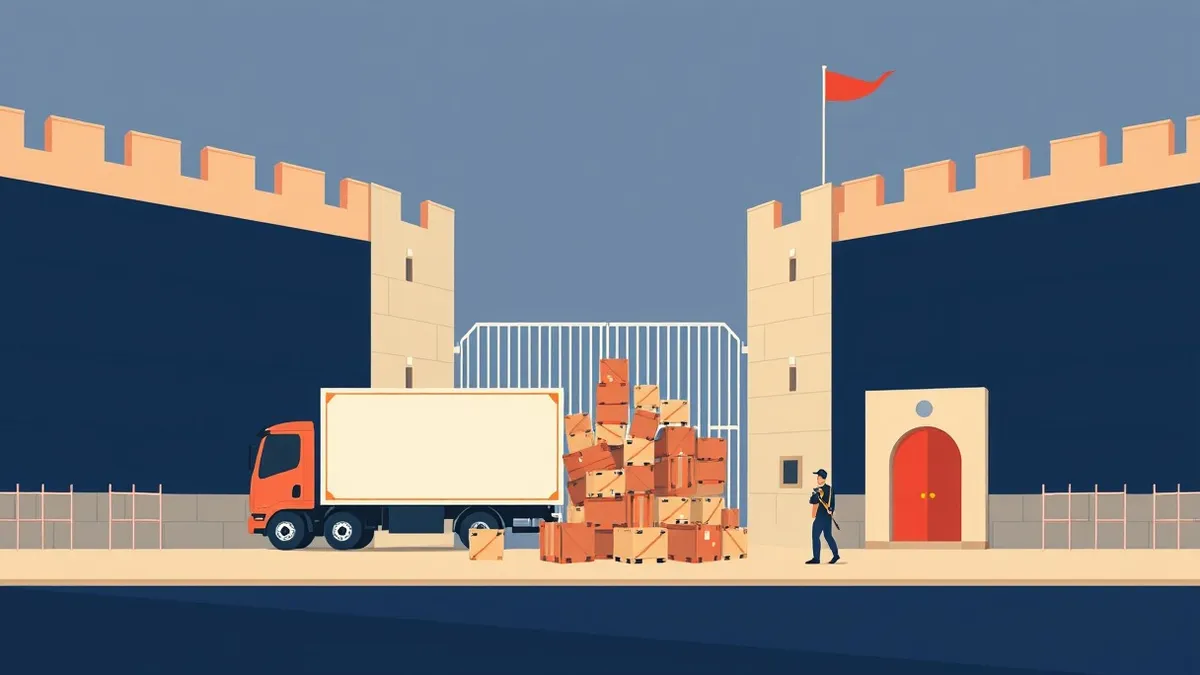
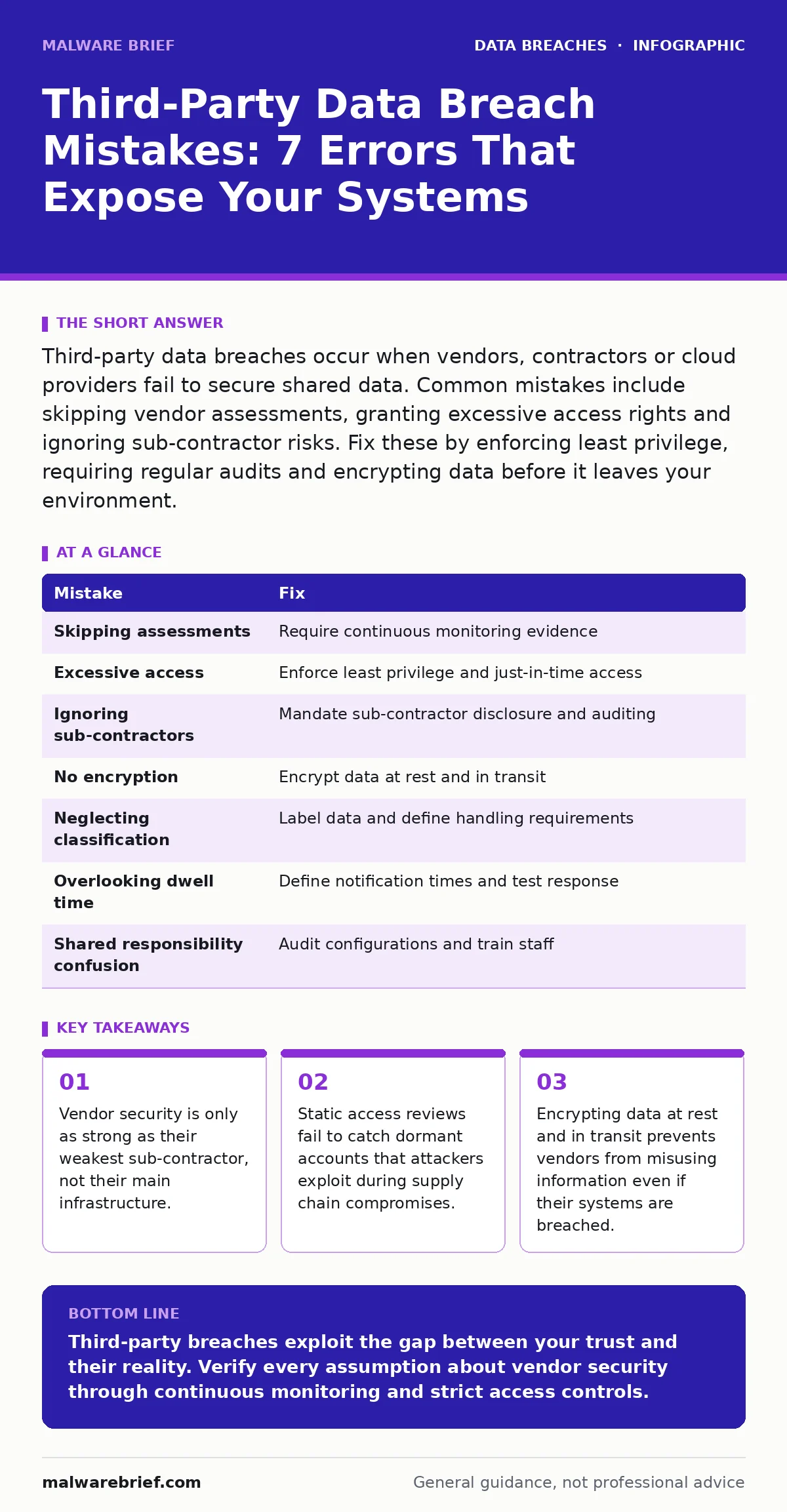
Third-party data breaches occur when vendors, contractors or cloud providers fail to secure shared data. Common mistakes include skipping vendor assessments, granting excessive access rights and ignoring sub-contractor risks. Fix these by enforcing least privilege, requiring regular audits and encrypting data before it leaves your environment.
Mistake 1: Skipping Vendor Security Assessments
Organisations often accept a vendor’s security certification at face value without independent verification. A certificate proves compliance at a single point in time, not ongoing resilience. You assume the vendor maintains the standards required for your data, but their processes may have degraded since the last audit. This gap allows vulnerabilities to persist unnoticed until an attacker exploits them.
Why it hurts:
You inherit the vendor’s security debt. If their configuration management is poor, your data sits on misconfigured servers. Attackers target vendors with weaker defences to pivot into larger networks. Your organisation becomes the exit point for data exfiltration, even though the breach originated outside your direct control.
The fix:
Require evidence of continuous monitoring, not just annual certificates. Ask for recent penetration test summaries and incident response plans. Verify that their security team has the authority to enforce changes. Do not rely on marketing materials. Treat their security posture as a dynamic variable that requires regular re-evaluation against your specific risk tolerance.
Mistake 2: Granting Excessive Access Rights
Vendors are often given administrative access to integrate systems smoothly. This convenience creates a massive attack surface. When you grant broad permissions, you remove the ability to contain a breach within a specific subsystem. An attacker who compromises the vendor’s credentials gains immediate entry to your entire network structure.
Why it hurts:
Excessive privileges allow lateral movement without detection. Attackers use the vendor’s account to access sensitive databases, modify logs or install persistent backdoors. The principle of least privilege is violated, meaning every session carries the risk of total system compromise. You lose visibility into what actions the vendor is performing.
The fix:
Implement role-based access control with the minimum permissions required for the task. Use just-in-time access for administrative tasks, requiring approval for each session. Monitor all vendor activity through dedicated logging channels. Revoke access immediately when contracts end or roles change. Regularly audit permissions to ensure they still align with current operational needs.
Mistake 3: Ignoring Sub-Contractor Risks
Vendors often outsource work to smaller sub-contractors. You assess the primary vendor but rarely vet the entities handling your data downstream. This blind spot is where most supply chain breaches originate. The sub-contractor may lack the resources or expertise to secure your information, creating a weak link in the chain.
Why it hurts:
Data flows to unvetted systems with weaker security controls. A sub-contractor might store your data on personal devices or unencrypted cloud storage. When their environment is compromised, your data is exposed without your knowledge. You cannot remediate the issue because you have no contractual leverage over the sub-contractor.
The fix:
Include clauses in contracts that require vendors to disclose sub-contractors handling your data. Mandate that sub-contractors meet the same security standards as the primary vendor. Require the vendor to manage and audit their supply chain. If a vendor refuses to disclose their sub-contractors, treat this as a high-risk indicator and consider alternative providers.
Mistake 4: Failing to Encrypt Shared Data
Organisations share data with vendors in plain text, trusting the vendor’s internal security. This assumption fails when the vendor’s environment is breached. Without encryption, attackers who gain network access can read sensitive files directly. Encryption is the only control that remains effective when the infrastructure is compromised.
Why it hurts:
Plain text data is immediately usable by attackers. There is no barrier between the breach and data exfiltration. Even if the vendor has strong perimeter defences, insider threats or misconfigurations can expose raw data. You lose all control over how the data is viewed or copied once it leaves your secure environment.
The fix:
Encrypt data both at rest and in transit. Use strong encryption standards and manage keys independently of the vendor. Ensure that decryption keys are not stored on the vendor’s systems. This approach ensures that even if the vendor’s servers are breached, the data remains unreadable. See our guide on encryption key management for details on handling keys securely.
Mistake 5: Neglecting Data Classification
Vendors are often given bulk data dumps without clear labels on sensitivity. Without classification, the vendor cannot apply appropriate security controls to different data types. Critical intellectual property is treated with the same protection as public marketing materials. This lack of distinction leads to inadequate safeguards for high-value assets.
Why it hurts:
High-value data receives low-level protection. Attackers target the most sensitive data, but it is stored in the same repositories as less critical information. The vendor’s security tools may not flag anomalies in the handling of unlabelled data. You cannot enforce specific retention or deletion policies for sensitive information.
The fix:
Classify data before sharing it with any third party. Label files with clear sensitivity markers. Define handling requirements for each classification level in your contracts. Ensure the vendor has tools to recognise and enforce these labels. Refer to our data classification guide for methods to automate this process across your organisation.
Mistake 6: Overlooking Breach Dwell Time
You assume that a vendor will detect and report a breach immediately. In reality, breach dwell time can be extensive. Attackers may remain in a vendor’s network for months before being detected. During this period, they map your data and plan exfiltration. Late notification means you have lost the window to contain the impact.
Why it hurts:
Delayed detection allows attackers to escalate privileges and exfiltrate large volumes of data. You cannot respond to a threat you do not know exists. The vendor’s slow response amplifies the damage to your organisation. You may face regulatory penalties for failing to protect data that was compromised long before notification.
The fix:
Contractually define maximum notification times for security incidents. Require vendors to use automated detection tools that alert on anomalous behaviour. Conduct tabletop exercises with vendors to test their incident response communication. Monitor your own systems for signs of compromise that may indicate a vendor-side breach. See our guide on breach dwell time for strategies to reduce detection windows.
Mistake 7: Assuming Cloud Security is Shared
Organisations believe that moving data to a cloud vendor shifts security responsibility entirely to the provider. This is a shared responsibility model. The vendor secures the infrastructure, but you secure the data and access. Misconfigurations in your cloud settings are a leading cause of data exposure. You retain liability for your own errors.
Why it hurts:
Misconfigured storage buckets or databases expose data to the public internet. The vendor’s security controls do not fix your permission errors. Attackers scan for these misconfigurations constantly. You assume the vendor’s security team will catch your mistakes, but they monitor for infrastructure issues, not your application logic.
The fix:
Understand the specific responsibilities in the shared model. Audit your own configurations regularly using automated tools. Implement data loss prevention controls to block unauthorized uploads. Train your staff on secure cloud practices. Refer to our data loss prevention guide for tools that monitor outbound data flows.
| Mistake | Fix |
|---|---|
| Skipping assessments | Require continuous monitoring evidence |
| Excessive access | Enforce least privilege and just-in-time access |
| Ignoring sub-contractors | Mandate sub-contractor disclosure and auditing |
| No encryption | Encrypt data at rest and in transit |
| Neglecting classification | Label data and define handling requirements |
| Overlooking dwell time | Define notification times and test response |
| Shared responsibility confusion | Audit configurations and train staff |
Key takeaways
- Vendor security is only as strong as their weakest sub-contractor, not their main infrastructure.
- Static access reviews fail to catch dormant accounts that attackers exploit during supply chain compromises.
- Encrypting data at rest and in transit prevents vendors from misusing information even if their systems are breached.
Third-party breaches exploit the gap between your trust and their reality. Verify every assumption about vendor security through continuous monitoring and strict access controls.
Frequently asked questions
How often should I re-evaluate my vendors?
Re-evaluate annually at minimum, or immediately after any significant change in their service model or security posture.
Can I trust a vendor who refuses to share audit reports?
No. Transparency is a core security requirement. Refusal to share indicates hidden risks or poor practices.
What if a vendor uses open-source software?
Ensure they have a process for patching known vulnerabilities in open-source components promptly.
Does insurance cover third-party breaches?
Insurance may cover financial losses, but it does not mitigate reputational damage or regulatory penalties.
How this guide was produced: written by the Malware Brief editorial team with AI assistance, checked against the public references listed below, and reviewed when the facts change. See our editorial policy or report an error.