Endpoint Detection and Response vs Antivirus: Core Differences
Antivirus blocks known signatures while endpoint detection and response analyses behaviour to stop novel threats that bypass traditional scanning methods.

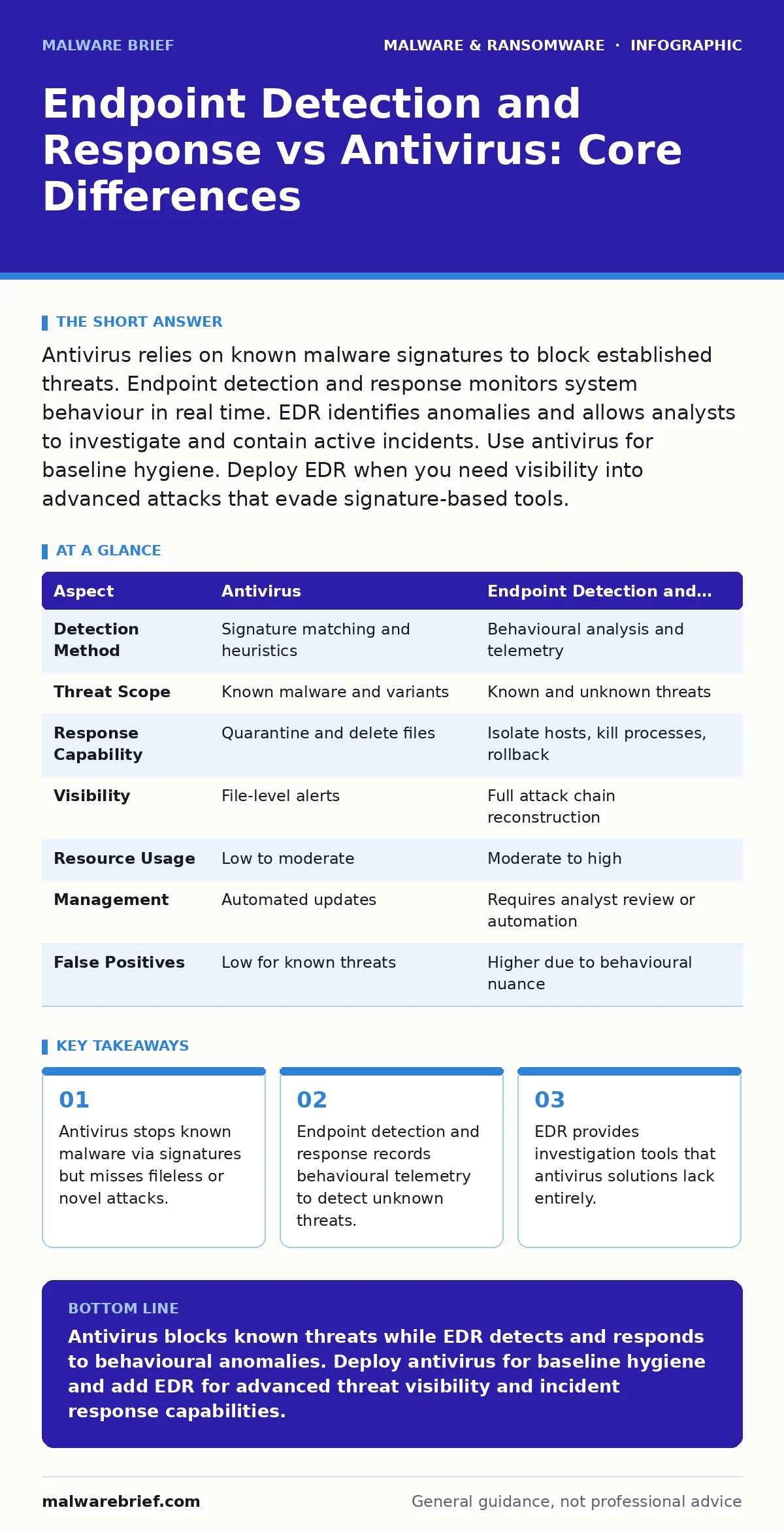
Antivirus relies on known malware signatures to block established threats. Endpoint detection and response monitors system behaviour in real time. EDR identifies anomalies and allows analysts to investigate and contain active incidents. Use antivirus for baseline hygiene. Deploy EDR when you need visibility into advanced attacks that evade signature-based tools.
The Core Difference Between Endpoint Detection and Response vs Antivirus
Antivirus software acts as a gatekeeper that compares files against a database of known malicious signatures. It prevents execution if a match occurs. Endpoint detection and response operates as a continuous observer. It records system calls, process creations, and network connections. When behaviour deviates from the norm, EDR alerts security teams. Antivirus tells you if a file is bad. Endpoint detection and response vs antivirus debates often confuse detection with response. EDR includes the ability to isolate an infected machine or kill a rogue process remotely. Antivirus typically quarantines files but cannot trace lateral movement across a network.
What Is Antivirus Software?
Antivirus solutions scan files on disk and in memory. They maintain a local or cloud-synced list of malware hashes. If a file matches a known threat, the software blocks or deletes it. This method is computationally cheap and effective against widespread malware. It fails against polymorphic code that changes its signature. It also misses zero-day malware that has no known signature yet. Antivirus does not monitor how a legitimate program behaves. A compromised office document that launches a benign-looking script may pass antivirus checks entirely.
What Is Endpoint Detection and Response?
Endpoint detection and response agents run on every device. They collect telemetry data about processes, registry changes, and file access. Security analysts review this data to find patterns of abuse. EDR platforms use behavioural analysis rather than just signature matching. They can reconstruct an attack chain after the fact. This allows teams to understand how an attacker moved through the environment. EDR also provides containment capabilities. You can isolate a host from the network without shutting it down. This preserves evidence while stopping further damage.
Comparison Table: Antivirus vs EDR
| Aspect | Antivirus | Endpoint Detection and Response |
|---|---|---|
| Detection Method | Signature matching and heuristics | Behavioural analysis and telemetry |
| Threat Scope | Known malware and variants | Known and unknown threats |
| Response Capability | Quarantine and delete files | Isolate hosts, kill processes, rollback |
| Visibility | File-level alerts | Full attack chain reconstruction |
| Resource Usage | Low to moderate | Moderate to high |
| Management | Automated updates | Requires analyst review or automation |
| False Positives | Low for known threats | Higher due to behavioural nuance |
When To Choose Antivirus Solutions
Choose antivirus when you need a low-effort baseline defence. It works well for environments with limited security staff. Antivirus handles the bulk of common malware threats effectively. It requires minimal tuning after installation. If your primary concern is preventing users from downloading known trojans, antivirus suffices. It also serves as a first line of defence in layered security architectures. Antivirus does not replace the need for patching or user training. It simply blocks files that have already been identified as malicious by vendors.
See also: Difference Between Keyloggers and Spyware in Cyber Security · Ransomware Incident Response: Steps to Contain and Recover
When To Choose Endpoint Detection and Response
Choose EDR when you face advanced persistent threats. It is necessary for organisations handling sensitive data. EDR provides the visibility needed to investigate incidents. If you suspect web shells or keyloggers are present, EDR helps locate them. It tracks the execution flow that antivirus ignores. EDR is also valuable for compliance requirements that demand audit trails. You must have staff capable of reviewing alerts. Without human analysis, EDR generates noise that overwhelms security teams. It is a tool for investigation, not just prevention.
Where The Two Overlap
Modern antivirus vendors often add EDR features. These hybrid solutions blur the lines. They offer basic behavioural monitoring alongside signature scanning. However, they rarely match dedicated EDR platforms in depth. Dedicated EDR tools provide richer telemetry and better investigation interfaces. Antivirus-focused hybrids may lack deep packet inspection or memory analysis. You must evaluate the specific capabilities of each product. Do not assume antivirus includes full response capabilities. Check if the solution allows remote command execution on endpoints.
Operational Trade-offs And Costs
EDR consumes more system resources than antivirus. This can impact performance on older devices. It also generates significant data volumes. Storing and analysing this data requires infrastructure. Antivirus is cheaper to license and manage. EDR requires skilled personnel to interpret alerts. Imagine a scenario where a banking trojan uses legitimate tools. Antivirus sees no malicious file. EDR detects the unusual command-line arguments. The trade-off is complexity for visibility. You pay in staff time and compute power. You gain the ability to stop sophisticated attacks.
Integration With Broader Security
Antivirus operates in isolation. It rarely shares context with other tools. EDR integrates with security information and event management systems. This allows correlation with network logs and identity data. It supports ransomware incident response by providing timeline data. It helps identify if immutable backups were targeted. EDR feeds into a broader security posture. Antivirus is a single control. EDR is part of a detection engineering strategy. You need both for a balanced approach. Antivirus stops the easy threats. EDR catches the rest.
Key takeaways
- Antivirus stops known malware via signatures but misses fileless or novel attacks.
- Endpoint detection and response records behavioural telemetry to detect unknown threats.
- EDR provides investigation tools that antivirus solutions lack entirely.
Antivirus blocks known threats while EDR detects and responds to behavioural anomalies. Deploy antivirus for baseline hygiene and add EDR for advanced threat visibility and incident response capabilities.
Frequently asked questions
Can EDR replace antivirus entirely?
No. EDR focuses on detection and response. It may not block all known malware as efficiently as dedicated antivirus. Most organisations use both for layered defence.
Does EDR protect against ransomware?
EDR can detect ransomware behaviour and stop it. It does not prevent initial infection as reliably as antivirus. It excels at limiting damage after detection.
Is EDR too complex for small teams?
It can be. EDR requires analyst time to review alerts. Small teams may struggle with noise. Managed detection services can mitigate this burden.
How does EDR handle false positives?
EDR generates more false positives due to behavioural analysis. Teams must tune rules and whitelist legitimate activities. Continuous tuning reduces noise over time.
How this guide was produced: written by the Malware Brief editorial team with AI assistance, checked against the public references listed below, and reviewed when the facts change. See our editorial policy or report an error.