Synthetic Identity Fraud Mistakes That Leave Organisations Open
Synthetic identity fraud evades standard checks because the stolen data fragments belong to real people who never applied for the credit in question.

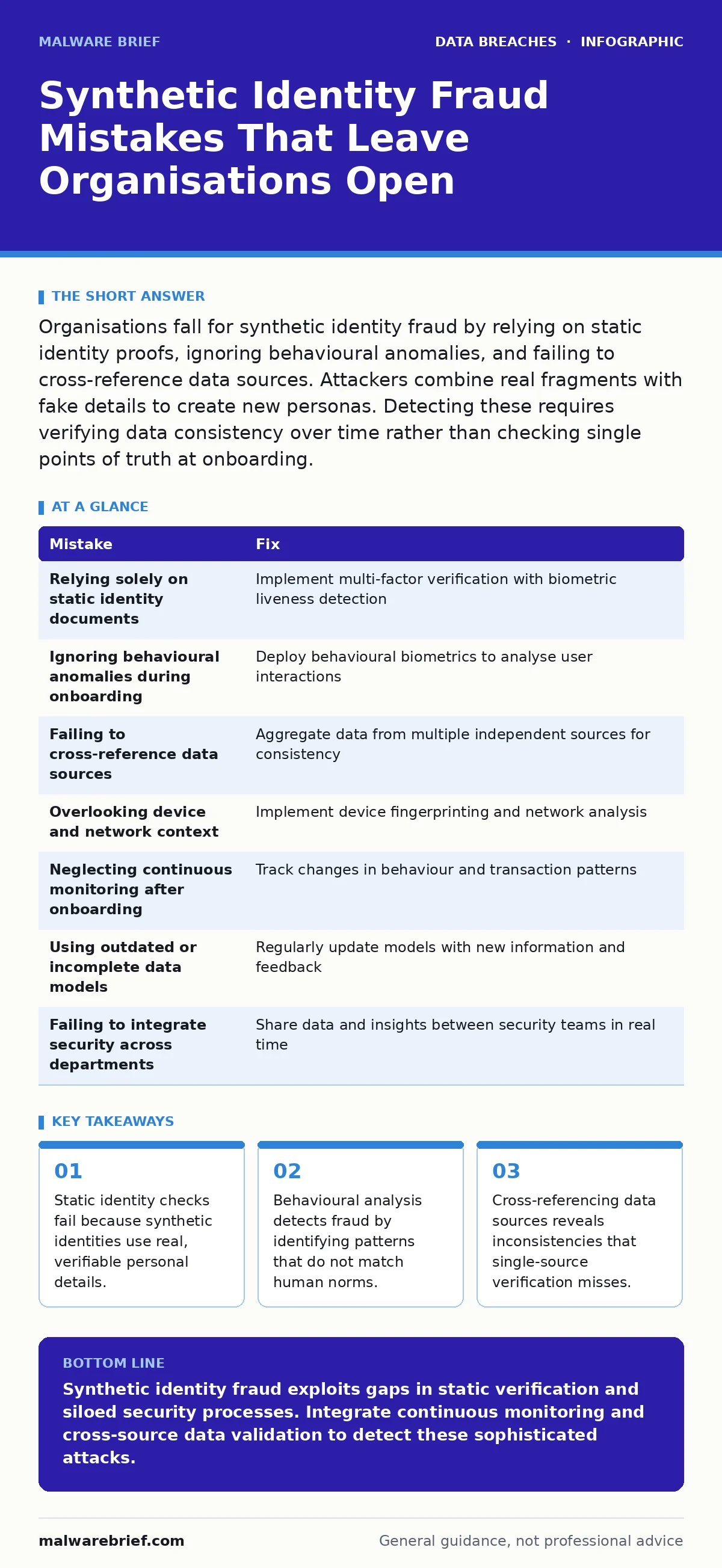
Organisations fall for synthetic identity fraud by relying on static identity proofs, ignoring behavioural anomalies, and failing to cross-reference data sources. Attackers combine real fragments with fake details to create new personas. Detecting these requires verifying data consistency over time rather than checking single points of truth at onboarding.
Mistake 1: Relying solely on static identity documents
Static identity documents include passports, driver licences and national identity cards. These items prove that a physical object exists and that it was issued by a government body. They do not prove that the person holding the document is who they claim to be. Attackers create high-quality forgeries of these documents. They often combine a real photograph with fabricated details. The document passes basic visual inspection and even some digital verification checks.
Why it hurts:
Synthetic identity fraudsters use real fragments of data. They might use a genuine national insurance number or a real date of birth. These details pass database checks because they belong to real individuals. The fraudster adds a fake name or address to the real data. A system that only checks if the document format is correct will accept this hybrid identity. The organisation believes it has verified a real person. The risk remains hidden until the fraudster builds sufficient credit history.
The fix:
Implement multi-factor identity verification that goes beyond document inspection. Use biometric liveness detection to ensure a live human is present. Cross-reference the document details against multiple independent data sources. Check if the name, address and date of birth appear together in historical records. If the data points have never appeared together, the identity is likely synthetic. This approach aligns with best practices for identity theft protection by verifying the consistency of data over time.
Mistake 2: Ignoring behavioural anomalies during onboarding
Behavioural analysis examines how a user interacts with a system. This includes typing speed, mouse movements and navigation patterns. Humans have unique quirks in these actions. Synthetic identities are often created by automated scripts or by humans using scripts to mimic behaviour. These scripts tend to be too perfect or too erratic. They lack the subtle randomness of genuine human interaction. Ignoring these signals leaves a gap in your defence.
Why it hurts:
Automated tools can fill out forms at superhuman speeds. They can also simulate human delays to avoid detection. However, they often struggle with complex interactions that require decision-making. A fraudster might pause at unexpected prompts or navigate in a linear fashion that real users do not follow. If your system only checks the data entered, it misses these behavioural red flags. The account is created successfully. The fraudster then uses the account to build a false credit history.
The fix:
Deploy behavioural biometrics that analyse user interactions in real time. Look for deviations from established norms for your user base. Flag accounts that show robotic precision or unusual hesitation. Combine this with device fingerprinting to identify if the device has been used for other suspicious activities. This adds a layer of security that does not rely on the accuracy of the provided data. It helps mitigate risks similar to those found in employee data breaches where insider knowledge is combined with automated tools.
Mistake 3: Failing to cross-reference data sources
Data sources include credit bureaus, utility providers and government databases. Each source holds a fragment of an individual’s digital footprint. Synthetic identities often have a sparse footprint. They may have a credit file but no utility bills. Or they may have a registered address but no employment history. Checking only one source gives a false sense of security. The data in that single source may be genuine but incomplete.
Why it hurts:
Fraudsters know that real people have data scattered across many systems. They replicate this by planting data in one or two accessible databases. They might pay a small utility bill to create a record. They then use this record to apply for larger services. If you only check the credit bureau, you see the planted record. You miss the fact that the rest of the digital footprint is missing. The synthetic identity appears legitimate within the context of that single check.
The fix:
Aggregate data from multiple independent sources. Look for consistency across these sources. A real person will have a coherent history across banking, utilities and government records. A synthetic identity will have gaps or contradictions. Use data loss prevention techniques to ensure you are accessing these sources securely. Verify that the data points align geographically and temporally. If an address appears in a credit file but not in a utility record for the same period, investigate further.
Mistake 4: Overlooking device and network context
Device context includes the hardware ID, operating system and installed applications. Network context includes the IP address, location and connection type. Synthetic identity fraud often originates from devices or networks that are reused. Attackers use virtual machines or compromised devices to create multiple identities. These devices may have been used for other fraudulent activities. Ignoring the context of the device allows these patterns to go unnoticed.
Why it hurts:
A single device might be used to create dozens of synthetic identities. Each identity appears unique because the personal data is different. However, the device fingerprint remains the same. If you do not track device history, you treat each application as an isolated event. You miss the connection between the accounts. This allows fraudsters to scale their operations. They can create new identities rapidly without raising alarms. This is similar to how third-party data breaches expose vulnerabilities when supply chain links are ignored.
The fix:
Implement device fingerprinting that tracks hardware and software characteristics. Maintain a history of devices associated with your users. Flag devices that are associated with multiple new accounts. Check if the device has been linked to previous fraud attempts. Use network analysis to identify if the IP address is from a known proxy or virtual private network. Combine these signals with the personal data to build a risk score. This holistic view helps identify synthetic identities that pass static checks.
Mistake 5: Neglecting continuous monitoring after onboarding
Onboarding is a single point in time. Fraudsters often wait to build trust before committing fraud. They may use the account for small, legitimate transactions for months. This establishes a pattern of behaviour. Then they switch to high-risk activities. If you only verify identity at onboarding, you miss this change. The account is already established and trusted. The fraud happens in the shadows of normal activity.
Why it hurts:
Synthetic identities need time to mature. They must build a credit history or transaction history. During this period, they appear normal. They make small purchases or pay bills on time. This builds a reputation. Once the reputation is established, they request larger loans or services. If you do not monitor for changes in behaviour, you approve these requests. The damage is done before you realise the identity was fake. This delay increases the financial impact.
The fix:
Implement continuous monitoring that tracks changes in behaviour. Look for sudden spikes in transaction value or frequency. Monitor for changes in device or location. If a user suddenly switches from a mobile device to a desktop, investigate. Use machine learning to detect deviations from the established baseline. This approach ensures that you catch fraud even if it passes initial checks. It complements strategies for database security by ensuring that access patterns remain consistent with user profiles.
See also: Employee Data Breaches: Causes, Impacts and Prevention
Mistake 6: Using outdated or incomplete data models
Data models are algorithms that predict fraud based on historical data. These models need to be updated regularly. Fraud techniques evolve. Attackers find new ways to create synthetic identities. If your model is static, it becomes blind to new tactics. It relies on patterns that no longer exist. This creates a false sense of security. You believe you are protected because the model is running. In reality, it is missing the current threats.
Why it hurts:
Fraudsters adapt to your defences. If they know you check for specific patterns, they change their methods. They might use different data sources or alter their behaviour. A static model cannot detect these changes. It continues to flag the old patterns. New patterns slip through. This leads to an increase in successful fraud attempts. The organisation suffers losses because its detection capabilities are outdated. This is a risk similar to poor encryption key management where static keys become vulnerable over time.
The fix:
Regularly update your data models with new information. Incorporate feedback from confirmed fraud cases. Use machine learning that adapts to new patterns. Test your models against simulated attacks. Ensure that the model considers a wide range of signals. This includes data consistency, behavioural analysis and device context. A dynamic model can detect new tactics as they emerge. It reduces the window of opportunity for fraudsters.
Mistake 7: Failing to integrate security across departments
Security is often siloed. Identity verification is handled by one team. Fraud detection by another. Customer service by a third. This separation creates gaps. Information is not shared. A pattern that is obvious when viewed holistically is missed in isolation. Synthetic identity fraud exploits these gaps. It moves through the organisation without triggering a unified response.
Why it hurts:
A customer service agent might notice a strange request. A fraud analyst might see a suspicious transaction. If these insights are not shared, the full picture remains hidden. The synthetic identity continues to operate. The organisation reacts to individual incidents rather than the broader campaign. This reactive approach is costly. It allows fraud to persist. Integration ensures that all parts of the organisation work together.
The fix:
Break down silos between security teams. Share data and insights in real time. Create a unified view of customer interactions. Ensure that identity verification, fraud detection and customer service are aligned. Use a centralised platform to monitor risks. This holistic approach improves detection. It allows for faster response to emerging threats. It also supports broader goals like protecting protected health information by ensuring consistent access controls.
| Mistake | Fix |
|---|---|
| Relying solely on static identity documents | Implement multi-factor verification with biometric liveness detection |
| Ignoring behavioural anomalies during onboarding | Deploy behavioural biometrics to analyse user interactions |
| Failing to cross-reference data sources | Aggregate data from multiple independent sources for consistency |
| Overlooking device and network context | Implement device fingerprinting and network analysis |
| Neglecting continuous monitoring after onboarding | Track changes in behaviour and transaction patterns |
| Using outdated or incomplete data models | Regularly update models with new information and feedback |
| Failing to integrate security across departments | Share data and insights between security teams in real time |
Key takeaways
- Static identity checks fail because synthetic identities use real, verifiable personal details.
- Behavioural analysis detects fraud by identifying patterns that do not match human norms.
- Cross-referencing data sources reveals inconsistencies that single-source verification misses.
Synthetic identity fraud exploits gaps in static verification and siloed security processes. Integrate continuous monitoring and cross-source data validation to detect these sophisticated attacks.
Frequently asked questions
How do synthetic identities differ from traditional identity theft?
Traditional identity theft uses a real person's full identity. Synthetic identity fraud combines real and fake data to create a new, non-existent persona.
Can machine learning detect synthetic identity fraud?
Yes, machine learning can identify patterns and anomalies that static rules miss. It adapts to new tactics and improves detection accuracy over time.
What is the role of biometrics in preventing this fraud?
Biometrics verify that a live human is present. They prevent the use of forged documents and automated scripts during the onboarding process.
How often should data models be updated?
Models should be updated regularly with new data and feedback. Continuous learning ensures they remain effective against evolving fraud tactics.
How this guide was produced: written by the Malware Brief editorial team with AI assistance, checked against the public references listed below, and reviewed when the facts change. See our editorial policy or report an error.