Zero-Day Malware: How Unknown Threats Bypass Defences
Zero-day exploits succeed because they target logic flaws that vendors have not yet patched, leaving standard signature detection entirely blind to the activity.

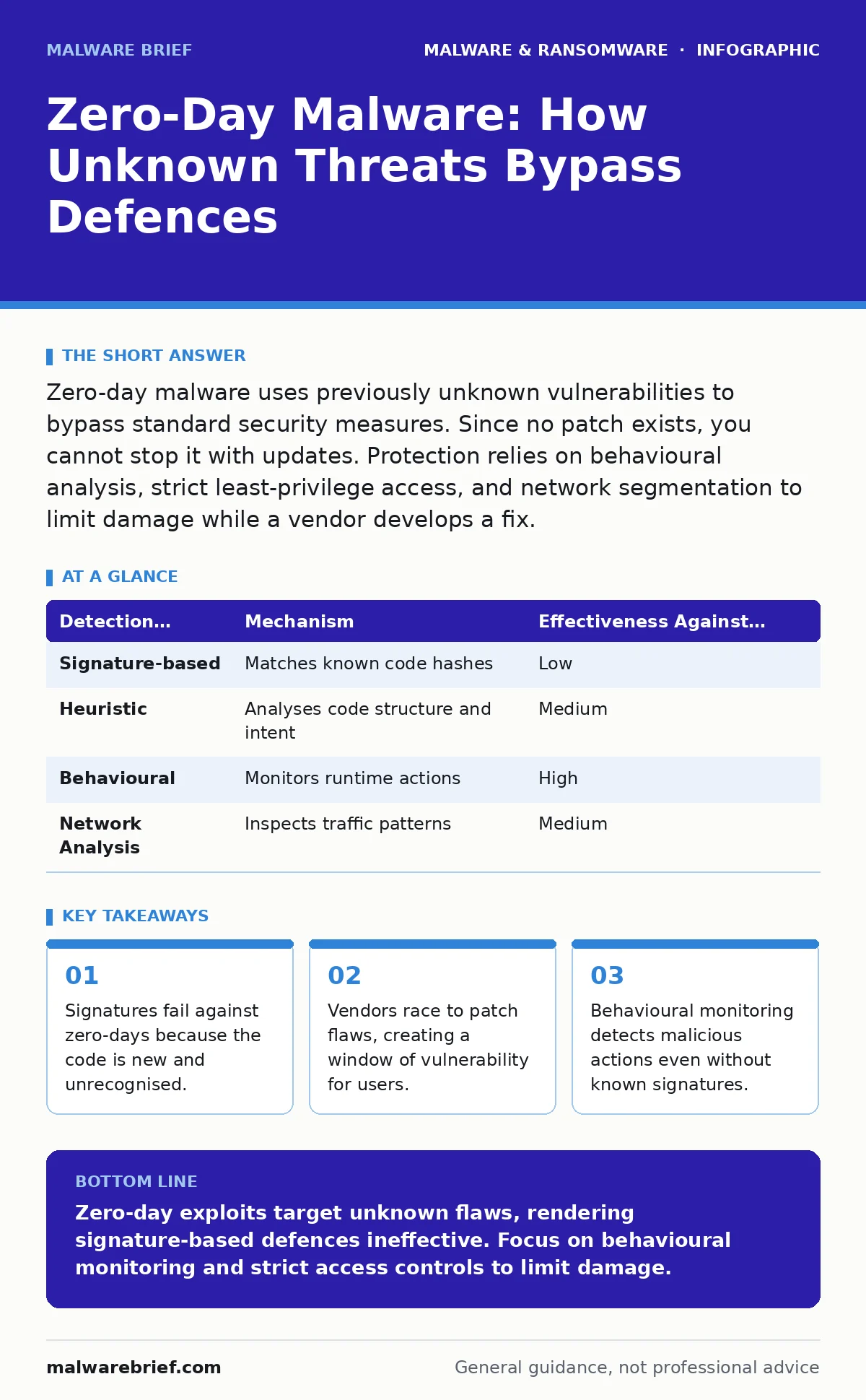
Zero-day malware uses previously unknown vulnerabilities to bypass standard security measures. Since no patch exists, you cannot stop it with updates. Protection relies on behavioural analysis, strict least-privilege access, and network segmentation to limit damage while a vendor develops a fix.
What defines a zero-day exploit?
A zero-day exploit targets a software vulnerability that is unknown to the vendor and for which no patch or mitigation exists. The term "zero-day" refers to the number of days the vendor has had to fix the flaw before it is discovered or exploited in the wild. Because the weakness is secret, traditional defence mechanisms that rely on known patterns cannot identify the attack.
Why do antivirus programs miss zero-day malware?
Antivirus software primarily relies on signature-based detection, which compares file characteristics against a database of known malicious code. When a zero-day attack occurs, the code is entirely new and does not match any entry in that database. Consequently, the security tool treats the file as benign because it lacks the historical data required to flag it as a threat.
Can firewalls block zero-day attacks?
Firewalls inspect network traffic against predefined rules, allowing or blocking data based on source, destination, and port. A zero-day exploit often travels through permitted ports using standard protocols like HTTPS, making it indistinguishable from legitimate traffic to a basic firewall. Unless the firewall performs deep packet inspection with behavioural rules, the malicious payload passes through unchallenged.
How do attackers find zero-day vulnerabilities?
Attackers reverse-engineer software to find logic errors, memory management flaws, or input validation weaknesses that developers overlooked. They may use automated fuzzing tools to send random data to a program, looking for crashes that indicate a potential entry point. Once a flaw is identified, they craft specific instructions, known as exploit code, to manipulate that weakness and gain control.
What is the difference between a zero-day and a one-day?
A zero-day vulnerability remains unpatched when it is first exploited. A one-day vulnerability is one where a patch has been released, but attackers exploit it before users have applied the update. The distinction matters because defences differ: you cannot patch a zero-day, but you can mitigate a one-day by prioritising immediate updates and restricting access to vulnerable systems.
See also: Banking Trojans: Why Small Firms Get Targeted and How to Stop Them · Macro Malware: How Scripts Hide in Office Documents
How does sandboxing help against zero-day threats?
Sandboxing runs applications in an isolated environment, separate from the main operating system and critical data. If a zero-day exploit executes within the sandbox, its effects are contained and cannot spread to the host machine. This containment prevents the malware from accessing sensitive files or establishing persistent connections, even if the initial intrusion succeeds. Understanding sandboxing principles is vital for limiting the blast radius of unknown threats.
Can machine learning detect zero-day malware?
Machine learning models can identify zero-day malware by analysing behavioural patterns rather than specific code signatures. These systems learn what normal application activity looks like and flag deviations, such as unusual process creation or unexpected network connections. While effective, this approach can produce false positives, where legitimate software is mistakenly flagged due to atypical but benign behaviour.
| Detection Method | Mechanism | Effectiveness Against Zero-Days |
|---|---|---|
| Signature-based | Matches known code hashes | Low |
| Heuristic | Analyses code structure and intent | Medium |
| Behavioural | Monitors runtime actions | High |
| Network Analysis | Inspects traffic patterns | Medium |
Why is the zero-day market significant?
Some researchers sell discovered vulnerabilities to the highest bidder rather than disclosing them to vendors. This underground market fuels the creation of advanced, targeted attacks that bypass standard defences. The existence of this trade means that vulnerabilities may be exploited for profit before the public or the vendor is aware of the flaw, prolonging the window of exposure.
How should you respond if a zero-day hits?
Immediate containment is the priority, as you cannot patch the specific flaw yet. Isolate affected systems from the network to prevent lateral movement, then apply any available mitigations, such as disabling specific features or blocking related IP addresses. Monitor for signs of data exfiltration and prepare for a potential full system rebuild once a vendor patch becomes available. For mobile devices, refer to guides on removing malware from an Android phone or Mac malware to understand platform-specific containment steps.
Do zero-days always lead to full system compromise?
Not necessarily. A zero-day exploit might only grant limited access, such as reading a specific file or executing a single command. Whether this leads to full compromise depends on the attacker's intent and the system's configuration. If least-privilege principles are enforced, the damage may be contained even if the initial exploit succeeds. However, attackers often use initial access to deploy further payloads, such as web shells or computer worms, to escalate privileges.
Can you ever be fully protected against zero-days?
No measure guarantees complete immunity because new flaws are constantly discovered in complex software. The goal is to reduce the attack surface and increase the cost for attackers to succeed. By combining strict access controls, regular updates for known issues, and behavioural monitoring, you make exploitation significantly harder. Remember that Android malware and browser hijackers often use different entry vectors, so defence must be layered across all entry points.
What is the role of threat intelligence in zero-day defence?
Threat intelligence provides early warnings about emerging vulnerabilities and active exploitation campaigns. By subscribing to reputable feeds, you learn which software is currently being targeted, allowing you to apply temporary mitigations before a patch is available. This proactive stance allows you to harden systems against likely attack vectors, reducing the time you are exposed to a new flaw.
How do zero-days relate to ransomware?
Ransomware operators often use zero-day exploits to gain initial access to high-value targets. Once inside, they move laterally to encrypt critical data, leveraging the secrecy of the exploit to avoid detection by standard security tools. The success of ransomware campaigns often hinges on the ability to bypass initial defences, making unknown vulnerabilities a preferred entry point for sophisticated groups. Understanding macro malware can also help, as attackers sometimes combine zero-days with social engineering to ensure execution.
Key takeaways
- Signatures fail against zero-days because the code is new and unrecognised.
- Vendors race to patch flaws, creating a window of vulnerability for users.
- Behavioural monitoring detects malicious actions even without known signatures.
Zero-day exploits target unknown flaws, rendering signature-based defences ineffective. Focus on behavioural monitoring and strict access controls to limit damage.
Frequently asked questions
How long does a zero-day vulnerability remain unpatched?
The duration varies significantly, ranging from weeks to months, depending on the complexity of the flaw and the vendor's response time.
Are zero-day attacks common for individual users?
They are rare for individuals, as the high cost of development makes them attractive primarily for state-sponsored or highly targeted criminal campaigns.
Can a antivirus update fix a zero-day issue?
No, antivirus updates add signatures for known malware, but they cannot patch the underlying software vulnerability that the zero-day exploit targets.
Should I pay for zero-day protection services?
Evaluate the specific features offered; basic behavioural monitoring and strict system hygiene often provide sufficient defence without additional costs.
How this guide was produced: written by the Malware Brief editorial team with AI assistance, checked against the public references listed below, and reviewed when the facts change. See our editorial policy or report an error.