Difference between ISO 27001 and 42001: Scope, Supply Chain Focus, and Audit Realities
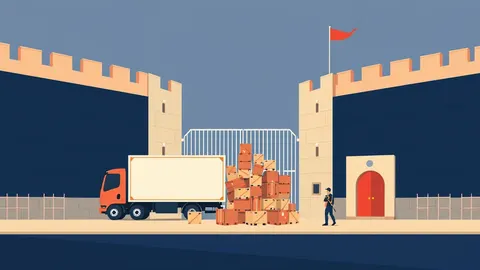
ISO 27001 protects your own data assets, while ISO 42001 mandates rigorous controls over every vendor and partner in your supply chain.
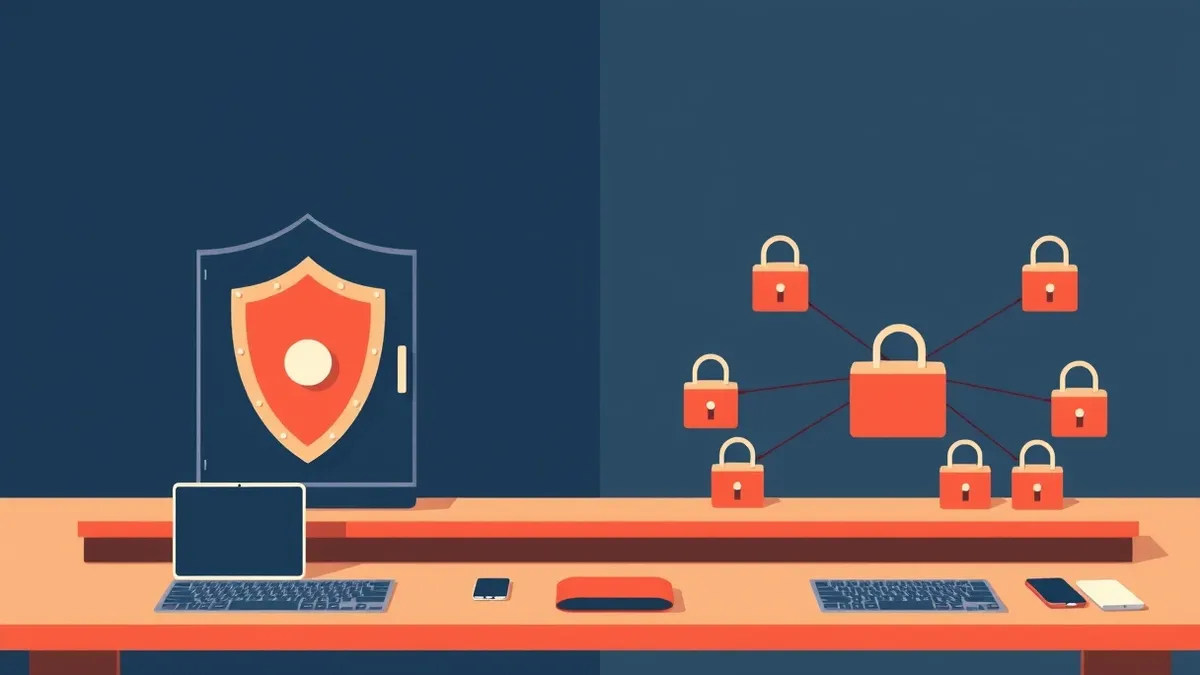
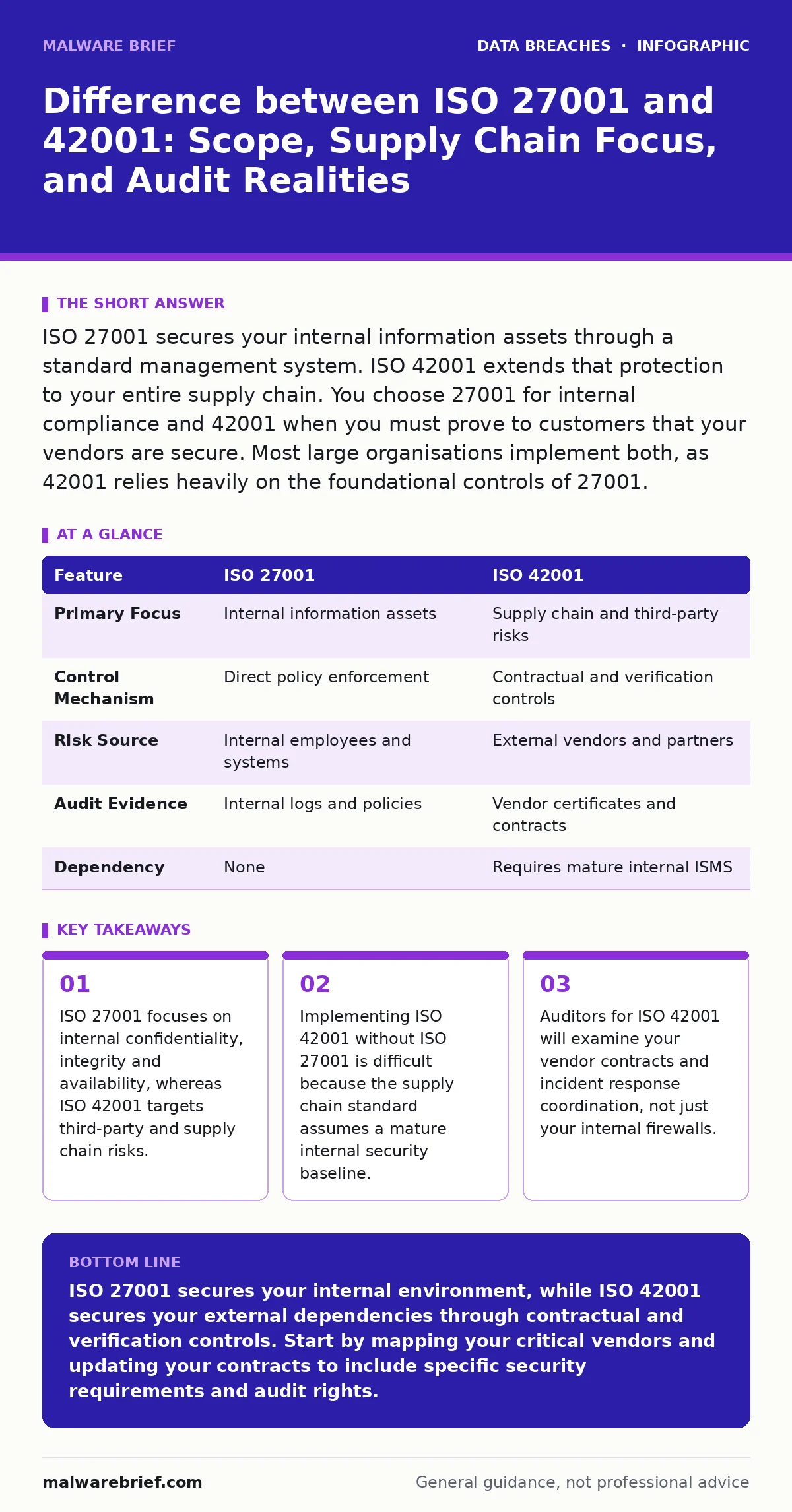
ISO 27001 secures your internal information assets through a standard management system. ISO 42001 extends that protection to your entire supply chain. You choose 27001 for internal compliance and 42001 when you must prove to customers that your vendors are secure. Most large organisations implement both, as 42001 relies heavily on the foundational controls of 27001.
What is the difference between iso 27001 and 42001?
ISO 27001 establishes an Information Security Management System (ISMS) for your organisation, while ISO 42001 establishes a Supply Chain Security Management System. The first standard asks you to protect your own data. The second standard asks you to ensure that every organisation you rely on protects their data in a way that protects yours. ISO 27001 is the baseline for internal security. ISO 42001 is the overlay for external dependencies. You cannot effectively implement the second without the first, as supply chain security collapses if your own house is not in order. The distinction is not just about scope, but about trust boundaries.
Why do internal controls differ from supply chain controls?
Internal controls under ISO 27001 rely on your direct authority over employees, hardware and software. You can enforce policies because you employ the staff. Supply chain controls under ISO 42001 rely on contractual leverage and verification. You do not employ the vendor’s staff. You cannot install agents on their servers. This creates a fundamental asymmetry. You must design controls that work through legal agreements and continuous monitoring rather than direct command. This shift from command to verification changes how you assess risk. You must evaluate the vendor’s security posture as part of your own risk assessment, which adds significant administrative overhead.
How does scope expansion impact your risk assessment?
Expanding from ISO 27001 to ISO 42001 requires mapping every third-party relationship. You must identify which vendors have access to sensitive data or critical infrastructure. A simple software update provider has a different risk profile than a cloud storage host. You must categorise vendors by criticality. High-criticality vendors require deeper due diligence.
You must assess their ability to handle incidents. You must verify their security claims through audits or certificates. This process exposes hidden dependencies that internal audits often miss. A single weak vendor can compromise your entire ISO 27001 certification if their breach affects your data. This is why understanding third-party data breaches is often the first step in expanding your scope.
| Feature | ISO 27001 | ISO 42001 |
|---|---|---|
| Primary Focus | Internal information assets | Supply chain and third-party risks |
| Control Mechanism | Direct policy enforcement | Contractual and verification controls |
| Risk Source | Internal employees and systems | External vendors and partners |
| Audit Evidence | Internal logs and policies | Vendor certificates and contracts |
| Dependency | None | Requires mature internal ISMS |
What happens when a vendor fails security checks?
Imagine a critical cloud provider fails an audit. ISO 27001 does not explicitly mandate how you handle this, beyond general risk management. ISO 42001 requires a specific response. You must have a contingency plan. This might involve switching providers or isolating their access. You must define acceptable risk levels for each vendor tier.
If a vendor cannot meet your standards, you must decide whether to terminate the contract or accept the risk with additional compensating controls. This decision process must be documented. Auditors will look for evidence that you actively manage vendor risk, not just assume they are secure. This often leads to difficult conversations with procurement teams who prioritise cost over security.
How do incident response protocols change with 42001?
Internal incident response focuses on containment and recovery within your network. Supply chain incident response requires coordination with external entities. You must define communication channels with vendors before an incident occurs. You need agreements on data sharing during investigations. A breach at a vendor might not trigger your internal alarms.
You rely on their transparency. If they hide the breach, you remain vulnerable. ISO 42001 mandates that you test this coordination. You must include vendors in your tabletop exercises. This reveals gaps in your visibility. You may find that you do not know who accesses your data at the vendor’s site. This lack of visibility is a common finding in initial audits.
See also: Database Security Best Practices: 8 Technical Controls · Protected health information is an association between patient and provider
What are the hidden costs of implementing ISO 42001?
The most significant cost is not certification fees, but the time spent assessing vendors. You must review hundreds of contracts and security questionnaires. You must train staff to evaluate external security claims. This slows down procurement cycles. Business units may resist the delay. You must balance security requirements with business agility. Another hidden cost is the loss of vendor relationships.
Some vendors will not provide the required evidence. You may need to drop them, which can disrupt operations. This forces a restructuring of your supply chain. The effort required to maintain continuous monitoring of vendors is substantial. It is an ongoing operational expense, not a one-time project. This is why data loss prevention strategies must extend to vendor communications.
Can you achieve compliance with only one standard?
You can technically certify to ISO 42001 without ISO 27001, but it is inefficient. ISO 42001 references ISO 27001 controls. If you lack an internal ISMS, you must build it simultaneously. This doubles the effort. Most organisations implement ISO 27001 first. They stabilise their internal security. Then they add ISO 42001 to extend that security outward. This phased approach reduces risk.
It allows you to learn the audit process. It builds a culture of security. Attempting both at once often leads to fatigue and superficial compliance. Auditors will spot weak internal controls and fail the supply chain assessment. A strong foundation is necessary for any extension. This is particularly relevant when considering database security, as external access to databases is a major supply chain risk.
How do you maintain certification over time?
Maintenance requires continuous monitoring. You must track vendor changes. A vendor’s security posture can degrade. They may hire new staff or change infrastructure. You need mechanisms to detect these changes. Automated tools can help monitor external indicators. You must re-assess high-risk vendors regularly. This ensures your risk assessment remains current.
Neglecting this leads to certification lapses. Auditors will check for recent assessments. They will verify that you have addressed any new vulnerabilities. This requires a dedicated team or resource. It is not a set-and-forget process. The dynamic nature of supply chains demands constant attention. This ongoing effort helps protect against data extortion attempts that target weak links in the chain.
What is the role of contracts in security?
Contracts are your primary control mechanism for third parties. They must include specific security clauses. These clauses define data handling, incident notification and audit rights. Vague language offers no protection. You must specify technical requirements. You must define consequences for breaches. Legal teams often resist these additions. You must educate them on the security implications.
A contract without security clauses is a risk. It leaves you liable for vendor failures. You must ensure that security requirements are enforceable. This legal framework supports your technical controls. It provides recourse when things go wrong. This is vital for identity theft protection, as stolen data from vendors can lead to direct harm to individuals.
Key takeaways
- ISO 27001 focuses on internal confidentiality, integrity and availability, whereas ISO 42001 targets third-party and supply chain risks.
- Implementing ISO 42001 without ISO 27001 is difficult because the supply chain standard assumes a mature internal security baseline.
- Auditors for ISO 42001 will examine your vendor contracts and incident response coordination, not just your internal firewalls.
ISO 27001 secures your internal environment, while ISO 42001 secures your external dependencies through contractual and verification controls. Start by mapping your critical vendors and updating your contracts to include specific security requirements and audit rights.
Frequently asked questions
Do I need ISO 27001 to get ISO 42001?
Technically no, but practically yes. ISO 42001 assumes you have a mature internal security management system. Implementing 42001 without 27001 means building both systems simultaneously, which is inefficient and risky. Most auditors will require evidence of strong internal controls before certifying your supply chain security.
How long does ISO 42001 implementation take?
Implementation time depends on your existing maturity. If you already have ISO 27001, adding 42001 may take 6 to 12 months. This time is spent mapping vendors, updating contracts and establishing monitoring processes. If you start from scratch, expect 18 to 24 months to build the foundational internal controls before addressing the supply chain.
What happens if a vendor refuses to comply?
You must assess the risk of their non-compliance. If the vendor is critical, you may need to terminate the contract and find an alternative. If termination is not possible, you must implement compensating controls within your own environment to mitigate the risk. Document this decision and the additional controls for auditors. This shows you are managing the risk actively.
Does ISO 42001 replace ISO 27001?
No, ISO 42001 complements ISO 27001. It focuses on external risks, while 27001 focuses on internal risks. You need both to cover the full spectrum of security threats. Many organisations hold both certifications to demonstrate comprehensive security to customers and partners. They are designed to work together, not as substitutes.
How this guide was produced: written by the Malware Brief editorial team with AI assistance, checked against the public references listed below, and reviewed when the facts change. See our editorial policy or report an error.